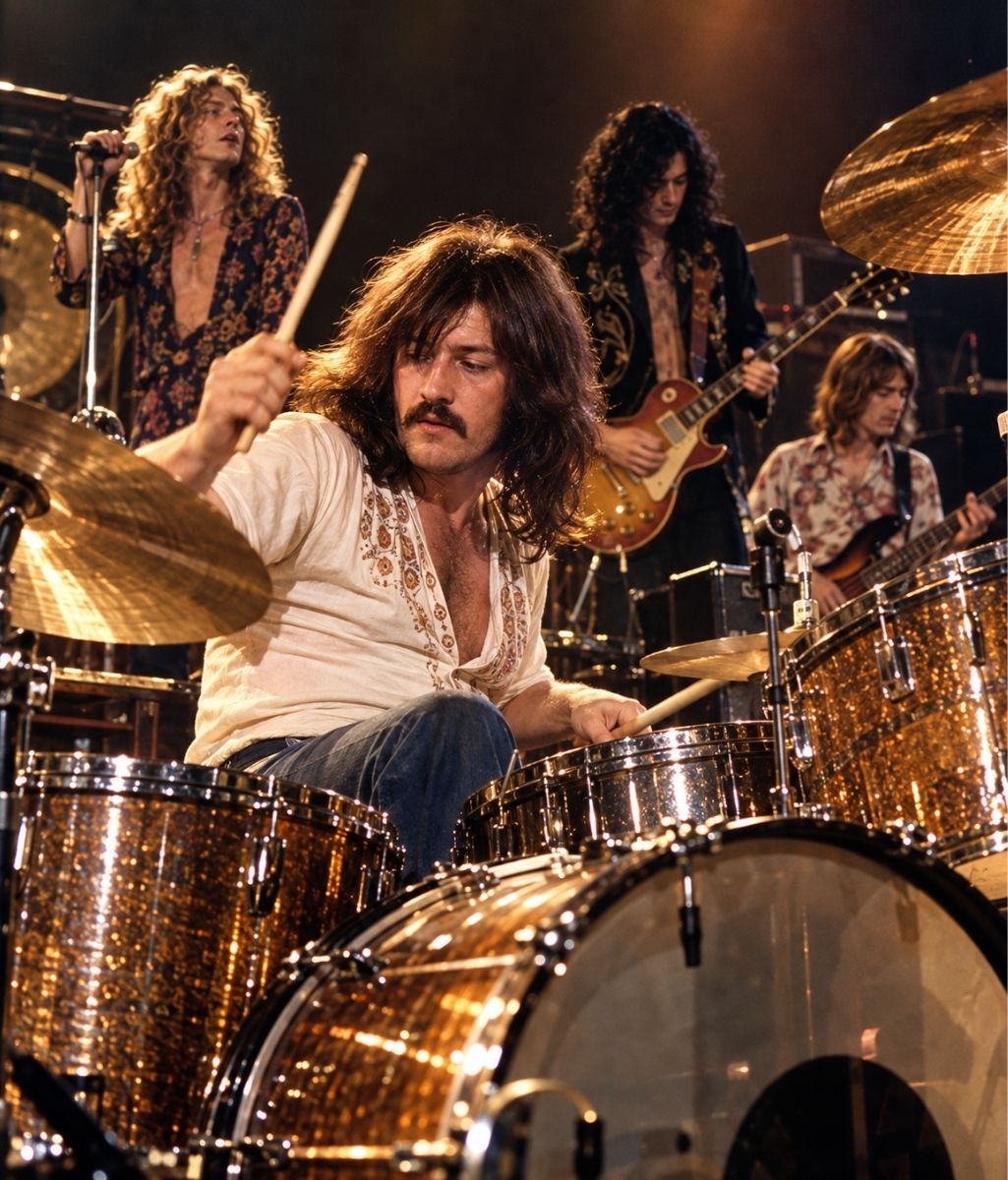
Few drummers in rock history are as instantly recognizable as John Bonham. You do not always need to hear an entire Led Zeppelin song to know he is behind the kit. Sometimes a few seconds are enough—the enormous kick drum, the deep snare, the unusual swing, and that unmistakable feeling that every strike has both tremendous weight and remarkable purpose.
When Led Zeppelin formed in 1968, Bonham joined Jimmy Page, Robert Plant, and John Paul Jones in creating something that depended upon far more than volume. The band could certainly be thunderous, but Bonham’s greatness came from his ability to understand space, dynamics, timing, and musical conversation. He could make a simple beat feel monumental because he knew precisely where to place it.
Listen to “When the Levee Breaks.” The opening drum pattern is not filled with unnecessary complexity, yet it became one of the most celebrated drum sounds ever recorded. Bonham leaves room between the strikes. The enormous ambience surrounding the kit becomes part of the rhythm itself. What sounds simple on paper becomes almost impossible to imitate with the same authority.
Then consider “Good Times Bad Times.” On Led Zeppelin’s first album, Bonham immediately demonstrated the remarkable control of his right foot. His rapid bass-drum figures made many listeners assume he was using a double-bass setup, yet his technique came from a single bass drum. It was an early announcement that Led Zeppelin had a drummer capable of combining power with extraordinary physical control.
But technique alone does not explain Bonham.
His greatest quality may have been feel.
Bonham loved rhythm that moved. Even at Led Zeppelin’s heaviest, his playing often contained a swing inherited from the blues, soul, R&B, and earlier American music that influenced the band. He did not simply place beats mechanically on a grid. He pushed and pulled against Page’s guitar, creating tension that made Zeppelin sound alive rather than perfectly polished.
That relationship with Jimmy Page was crucial.
Page could build enormous guitar riffs, but Bonham gave those riffs physical weight. Listen to “Black Dog,” “Kashmir,” “The Ocean,” or “Whole Lotta Love.” Bonham rarely sounds as though he is merely accompanying the guitar. Instead, the guitar and drums seem to be having a conversation—sometimes agreeing, sometimes challenging each other, and sometimes deliberately leaving enormous spaces.
John Paul Jones was equally important to that chemistry. His bass playing could lock tightly with Bonham while also moving independently beneath Page. Together, Jones and Bonham created a rhythmic foundation flexible enough for Led Zeppelin to move from crushing hard rock into blues, folk, funk, and extended improvisation without losing its identity.
Bonham could also be surprisingly restrained.
That side of his musicianship is sometimes overlooked because his reputation became associated with sheer power. Yet some of his finest performances demonstrate patience. He understood that playing less could make the next strike sound bigger.
And when he did unleash everything, few drummers sounded larger.
“Moby Dick” became Bonham’s great live showcase. His extended solos demonstrated speed, coordination, stamina, and imagination, but audiences were responding to something beyond technique. Bonham could make percussion feel almost physical. In large venues, his drums did not merely keep time—they seemed to move the air.
Then there is “Fool in the Rain,” where Bonham’s famous half-time shuffle revealed another dimension entirely. The groove is sophisticated, relaxed, and deceptively difficult. It is the kind of performance that reminds listeners why reducing Bonham to the description “powerful drummer” misses so much of what made him exceptional.
He was powerful.
But he was also subtle.
He listened.
He left space.
He understood groove.
And perhaps most importantly, he sounded like himself.
That individuality explains why Led Zeppelin faced an impossible decision after Bonham died on September 25, 1980, at only 32 years old. There were other technically brilliant drummers available. The problem was never finding someone capable of playing difficult drum parts.
The problem was finding John Bonham.
On December 4, 1980, Led Zeppelin announced that they could not continue as they had before. The decision reflected something the surviving musicians understood better than anyone listening from outside: Led Zeppelin was not simply Page’s guitar, Plant’s voice, Jones’s musicianship, and a drummer keeping time behind them.
It was the interaction among four specific people.
Remove Bonham, and you could still play the songs.
But it would no longer be exactly the same conversation.
More than four decades after his passing, drummers continue studying those recordings. They analyze his bass-drum technique, tuning, dynamics, triplets, shuffles, and legendary drum sound. Modern recording technology can recreate enormous rooms and sophisticated effects, but technology alone cannot reproduce the thing that mattered most.
Feel cannot be programmed so easily.
That is why John Bonham remains such a towering figure in rock history.
He could shake an arena without filling every second with notes. He understood that silence could make the next drumbeat more powerful. He could follow Jimmy Page one moment and challenge him the next.
And when all four members of Led Zeppelin locked together, something happened that technique alone cannot fully explain.
Bonham did not simply keep Led Zeppelin on the beat.
He gave the band its heartbeat.
Follow Led Zeppelin for more timeless songs, legendary performances, unforgettable stories, and memories from the golden age of rock. ❤️🎸