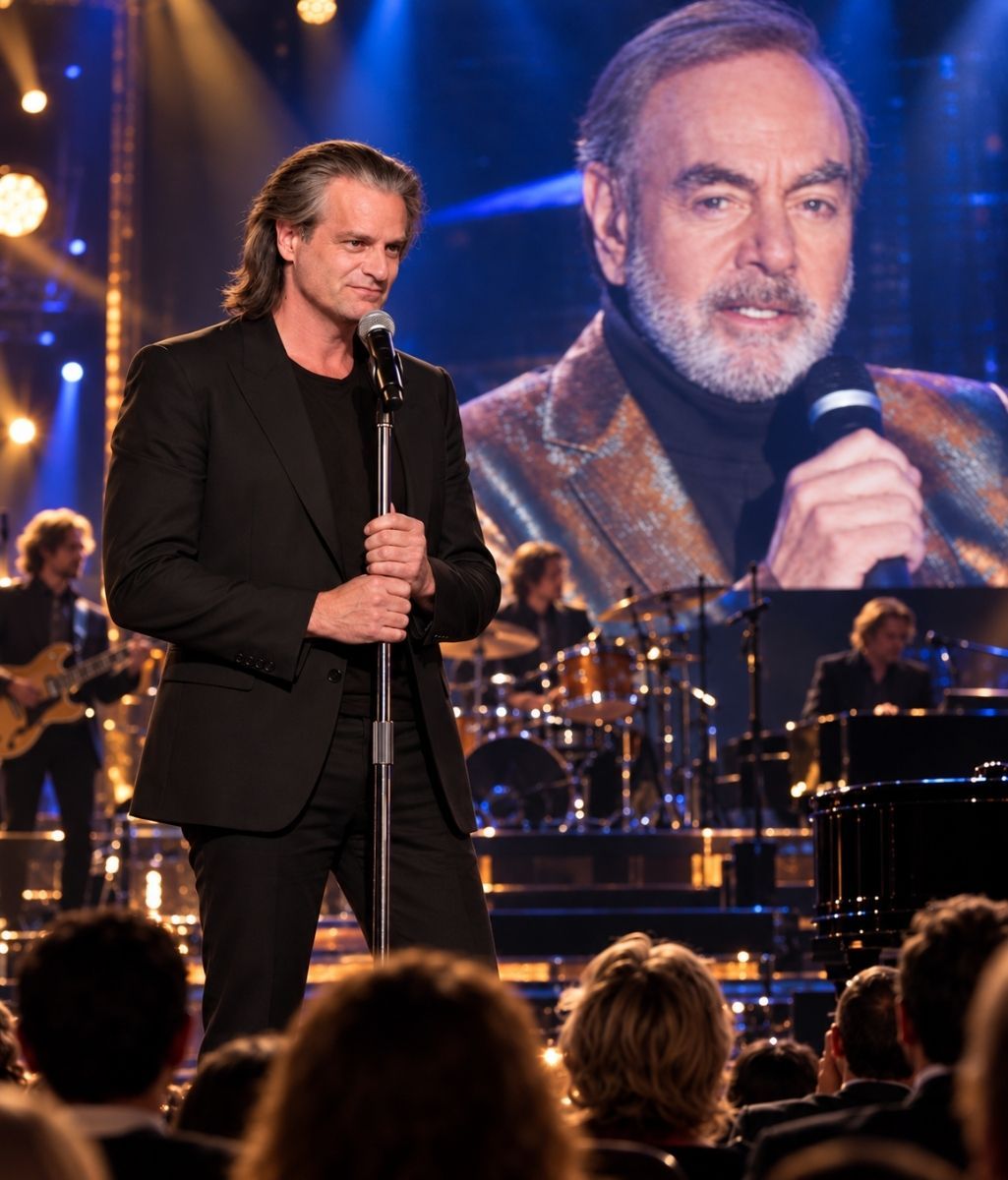
For more than half a century, Neil Diamond’s music has lived in public. His songs have filled radios, concert halls, family homes, automobiles, stadiums, and countless collections of carefully preserved records. Titles such as “Sweet Caroline,” “I Am… I Said,” “America,” “Cracklin’ Rosie,” and “Forever in Blue Jeans” became so familiar that generations of listeners came to believe they knew his musical story almost by heart. Yet every great songwriter leaves behind another world—the unfinished ideas, private recordings, forgotten melodies, and songs that never reached an album. And now, through Jesse Diamond, attention has turned toward one of those lesser-known chapters.
The idea itself is enough to fascinate longtime listeners: an unreleased Neil Diamond song, written years earlier but never given the public life of his celebrated recordings, finally being heard in a live setting. Such a song carries an unusual emotional weight because audiences approach it without decades of memories already attached. There is no famous chorus waiting around the corner and no familiar arrangement everyone can anticipate. Instead, listeners encounter something suspended between two eras—music created in the past suddenly receiving a new life in the present.
That is what makes Jesse Diamond’s connection to the story especially meaningful. Jesse is not simply another musician approaching Neil’s catalog from the outside. He is Neil Diamond’s son, someone whose perspective on the person behind the famous songs is naturally different from that of an audience. Millions knew Neil through records, television appearances, and enormous concerts. Family knew another side—the person who existed when the stage lights disappeared, when songs were still unfinished ideas, and when music belonged to a private world before it belonged to millions.
We often imagine that every important song written by a legendary performer eventually becomes part of the official catalog. In reality, creative lives are rarely so orderly. Songwriters accumulate notebooks, demos, abandoned arrangements, alternate versions, unfinished lyrics, and compositions that simply never find the right moment. Sometimes an album changes direction. Sometimes an arrangement does not feel complete. Sometimes a song is set aside because another composition takes its place. And sometimes a piece of music simply waits quietly for years until someone finally decides that its moment has arrived.
That possibility feels particularly powerful with Neil Diamond because his career crossed so many musical eras. Before he became the commanding performer remembered by millions, Diamond was first and foremost a songwriter, working patiently with words, melodies, and ideas. Through the late 1960s and 1970s, those ideas grew into recordings capable of filling enormous rooms. Yet beneath all the fame remained the same fundamental process: one person sitting somewhere quietly, searching for the melody or phrase that might turn an emotion into a song. An unreleased composition takes listeners back to that private beginning.
For longtime fans, hearing such material can carry a particularly deep emotional meaning. Many listeners who discovered Neil Diamond during the late 1960s and 1970s have traveled through most of their own lives with his records nearby. They remember purchasing albums when music came inside large cardboard sleeves, waiting beside radios without knowing which song would play next, and hearing “Sweet Caroline” in 1969 before it became the multigenerational tradition it is today. Those listeners grew older alongside the songs. Their families heard them too, and eventually another generation learned the melodies almost without realizing where those songs had first entered their lives.
That is why Jesse bringing one of his father’s lesser-known musical chapters into the light can mean more than simply adding another title to Neil Diamond’s catalog. A recording preserves a voice exactly as it sounded during one particular moment, but when another generation carries the music onto a stage, preservation becomes something living. The purpose does not have to be imitation. Jesse does not need to recreate his father’s voice or reproduce the past exactly. The greater tribute is allowing the song to breathe again while acknowledging that decades have passed and that the people hearing it have changed too.
And those decades matter. More than half a century has passed since “Sweet Caroline” arrived in 1969. Vinyl records gave way to cassettes, compact discs, downloads, and streaming. Radio changed. Concerts changed. The recording industry transformed almost beyond recognition. Many of the people who first heard Neil Diamond as young adults are now parents and grandparents. Yet music has an extraordinary ability to cross those distances. A melody written years ago can enter a room today and make time feel surprisingly small.
Perhaps that is the deeper meaning behind Jesse’s story. A musical legacy is not limited to the famous recordings everyone already knows. Somewhere beyond the albums and familiar concert favorites are the fragments of a creative life that audiences never encountered—songs that waited, ideas that remained unfinished, and stories known primarily to the people closest to the songwriter. When one of those pieces finally emerges, listeners are not merely hearing another composition. They are hearing the distance between the moment it was created and the moment it was finally allowed to speak.
And when the final note disappears, perhaps the most powerful realization is that the song was never truly lost. It was waiting—waiting for someone to remember it, waiting for another generation to understand what it carried, and waiting for the right moment to leave the private world where it had remained for so long. When Jesse Diamond helped open that hidden chapter of his father’s musical story, longtime listeners were offered something increasingly rare after more than fifty years of Neil Diamond’s music: the extraordinary feeling of discovering a piece of a familiar legend as though they were hearing him for the very first time.