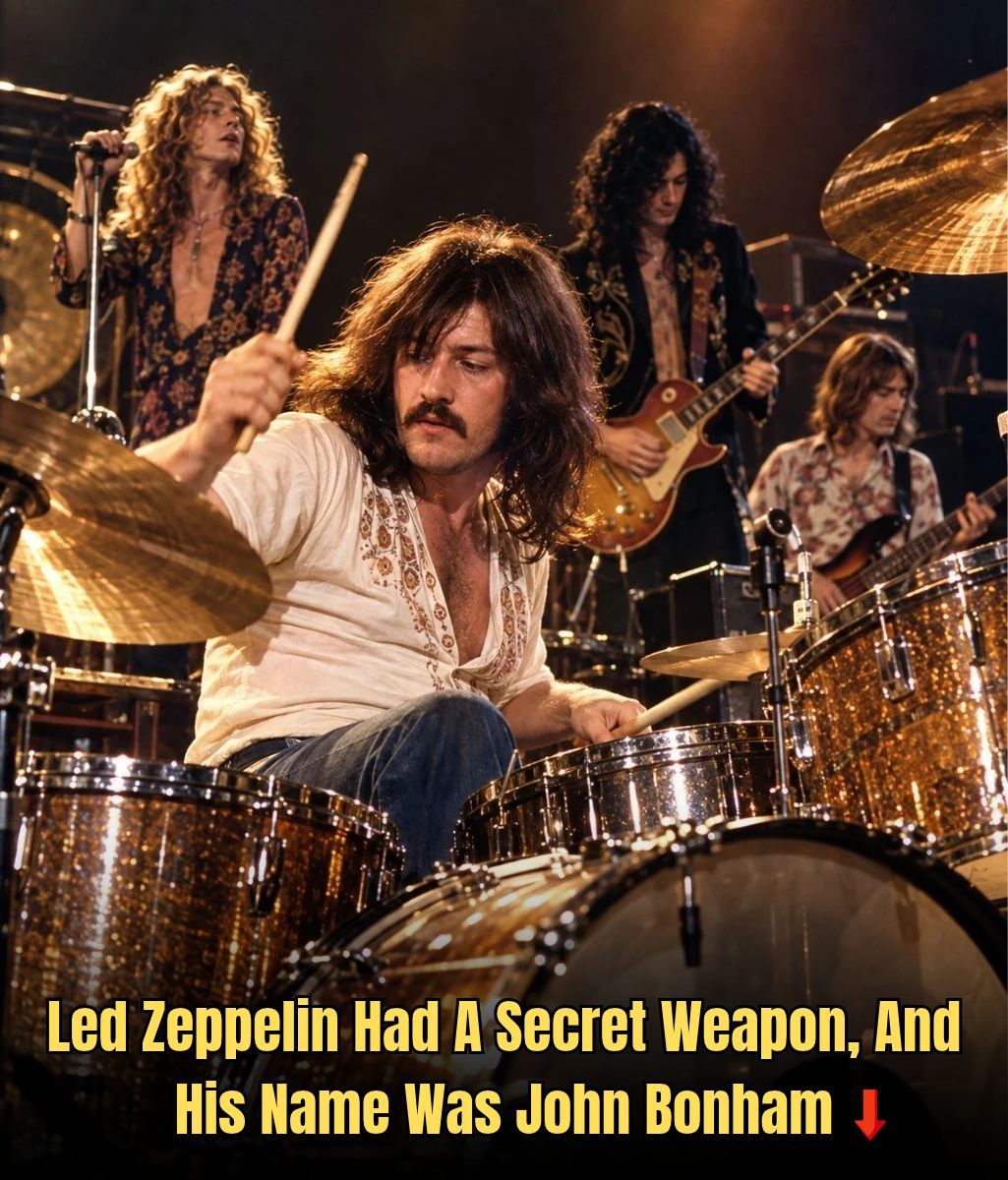
What made John Bonham one of the greatest drummers in rock history? It wasn’t simply his speed, his strength, or the thunderous sound that could fill an entire concert hall. It was something far more extraordinary: an almost instinctive understanding of rhythm, an unmistakable musical personality, and the ability to make every beat feel alive. As the legendary drummer of Led Zeppelin, Bonham helped create a sound that changed rock music forever. His playing was powerful without being mechanical, complicated without losing its natural groove, and explosive without sacrificing musical feeling. Even decades after his passing, drummers around the world continue studying his performances, trying to understand how one man could produce such an unmistakable combination of power, precision, and soul.
One of the most remarkable qualities of Bonham’s drumming was his extraordinary sense of timing. He did not simply keep the rhythm behind the other musicians. He shaped the entire musical experience. His beats could push a song forward with tremendous force, then suddenly settle into a relaxed groove that gave the music room to breathe. Listen to When the Levee Breaks, and the opening drum sound immediately commands attention. Heavy, atmospheric, and almost overwhelming, it became one of the most recognisable drum recordings in rock history. That sound was not an accident. It reflected Bonham’s understanding of acoustics, musical space, and the importance of creating a distinctive atmosphere.
Another defining characteristic was his incredible power and technique. Bonham had an unusually strong playing style, but strength alone never explained his greatness. He combined physical force with remarkable control, allowing him to move between thunderous bass-drum patterns, intricate fills, and beautifully controlled rhythms. His performances on songs such as Good Times Bad Times, Kashmir, and Rock and Roll demonstrated just how versatile he could be. The famous bass-drum passages in Good Times Bad Times remain particularly impressive because they reveal a drummer who could combine speed, coordination, and musical imagination long before modern drumming technology became commonplace.
His relationship with the other members of Led Zeppelin was equally important. Jimmy Page, Robert Plant, John Paul Jones, and John Bonham created a musical partnership built on individual talent and collective understanding. Bonham’s drumming gave Page’s guitar riffs their weight, supported Plant’s powerful vocals, and worked beautifully alongside Jones’s bass lines and arrangements. The chemistry was not always about playing louder or faster. Sometimes it was about knowing exactly when to hold back. Bonham understood that silence, space, and restraint could be just as important as a spectacular drum fill.
His famous performance on Moby Dick became another demonstration of his extraordinary abilities. During live performances, Bonham could turn the song into an extended display of rhythmic creativity, using his hands as well as his drumsticks. Yet even these celebrated moments were never simply demonstrations of technical ability. They reflected his personality as a musician: fearless, inventive, spontaneous, and completely committed to the performance.
Perhaps the greatest testament to his influence is what happened after his death in 1980. Following the tragic loss of John Bonham, Led Zeppelin announced that they could not continue as the same band without him. It was a decision that reflected the importance of his contribution to the group’s identity. He was not a replaceable member sitting behind a drum kit. He was an essential part of Led Zeppelin’s musical character.
Today, John Bonham’s legacy remains firmly established among the greatest achievements in rock music. His influence can be heard in the playing of countless drummers across hard rock, heavy metal, and modern music. But his greatest achievement may be something simpler: whenever the opening drums of When the Levee Breaks begin, listeners immediately recognise that unmistakable sound. That is the mark of a true original. John Bonham didn’t just play the drums for Led Zeppelin. He gave the band its heartbeat — and rock music has never quite sounded the same since.