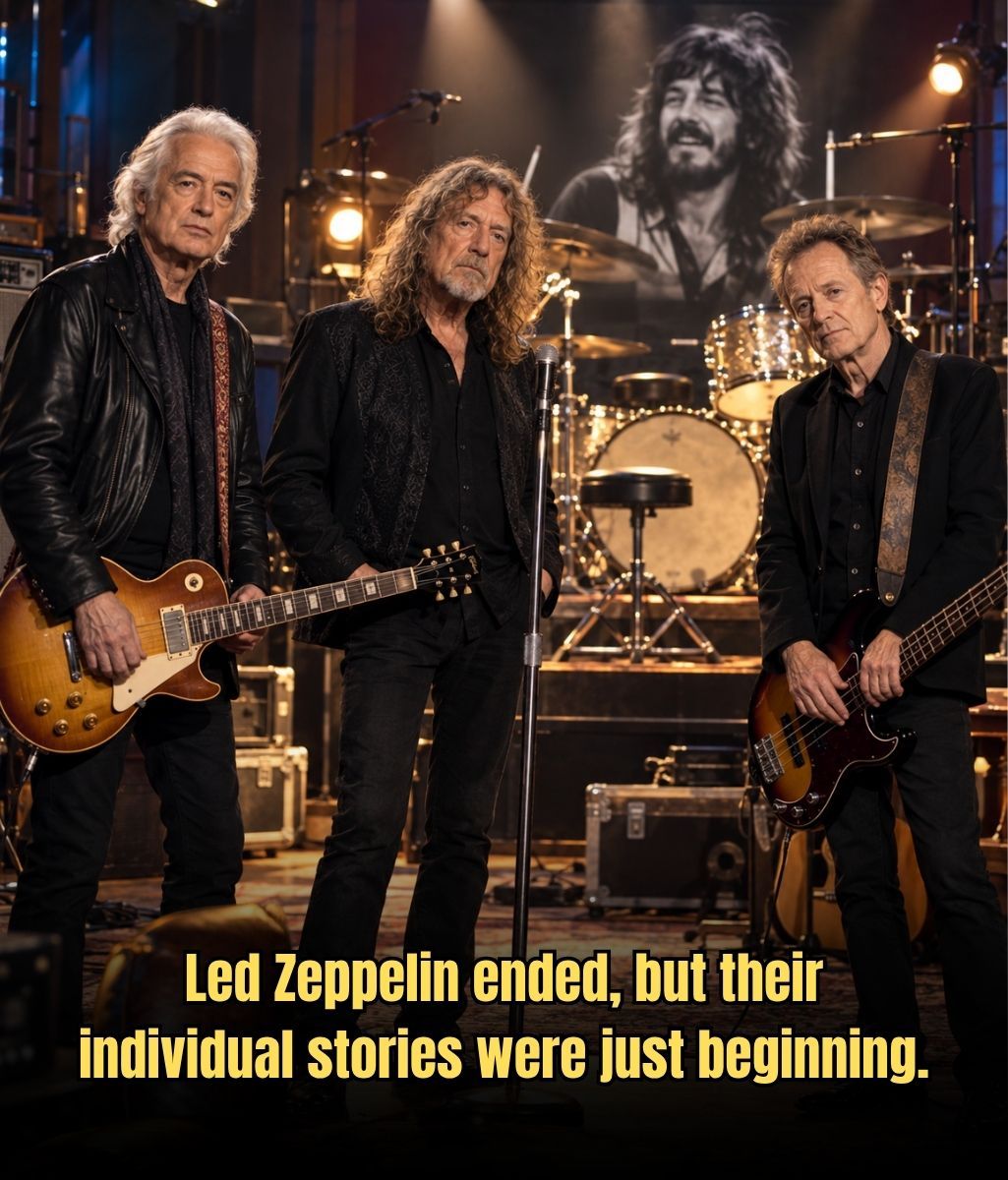
By 1980, Led Zeppelin had already conquered the world. Their albums had sold millions, their concerts had become legendary, and songs such as “Stairway to Heaven,” “Whole Lotta Love,” “Kashmir” and “Rock and Roll” had transformed four English musicians into rock royalty. But behind the extraordinary success, the band was facing exhaustion, personal struggles and an uncertain future. Then, on September 25, 1980, everything changed. John Bonham, the drummer whose extraordinary power had helped define Led Zeppelin’s sound, died at just 32 years old. What followed was not simply the breakup of a famous band. It was the beginning of three very different journeys through grief, reinvention and the painful realization that some musical partnerships can never be recreated.
For Jimmy Page, Bonham’s death shattered the musical world he had spent more than a decade building. Page had assembled Led Zeppelin in 1968, and the relationship between his guitar and Bonham’s drums became one of rock’s most recognizable sounds. The two musicians understood each other’s instincts almost without speaking. In the months before Bonham died, Page was already considering the direction of another Zeppelin album. There were new ideas, new possibilities and another American tour approaching. Suddenly, those plans disappeared. Page struggled to move forward, and for a time, the guitar that had defined his life became inseparable from the loss of his friend.
Page eventually returned to music, composing the soundtrack for Death Wish II in 1982 before forming The Firm with singer Paul Rodgers in 1984. He later released his solo album Outrider in 1988 and reunited with Robert Plant for major recording and touring projects during the 1990s. Yet Led Zeppelin remained central to his identity. Page devoted enormous attention to preserving the band’s recordings, overseeing remasters and archival releases. The music survived beautifully, but the musician who had once answered his guitar from behind the drums was gone. Page could preserve Led Zeppelin’s legacy, but he could not recreate the original four musicians who had made it.
For Robert Plant, the loss was different but equally profound. Bonham had been his friend before Led Zeppelin existed. They came from England’s Midlands music scene and shared a personal history that reached back before the enormous stages and international fame. Bonham had also supported Plant during the devastating loss of his young son Karac in 1977. When Bonham died three years later, Plant lost someone connected to some of the most important and painful moments of his life. Rather than immediately attempting to rebuild Led Zeppelin, Plant began searching for a musical identity beyond the band. His first solo album, Pictures at Eleven, arrived in 1982, followed by The Principle of Moments in 1983. Songs such as “Big Log” and “In the Mood” introduced audiences to a different Robert Plant.
Over the following decades, Plant continued moving forward. He explored blues, folk, world music and Americana, eventually creating acclaimed recordings with Alison Krauss. His musical journey suggested that he did not want the rest of his life to become an endless recreation of Led Zeppelin’s greatest moments. He continued performing Zeppelin songs occasionally, but often rearranged them to reflect the artist he had become. For Plant, moving forward did not mean forgetting Bonham or rejecting Zeppelin. It meant accepting that the original band belonged to a particular time, and that continuing to make music was not the same as bringing Led Zeppelin back.
John Paul Jones took perhaps the quietest path. As Led Zeppelin’s bassist, keyboardist and arranger, he had provided much of the musical intelligence beneath the band’s enormous sound. His relationship with Bonham formed one of rock’s greatest rhythm sections. After the breakup, Jones returned to the world of arranging, producing and collaborating with other musicians. He worked across different styles, eventually releasing his instrumental solo album Zooma in 1999 and The Thunderthief in 2001. Later, he joined Dave Grohl and Josh Homme in the supergroup Them Crooked Vultures. While Page remained closely associated with Zeppelin’s guitar legacy and Plant pursued an evolving vocal identity, Jones demonstrated that his creativity had always extended far beyond one band.
The decision to end Led Zeppelin became official on December 4, 1980. Page, Plant and Jones announced that the loss of their friend and the unique harmony between the members meant they could not continue as before. It was an extraordinary decision for a band capable of filling the world’s largest venues. They could have hired another drummer. They could have recorded another album. They could have continued earning enormous sums of money under the Led Zeppelin name. Instead, they recognized something audiences would spend decades trying to understand: John Bonham was not simply the drummer who played Led Zeppelin’s songs. He was one of the four musicians who made those songs possible.
There were attempts to revisit the past. The surviving members performed together at Live Aid in 1985, but the hurried reunion failed to capture the magic they remembered. Another appearance followed at Atlantic Records’ anniversary celebration in 1988. During the 1990s, Page and Plant collaborated extensively, proving that their musical connection remained powerful. Yet none of these moments fully restored Led Zeppelin. The closest they came was on December 10, 2007, when Page, Plant and Jones reunited at London’s O2 Arena with Jason Bonham, John’s son, behind the drums. This time, the preparation was serious, the performance was extraordinary, and the audience witnessed something many believed would never happen again. For one night, Led Zeppelin seemed to live and breathe once more.
But the success of that concert created another difficult question. If they could perform together so magnificently, why not continue? Page was interested in exploring further possibilities, and Jones and Jason were also involved in discussions about making more music. Plant, however, chose another direction. He had spent decades building a life beyond Zeppelin and did not want to commit to a permanent reunion. The O2 concert remained a remarkable celebration rather than the beginning of another era. For fans, it was heartbreaking. For the musicians, it reflected the reality that the world had changed since 1980. They could revisit the music, but they could never return to the moment when all four original members stood together.
Today, the legacy of John Bonham remains inseparable from everything Page, Plant and Jones accomplished afterward. Page became a devoted guardian of the band’s recordings. Plant continued exploring new musical worlds. Jones built an extraordinary career through collaboration and experimentation. Each survived the end of Led Zeppelin in his own way, but none could erase the significance of the friend they lost. Nearly half a century later, young musicians still study Bonham’s drumming, guitarists still learn Page’s riffs, singers still attempt Plant’s soaring vocals, and bassists still discover the subtle brilliance of Jones. Led Zeppelin ended in 1980, but its music never stopped living. And perhaps that is the most moving truth of all: Jimmy Page, Robert Plant and John Paul Jones found ways to continue without John Bonham—but they never tried to convince the world that Led Zeppelin could truly be the same without him.
Follow Led Zeppelin for more rare stories, legendary recordings, unforgettable performances, and memories from the golden age of rock. ❤️🎸