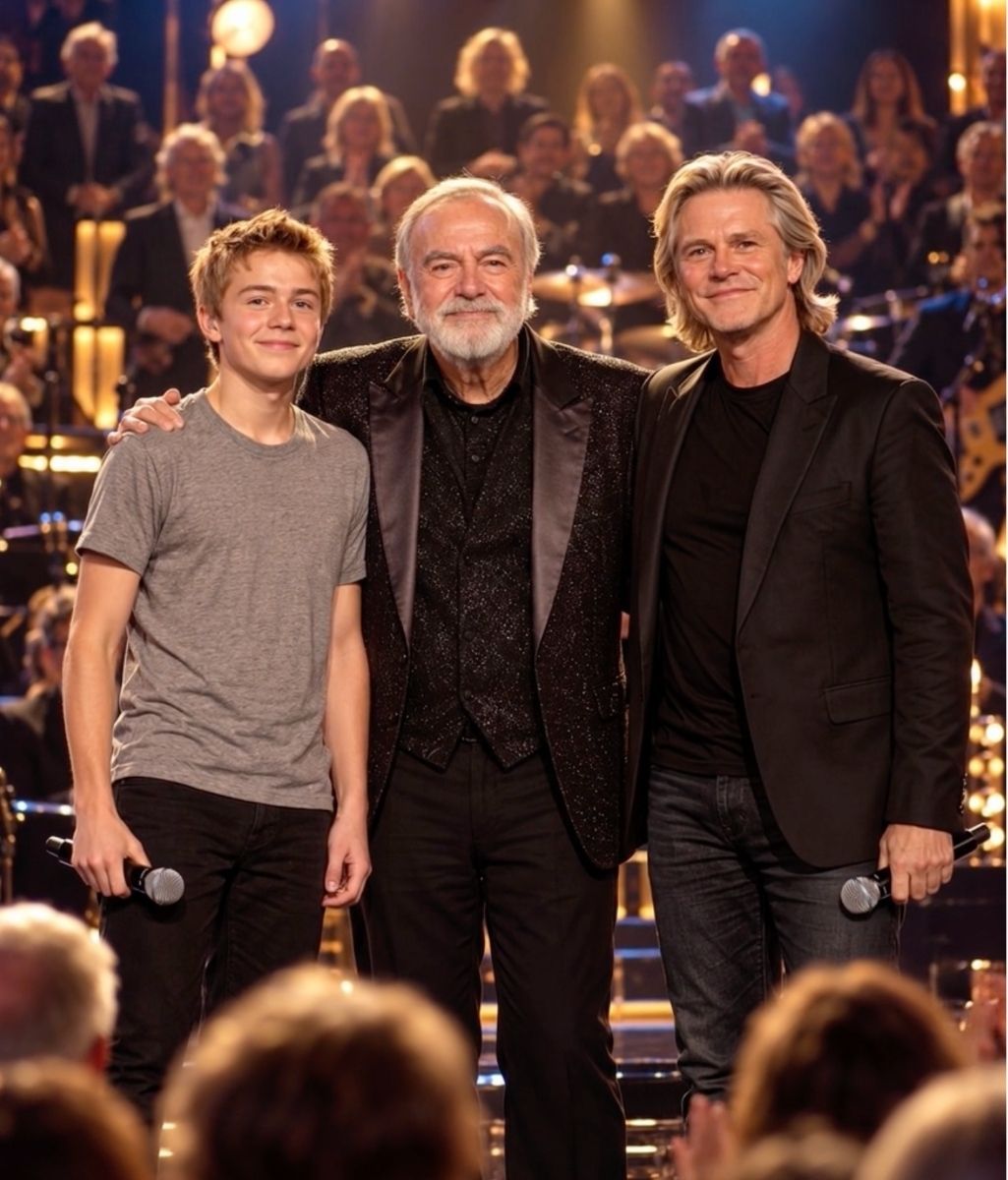
Some songs become successful because they arrive at exactly the right moment. Others remain because they eventually become part of a family’s history. For Neil Diamond, a song carried across more than half a century can now mean something very different from what it meant when audiences first discovered his unmistakable voice. When Jesse Diamond and Elijah Diamond stepped forward to honor Neil through music, the moment represented something larger than a familiar melody. It became a portrait of three generations connected by one musical legacy.
For longtime listeners, Neil Diamond’s songs have never belonged only to concert stages or record charts. They have lived in ordinary places: inside family cars, beside kitchen radios, on well-worn vinyl records, and at gatherings where someone inevitably began singing along. Songs such as “Sweet Caroline,” “America,” “I Am… I Said,” “Cracklin’ Rosie,” and “Forever in Blue Jeans” became companions to millions of listeners who grew older while the music somehow remained familiar.
That is why seeing younger members of the Diamond family connected to that musical story can carry such emotional weight. It creates a bridge between the artist audiences remember and the generations who came afterward.
Jesse Diamond, Neil’s son, represents one chapter of that story. Elijah Diamond, Neil’s grandson through Jesse, represents another. With Neil at the center of the family history, the image of three generations connected through music offers something audiences immediately understand: achievements may belong to one lifetime, but their meaning can continue long afterward.
And music has a remarkable way of carrying that meaning.
A photograph can preserve a face. A handwritten letter can preserve words. But a song can preserve something less tangible—the atmosphere of an entire period of life. Hearing a familiar melody decades later can suddenly return someone to an old living room, a long-forgotten automobile, a first apartment, or an evening spent with people whose voices they can still remember.
For many Neil Diamond listeners, that emotional connection stretches back more than fifty years.
They remember buying records when albums were objects you held carefully by the edges. They remember waiting beside the radio for a favorite song. They remember the unmistakable sound of Diamond’s voice arriving through speakers long before music could be summoned instantly from a phone.
Years passed, but the songs stayed.
That history changes the meaning of a family tribute. The younger generation is not merely revisiting an old recording. It is touching something that millions of people have carried through their own lives.
One song can suddenly contain several generations of memories.
A grandfather remembers hearing it when it was new. A son remembers hearing it because it was always playing at home. A grandson encounters the same melody in a completely different world—and somehow the song still works.
That may be one of the greatest measures of musical longevity.
Technology changes. Fashion changes. Concert stages become larger and more elaborate. The way people discover music changes almost beyond recognition. Yet a melody written decades earlier can still make a room grow quiet.
Then came the moment that gave the tribute another emotional dimension.
After Jesse and Elijah had honored the musical legacy associated with their family, the ending brought the focus back to Neil himself. What had begun as a tribute from younger generations suddenly felt like a circle closing: the music had traveled outward through millions of listeners and forward through decades, only to return to the family at its center.
There was no need for spectacle.
The significance was already there.
For older fans, moments like this can be especially moving because they understand what fifty years really means. They have watched artists grow older while growing older themselves. They remember voices that once seemed permanently young coming from radios and turntables. They remember friends who shared those records, places where those songs played, and ordinary days that seemed unimportant until decades later.
Neil Diamond’s music became part of that journey.
“Sweet Caroline,” in particular, demonstrated how far one recording could travel. Released in 1969, it eventually became more than a hit. Generations learned its chorus, and audiences developed their own traditions around it. At sporting events, celebrations, concerts, and family gatherings, people who had never met could suddenly become one enormous choir.
That is an unusual legacy for any songwriter.
But perhaps the most meaningful legacy is quieter.
It is a son knowing the songs.
It is a grandson discovering what those songs meant.
It is an older generation watching the younger one carry something forward—not by attempting to recreate the past exactly, but by acknowledging where the story began.
That is why the image of Neil, Jesse, and Elijah Diamond resonates beyond one performance. Three generations stand at different points along the same family timeline, while music provides the thread connecting them.
The years between them cannot be erased.
They do not need to be.
Because sometimes the beauty is found precisely in seeing how far the song has traveled.
A melody begins with one person. Millions hear it. Families grow around it. Decades pass. Then, unexpectedly, another generation sings it again.
And for a few extraordinary minutes, the distance between yesterday and today disappears.
One song.
Three generations.
More than half a century of memories.
And at the end, the most powerful realization may have been the simplest:
Neil Diamond gave the world the music—but watching that music find its way through his own family showed just how far a song can truly travel.