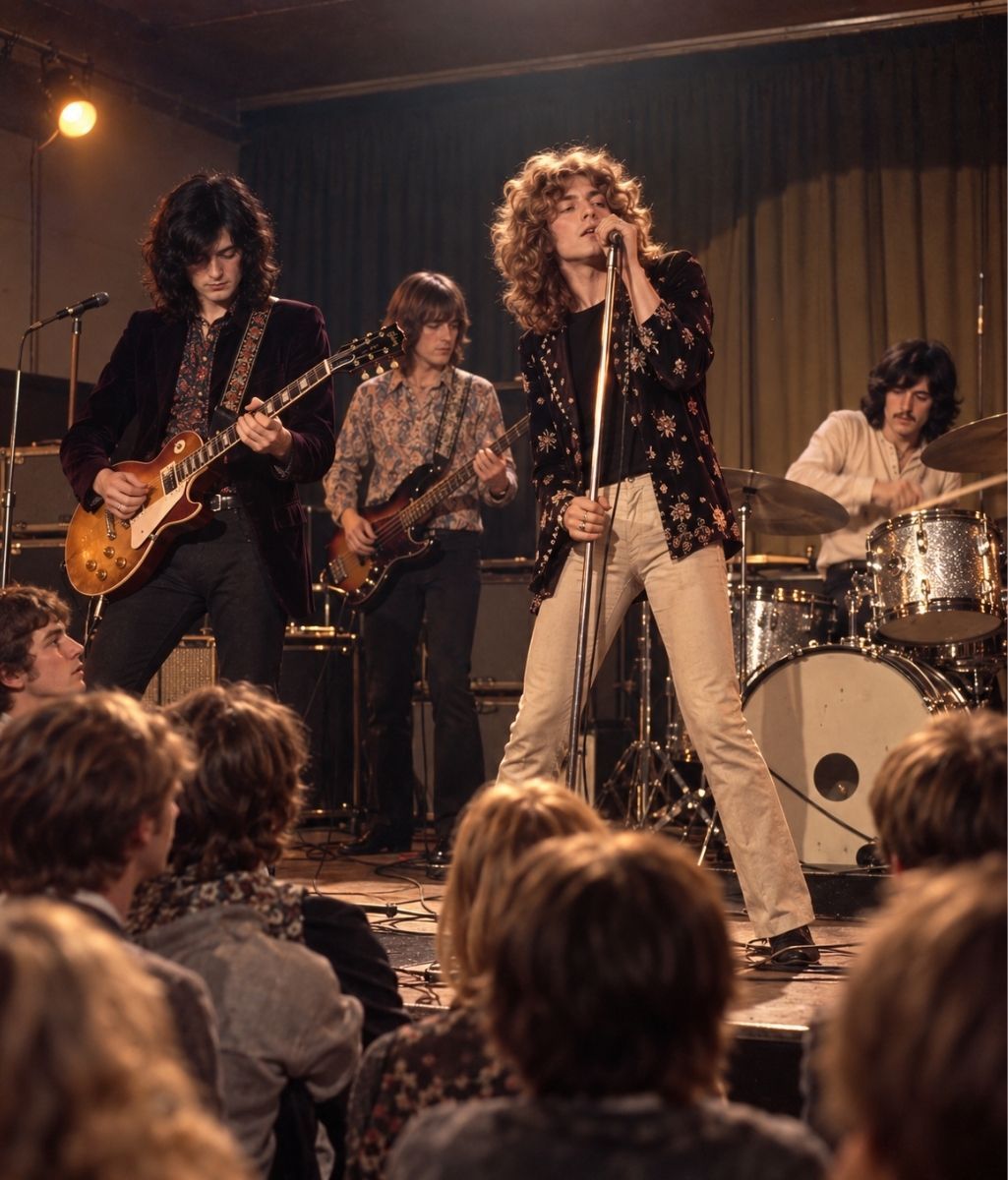
Some historic moments announce themselves with enormous crowds, flashing cameras, and headlines. Others happen so quietly that the people in the room cannot possibly know what they are witnessing. On September 7, 1968, four musicians—Jimmy Page, Robert Plant, John Paul Jones, and John Bonham—walked onto a modest stage in Gladsaxe, Denmark, and performed together in public for the first time. The world did not yet know them as Led Zeppelin, but one of rock music’s most extraordinary stories had begun.
The setting was remarkably ordinary compared with everything that would follow. The performance took place at Egegård School, far removed from the enormous arenas and stadiums that would eventually become familiar territory for the group. There was no legendary name glowing above the stage. No audience arrived knowing that these four musicians would soon help redefine the possibilities of rock music. At that moment, they were essentially a new lineup carrying unfinished business from another band.
Jimmy Page had been a member of The Yardbirds, whose lineup was falling apart during 1968. Yet previously arranged Scandinavian appearances still had to be fulfilled. Page assembled a new group around himself, bringing in singer Robert Plant, drummer John Bonham, and bassist-keyboardist John Paul Jones.
Initially, the new lineup performed under the name The New Yardbirds.
That temporary identity now seems almost impossible to imagine. Today, the names Page, Plant, Jones, and Bonham immediately evoke massive guitar riffs, thunderous drums, adventurous arrangements, and records that became landmarks of rock history. But on that September evening, none of that legacy had been written yet.
They were simply four musicians discovering what happened when they played together in front of an audience.
And there had been remarkably little time for preparation.
The musicians had only recently begun rehearsing together. Yet accounts of their earliest sessions suggest that something unusual became apparent almost immediately. Page brought experience, vision, and an instinct for combining blues foundations with heavier sounds. Plant possessed a powerful and highly distinctive voice. Jones brought years of professional studio experience and exceptional musical versatility. Bonham supplied a drumming style whose weight and precision would become one of the defining characteristics of the group.
Individually, each musician had something important.
Together, they created something none of them could have created alone.
That first Danish audience could not have known what was coming. They could not have known that within a short period the group would adopt the name Led Zeppelin. They could not have predicted albums that would become fixtures in record collections around the world. And they certainly could not have imagined that songs such as “Whole Lotta Love,” “Black Dog,” “Rock and Roll,” “Kashmir,” and “Stairway to Heaven” would eventually become part of rock’s permanent vocabulary.
That knowledge belongs to us, looking backward.
And perhaps that is what makes the first performance so fascinating.
We know what happened next.
After the Denmark appearances and the short Scandinavian tour, the four musicians continued developing the sound that had begun taking shape almost immediately. Before long, they recorded their debut album. Released in 1969, Led Zeppelin introduced listeners to a group that sounded both rooted in earlier blues traditions and strikingly different from much of what surrounded it.
The music could be extraordinarily heavy, but it could also become quiet and atmospheric. Page’s guitar could move from delicate acoustic passages to enormous electric riffs. Plant’s voice could rise above the arrangements with astonishing force. Jones could quietly reshape an entire song through bass, keyboards, or arrangement. And behind everything was Bonham, whose drumming gave even the simplest passages a sense of physical presence.
Their musical identity would continue evolving.
What began on a modest Danish stage would eventually stretch across albums including Led Zeppelin II, Led Zeppelin III, Led Zeppelin IV, Houses of the Holy, and Physical Graffiti. The group would move through blues, folk, hard rock, acoustic music, and increasingly ambitious studio experimentation without becoming easy to categorize.
But none of those records existed on September 7, 1968.
There was no “Stairway to Heaven.”
There was no “Kashmir.”
There was no Led Zeppelin mythology.
There were only Page, Plant, Jones, and Bonham standing together onstage for the first time, testing a musical chemistry that had barely been given time to develop.
For listeners who discovered Led Zeppelin during the 1970s, there is something especially moving about returning to that beginning. Many remember opening those enormous album sleeves, studying the artwork, lowering a needle onto vinyl, and waiting for the first guitar notes to emerge through speakers. Those records became part of bedrooms, college years, late-night drives, friendships, and countless afternoons spent discovering music.
Decades later, it can be difficult to imagine a world in which Led Zeppelin was completely unknown.
Yet that world existed.
And for a brief evening in Denmark, rock history was sitting quietly inside a small room, waiting for the rest of the world to catch up.
The four musicians could not know exactly where the road would lead. Audiences could not know that future generations would study those recordings, learn those guitar parts, debate favorite albums, and continue playing the music long after the original era had disappeared.
That is what makes beginnings so powerful in retrospect.
The biggest chapters often start without ceremony.
No one rings a bell announcing that history has begun. Sometimes four musicians simply walk onto a stage, plug in their instruments, exchange a glance, and start playing.
On September 7, 1968, that happened in Denmark.
They arrived as a newly assembled group still carrying another band’s name.
They left having played the first public performance of the four musicians the world would soon know as Led Zeppelin.