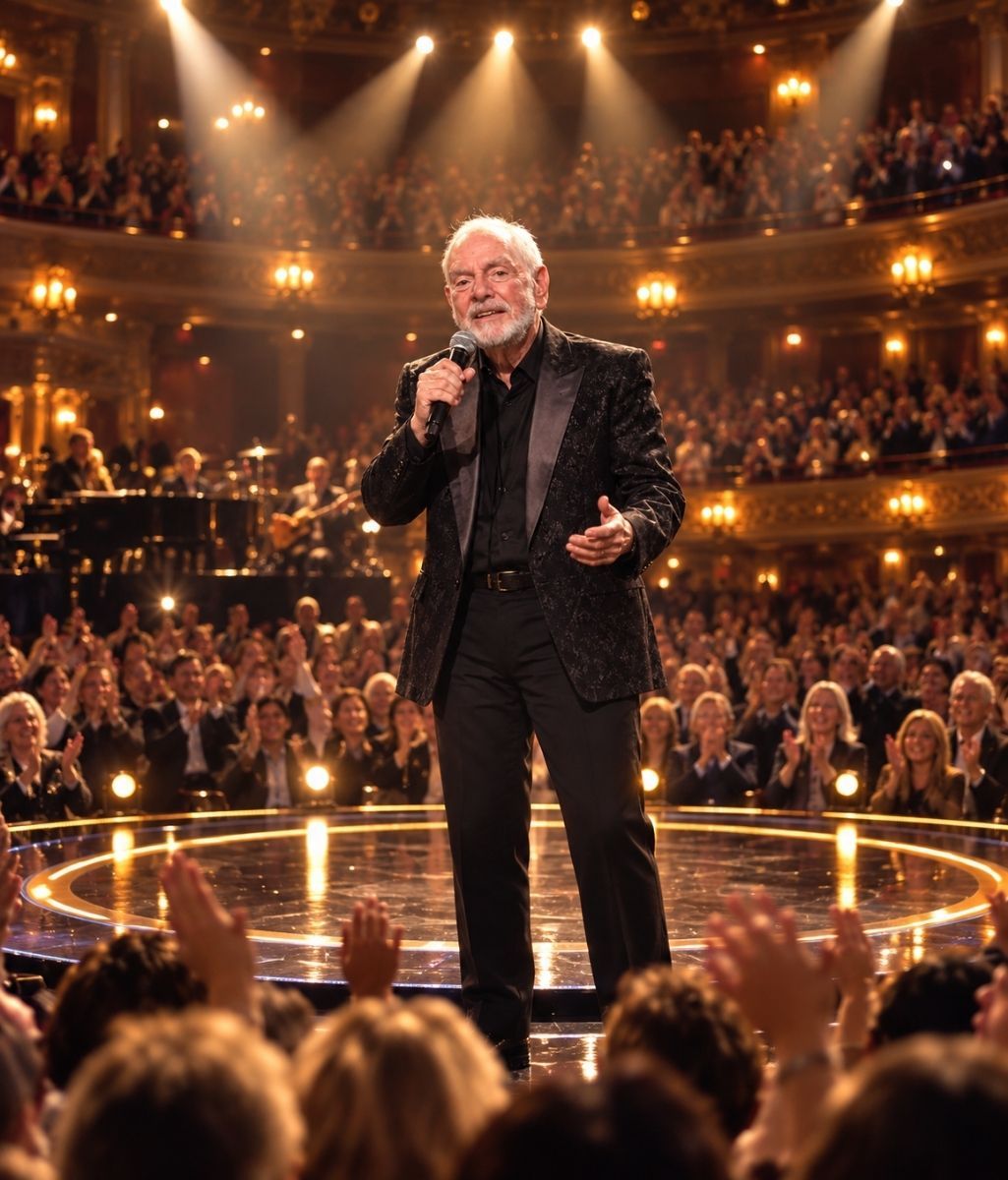
Last night, Neil Diamond surprised a theater audience by performing “Sweet Caroline,” and at 85 years old, the moment carried a meaning far beyond one familiar song. For longtime listeners, simply seeing Diamond step forward and return to a melody that has followed him for more than half a century was enough to stir memories of another era—when his voice filled radios, record players, automobiles, and concert halls across America.
There are songs that become hits, and then there are songs that become part of people’s lives. “Sweet Caroline” belongs firmly to the second category. Released in 1969, the recording grew from a successful Neil Diamond single into something far larger: a communal song, passed from one generation to the next and recognized almost instantly from its opening notes.
That history is what made the theater moment feel so remarkable. The audience was not simply watching an entertainer revisit an old number. Many were looking at a performer whose music had accompanied them through decades of their own lives. Some may have first heard Diamond when they were young adults. Others discovered his records through parents, friends, radio stations, sporting events, or old collections of vinyl albums. Yet when “Sweet Caroline” began, those different generations suddenly had one thing in common.
They knew what was coming.
And that is the extraordinary thing about this song. The audience has become part of the performance.
For decades, crowds have answered its famous chorus with the familiar “So good! So good! So good!” response. It became a tradition that grew beyond the original recording, transforming “Sweet Caroline” from something people listened to into something they experienced together. At concerts, celebrations, and sporting events, strangers who might never speak to one another suddenly find themselves singing the same melody.
Imagine what that must feel like when Neil Diamond himself is standing there at 85.
The years between 1969 and today are enormous when measured on a calendar. Families have grown. Neighborhoods have changed. Record stores have disappeared. Vinyl gave way to cassettes, compact discs, downloads, and streaming. The automobile radio that once introduced millions of Americans to new songs has been transformed beyond recognition.
But then someone plays those opening notes.
Suddenly, the distance between then and now does not seem quite so large.
That is the strange power of music and perhaps the reason this appearance resonated so deeply. A familiar song can unlock memories with astonishing speed. Someone in that theater may have remembered a summer drive from fifty years ago. Another person may have thought of a family member who loved Neil Diamond records. Someone else may have remembered dancing to the song, hearing it at a baseball game, or singing along at a gathering where everyone seemed to know the chorus.
One song can hold thousands of completely different memories at the same time.
Neil Diamond’s catalog contains many recordings that remain deeply familiar, including “Cracklin’ Rosie,” “I Am… I Said,” “Song Sung Blue,” “America,” and “Forever in Blue Jeans.” His songwriting helped define a particular strand of American popular music: melodic, direct, emotionally accessible, and capable of sounding equally at home through a small radio speaker or inside a packed arena.
Yet “Sweet Caroline” became something even bigger.
Its association with Fenway Park and the Boston Red Sox helped introduce it to audiences who may not have grown up buying Neil Diamond albums. Weddings, parties, sporting events, and public celebrations carried it further. Children heard parents singing it. Eventually those children became adults and discovered that they knew the chorus almost without remembering when they had learned it.
That is how a popular song becomes a tradition.
And it explains why seeing Diamond perform it at an advanced age can feel so different from watching an ordinary concert performance. The audience knows that time has passed. Diamond knows it. Everyone in the room carries that awareness.
There is no need to pretend otherwise.
In fact, the passage of time is precisely what gives such a moment its emotional weight.
The voice may belong to the same artist, and the melody may be instantly recognizable, but the people hearing it are no longer the people they were when the record first appeared. Decades of marriages, families, careers, friendships, losses, celebrations, ordinary afternoons, and unforgettable nights now stand between the original recording and the present moment.
Still, the chorus survives.
Perhaps that is why scenes like this matter so much to longtime music lovers. They remind us that a great recording does not remain trapped inside the year it was made. It travels alongside us. Its meaning changes because we change.
At 20, “Sweet Caroline” might simply sound like a wonderful record.
At 40, it may remind someone of younger years.
At 60, 70, or 80, those same notes can open an entire room of memories.
And when Neil Diamond himself stands before an audience and begins that familiar song again, more than half a century after it entered American culture, the moment becomes about much more than nostalgia.
It becomes a reminder of how far everyone has traveled.
For a few minutes, the theater is no longer divided by age or generation. The people who remember 1969 and those who discovered the song decades later are waiting for exactly the same moment.
Then the chorus arrives.
The audience answers.
And suddenly, after all these years, “Sweet Caroline” sounds young again.
Because some songs grow old with us.
The truly special ones somehow bring us back.