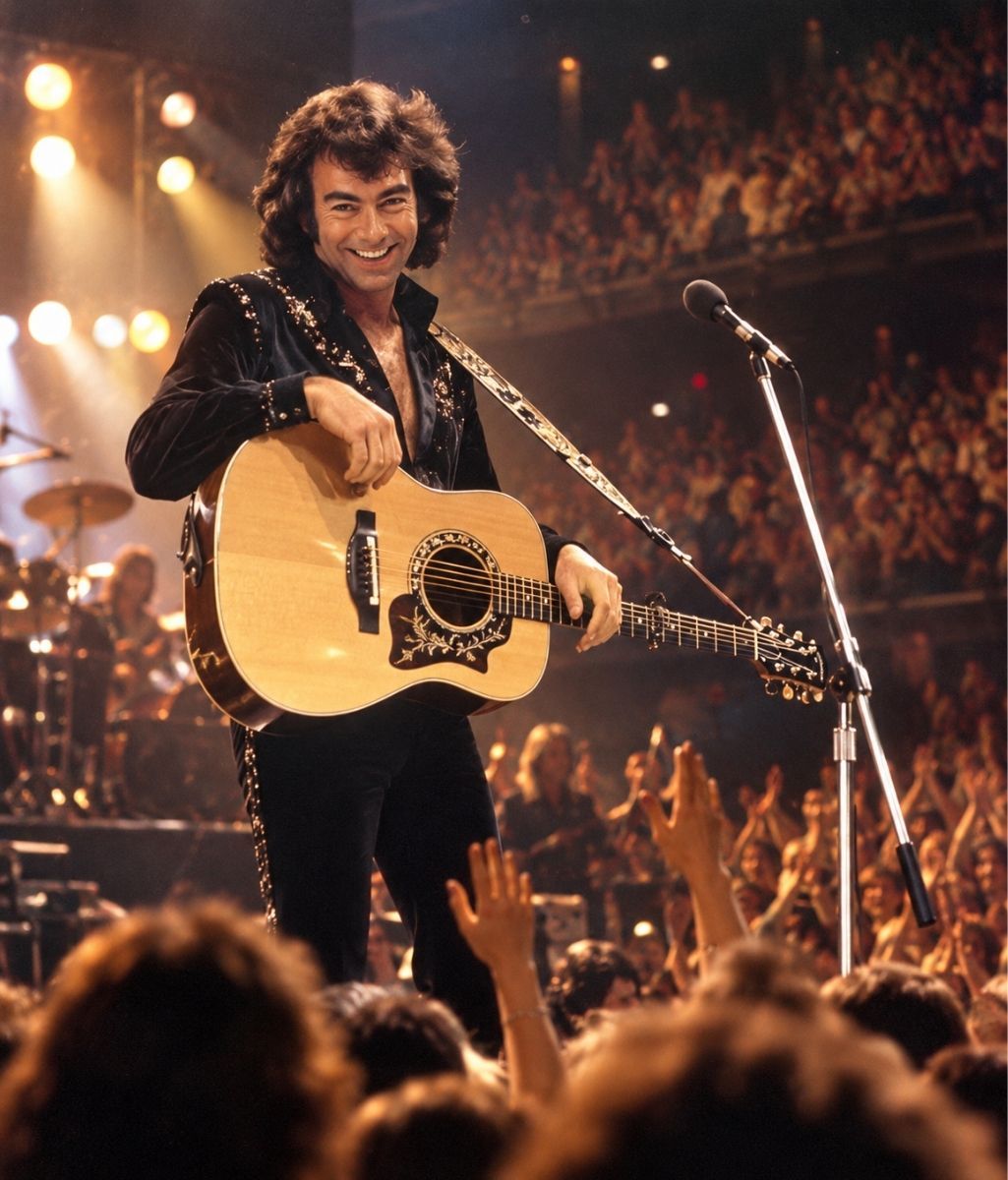
There are certain songs that belong to a particular year, and then there are songs that somehow escape the calendar entirely. More than half a century after Neil Diamond first introduced the world to “Sweet Caroline,” those familiar opening notes can still transform an ordinary gathering into something that feels almost communal. A few seconds are often all it takes. Conversations stop, heads turn, smiles appear, and before long, people who may have little else in common are singing the same unforgettable chorus.
Released in 1969, “Sweet Caroline” arrived during one of the most extraordinary periods in American popular music. Radio was changing rapidly, musical styles were colliding, and a new generation of performers was reshaping what listeners expected from a hit record. Yet Neil Diamond created something remarkably direct. The song did not depend on elaborate production or complicated storytelling. Instead, it carried a melody that seemed instantly familiar, supported by Diamond’s unmistakable voice and a chorus practically designed to be remembered.
What happened afterward was something no songwriter could completely plan. “Sweet Caroline” became bigger than the recording itself.
For listeners who first heard it on AM radio, the song can still summon memories of another America: long summer drives with the windows down, family gatherings where a radio played somewhere in the background, neighborhood dances, crowded restaurants, old jukeboxes, and record players spinning in living rooms after dinner. Music has a remarkable ability to preserve moments that photographs sometimes cannot, and “Sweet Caroline” became attached to millions of those moments.
Over the decades, something especially interesting happened during live performances. Audiences began answering the chorus with the now-famous “So good! So good! So good!” response. Those words were not part of the original 1969 recording in the way generations of concertgoers now instinctively perform them. They grew from the audience itself, turning a familiar pop song into a shared ritual.
That transformation may explain why the song has remained so powerful. You do not simply listen to “Sweet Caroline” anymore. You participate in it.
Walk into the right stadium, concert hall, wedding reception, neighborhood celebration, or crowded gathering when those opening notes begin, and you can watch the years disappear. Someone who remembers hearing Neil Diamond in the early 1970s may suddenly be singing beside someone who discovered the song decades later. They may come from entirely different generations, but for those few minutes, they know exactly what comes next.
And everyone waits for that chorus.
“Sweet Caroline” also became deeply connected with American sporting culture, most famously through its association with Fenway Park and the Boston Red Sox. In that setting, the song took on yet another life. Thousands of voices singing together turned Diamond’s recording into something resembling a tradition passed from one generation of fans to another.
But perhaps the enduring appeal goes deeper than any particular stadium or event. Neil Diamond possessed an unusual ability to write songs that sounded personal without becoming inaccessible. His strongest recordings could feel intimate enough for one listener wearing headphones and large enough for thousands of people standing together in an arena. “Sweet Caroline” may be one of the clearest examples of that gift.
There is also something wonderfully uncomplicated about the record. It does not demand that listeners understand a particular historical moment before enjoying it. You do not need to have been alive in 1969. You do not need to know where the song was recorded or how the arrangement was constructed. You only need to hear that melody.
Then memory—or perhaps instinct—does the rest.
For older listeners, hearing “Sweet Caroline” today can carry an additional emotional weight. The world in which they first discovered the song has changed enormously. The radios are different. The cars are different. Many of the old record stores have disappeared. Familiar gathering places have closed, and some of the people who once shared those songs with us now live primarily in our memories.
Yet the record remains.
Put it on today, and suddenly a room from 1970, 1980, or 1990 can feel remarkably close again. That may be one of music’s quiet miracles: three minutes of sound can cross decades faster than almost anything else.
Neil Diamond recorded many enduring songs throughout his remarkable career, including “Cracklin’ Rosie,” “Song Sung Blue,” “America,” “I Am… I Said,” and “Forever in Blue Jeans.” Each revealed another side of his songwriting and performing voice. But “Sweet Caroline” achieved something especially rare. It became part of popular culture without losing the warmth that made listeners embrace it in the first place.
That is why its longevity cannot be measured simply by record sales, chart positions, or streaming numbers. Its real legacy can be heard in the crowd.
It is there when the first notes begin and someone across the room immediately smiles. It is there when people who have never met suddenly sing together. It is there when parents introduce the song to their children, who eventually introduce it to another generation.
More than 50 years after its 1969 release, “Sweet Caroline” no longer belongs to only one decade. It belongs to the road trips, ballparks, family celebrations, old radios, concert halls, and countless ordinary evenings where people discovered that a familiar song could make a room feel a little smaller and the distance between generations feel a little shorter.
And when that famous chorus arrives, something remarkable still happens.
For a few moments, everyone seems to know the words, everyone knows what comes next, and a Neil Diamond song recorded more than half a century ago feels young again.