Some songs become famous because of their melodies. Others are remembered because of the emotions, arguments, and unexpected reactions they inspire. And occasionally, a song becomes so closely associated with a particular moment in music history that bringing it back years later can reignite conversations people thought had long been forgotten.
That is the intriguing story surrounding Neil Diamond’s musical legacy and his son, Jesse Diamond.
For decades, Neil Diamond has been one of America’s most celebrated songwriters. His music has accompanied generations through moments of happiness, heartbreak, family celebrations, and personal reflection. From the unforgettable opening of Sweet Caroline to the emotional depth of I Am… I Said, his recordings have become part of the soundtrack of everyday life.
But Neil’s catalogue is not limited to gentle melodies and familiar singalong classics.
Throughout his career, he also explored unusual themes, provocative storytelling, and musical ideas that sometimes challenged the expectations of his audience.
That is one reason the possibility of a younger family member revisiting an older recording can attract so much attention.
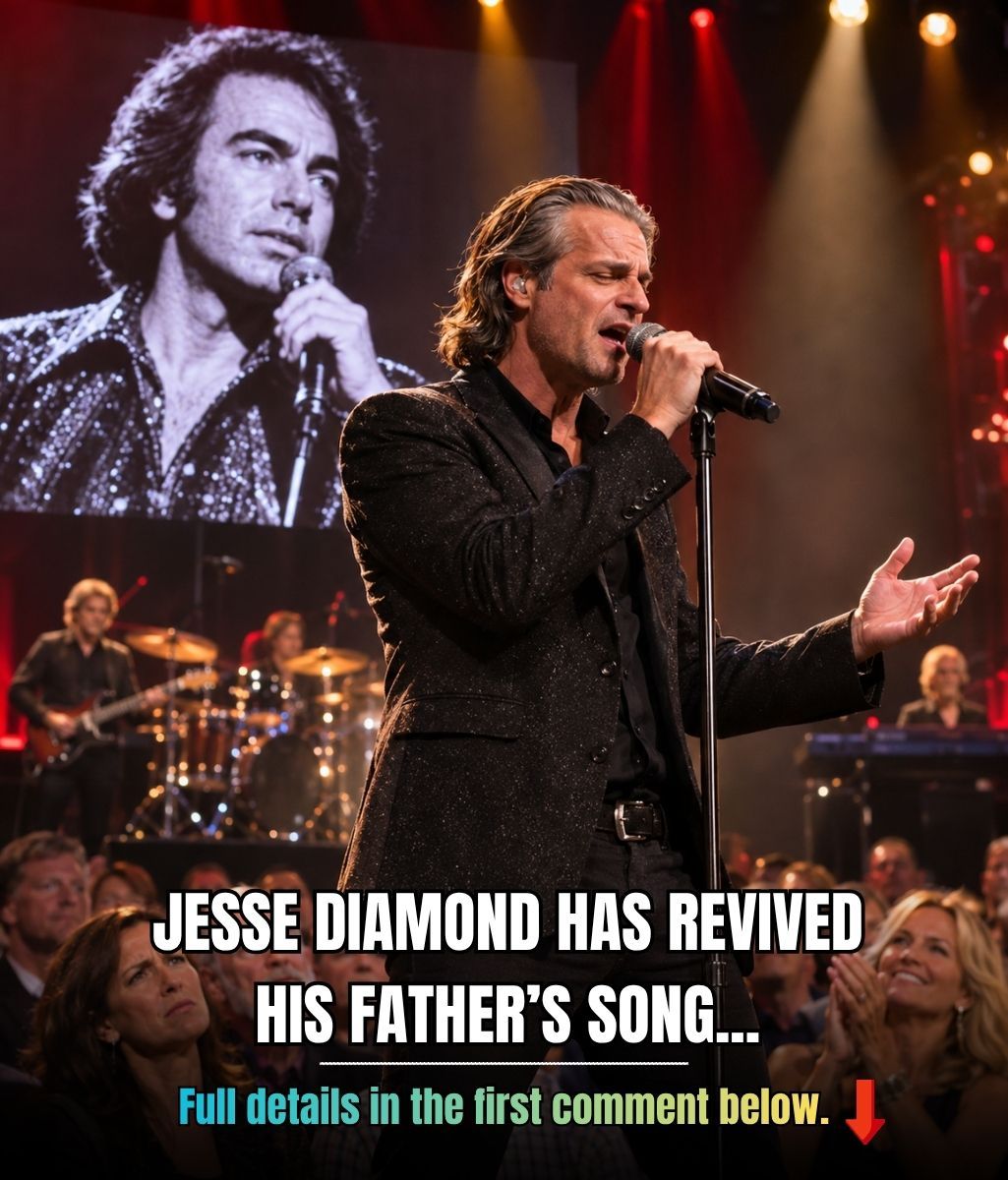
Imagine the atmosphere as Jesse steps onto a stage with a song connected to his father’s musical history. For longtime Neil Diamond admirers, the moment would carry an additional emotional meaning. They would not simply be listening to another performer interpreting a familiar composition. They would be hearing a younger generation reconnect with a musical heritage that has influenced millions.
A father’s song can become a completely different experience when it is performed by his own child.
The audience might remember where they first heard the original recording. Some could recall listening to it on the radio decades earlier, while others might remember the conversations and controversies surrounding its release.
Younger listeners, meanwhile, could discover the composition for the first time, experiencing its lyrics and musical arrangements without the historical context that shaped its original reception.
This difference in perspective is particularly interesting when a song carries a controversial reputation.
Music has always reflected the cultural atmosphere of its time. Ideas considered acceptable in one generation may become subjects of debate in another. Songs that once attracted criticism can later be appreciated as historical expressions of an artist’s creativity.
And that raises an important question: Should a controversial song be preserved exactly as it was originally created, or should a new generation reinterpret it?
For a performer revisiting a father’s work, the decision can be especially complicated.
There is the responsibility of respecting the original composition, but there is also the desire to establish an individual artistic identity. Reproducing every detail might satisfy longtime fans, while introducing a different interpretation could surprise listeners who have cherished the original for decades.
The challenge is not simply singing the song. It is deciding what that song should mean to a new generation.
Neil Diamond’s musical legacy provides plenty of material for such conversations.
His songwriting covered a remarkable range of emotions and subjects. Some compositions became international celebrations, while others explored loneliness, uncertainty, complicated relationships, and the less comfortable aspects of human experience.
His ability to move between these different musical worlds was one of the reasons his catalogue remained so distinctive.
For Jesse, the idea of continuing that legacy carries a special significance. Being the child of a celebrated musician means growing up with a connection to work that millions of people already consider part of their own personal histories.
But a family name does not automatically create an artistic identity.
Every new performer must find a way to connect with an audience through individual expression, musical understanding, and authenticity.
And perhaps that is what makes the idea of a younger Diamond performing his father’s work so compelling.
The emotional connection is already there, but the performance itself must stand on its own.
If audiences respond differently, that does not necessarily mean the music has lost its meaning. Sometimes, different generations simply hear the same composition through different experiences.
One listener may appreciate the nostalgia. Another may question the original message. A third may admire the courage of revisiting a recording that once attracted criticism.
That is the extraordinary ability of music to encourage conversation long after its original release.
However, the specific claim that Jesse Diamond recently performed a Neil Diamond song that was officially banned has not been established by reliable evidence. Nor is there sufficient documentation to identify the song or confirm that such a performance divided audiences as described.
It is important not to turn an intriguing headline into an unverified historical event.
What remains worth exploring is the larger question of how musical legacies evolve.
Neil Diamond spent decades creating songs that became deeply connected to the lives of his listeners. His music was never simply background entertainment. It became part of family memories, personal celebrations, and moments that people would remember long after the recordings ended.
The greatest tribute a new generation can give an artist is not merely to repeat the past, but to understand why the music mattered in the first place.
Perhaps that is the real power of a family musical legacy.
A song begins with one person’s imagination, travels through the world, and eventually finds meaning in the lives of people the songwriter may never meet.
Years later, another generation can rediscover that same melody and give it a new voice.
And whether listeners agree about every interpretation or not, the music continues to create something valuable: a connection between the past and the present.
Neil Diamond gave the world the songs. The next generation has the opportunity to keep their stories alive.