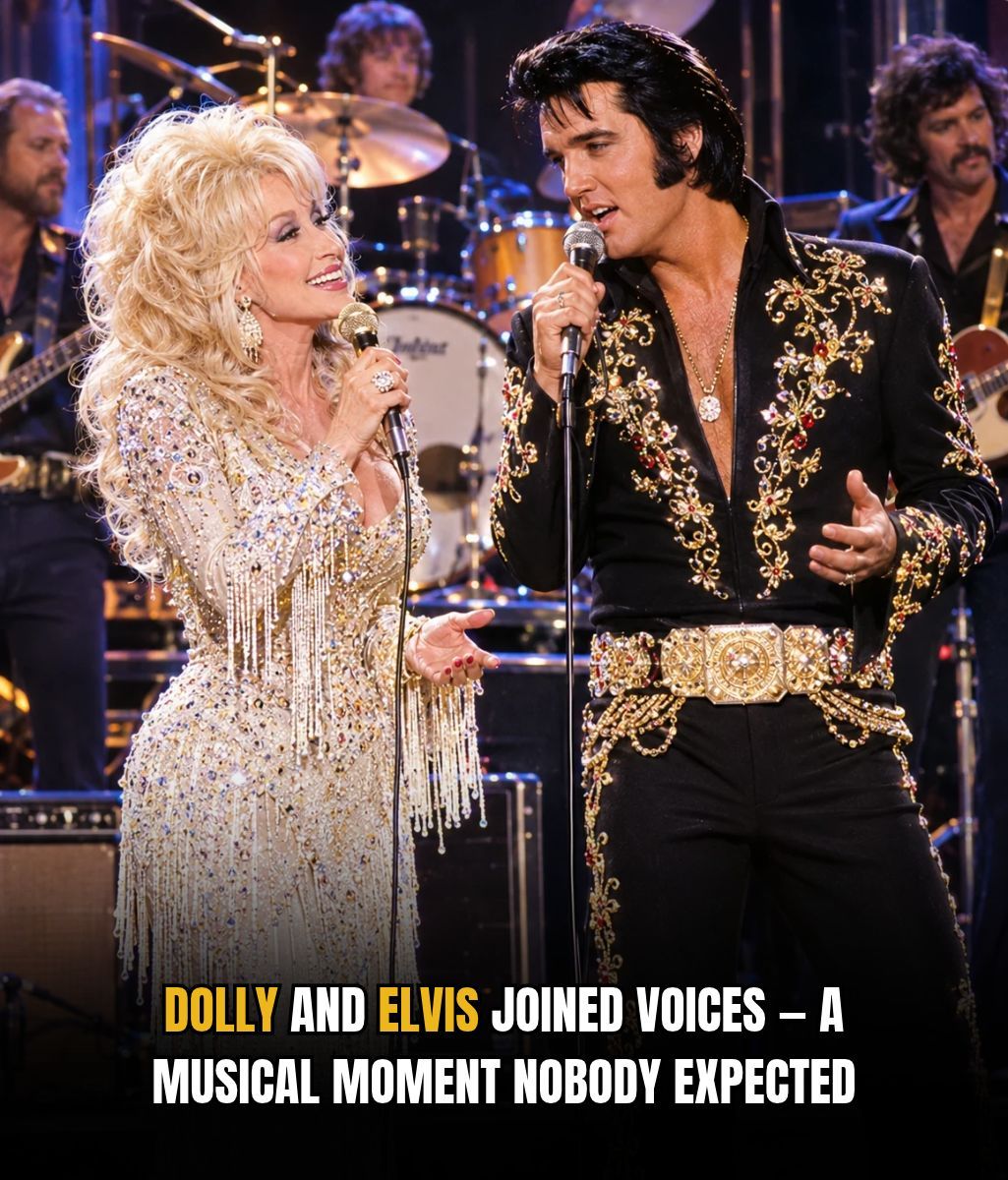
There are musical pairings that audiences dream about for years, imagining what might have happened if two extraordinary voices had shared the same stage. Few possibilities inspire as much fascination as Dolly Parton and Elvis Presley. She became one of country music’s most beloved storytellers, with a voice capable of moving effortlessly from tenderness to joy. He became the King of Rock and Roll, a performer whose presence transformed popular music and captivated audiences across generations. They belonged to different musical worlds in some ways, yet both possessed something rare: the ability to make millions of people feel personally connected to a song. Imagine the emotion of hearing their voices together. It is a beautiful possibility, even though the famous duet fans sometimes imagine never became a documented recording.
Their real musical connection is every bit as interesting as the imagined one. In the early 1970s, Elvis became interested in recording Dolly’s composition “I Will Always Love You.” The song had already become an important part of Dolly’s career after she released it in 1974 as a farewell to her professional partnership with Porter Wagoner. It was not simply another love song. It carried gratitude, sadness, respect, and the difficult understanding that sometimes people must follow separate paths. Dolly had written something deeply personal, and Elvis reportedly recognized the emotional power within its melody and words.
For Dolly, the possibility of Elvis recording her song was an extraordinary honor. She admired him, and the thought of hearing one of the greatest voices in popular music interpret her composition filled her with excitement. But the opportunity came with a difficult business condition. Elvis’s manager, Colonel Tom Parker, reportedly wanted half of the publishing rights. Dolly understood the importance of protecting the ownership of her songwriting, and she ultimately decided that she could not agree to the arrangement. It was a painful decision, especially because she had dreamed of hearing Elvis sing the song. She later recalled that she cried after learning the recording would not happen.
The story reveals a great deal about Dolly’s determination. She could have accepted the arrangement simply to become part of Elvis Presley’s recording history. Instead, she protected something she had created with her own imagination, experience, and hard work. Her decision demonstrated that admiration for another artist did not mean surrendering her identity as a songwriter. She could respect the King while remaining true to herself. In the years that followed, “I Will Always Love You” became one of the most successful and recognizable songs in the world, eventually reaching an entirely new generation through Whitney Houston’s celebrated interpretation.
Elvis, meanwhile, had already established his own extraordinary place in music history. His recordings combined rock and roll, gospel, country, rhythm and blues, and other musical influences into a sound that changed the direction of popular entertainment. Songs such as “Can’t Help Falling in Love,” “Suspicious Minds,” and “In the Ghetto” revealed different sides of his artistry. Behind the famous stage presence was a singer who understood the importance of emotional delivery. He could make a song feel intimate even when performing before thousands of people. That quality is one reason Dolly’s admiration for him has remained such an interesting part of her own story.
Dolly also recorded “In the Ghetto,” the powerful Mac Davis composition that Elvis had made famous in 1969. Her interpretation offered another perspective on a song about poverty, hardship, and the painful cycle of circumstances that can shape a young person’s future. It was not a duet, and there is no reliable evidence that the two performed it together. Nevertheless, the fact that both artists recorded the same composition creates a meaningful connection between their musical worlds. Each brought a distinctive voice and interpretation to a story that deserved to be heard.
Decades later, Dolly found another way to revisit the story of Elvis and the song he never recorded. On her 2023 album Rockstar, she included “I Dreamed About Elvis,” a song inspired by the unrealized possibility of his recording “I Will Always Love You.” It was a heartfelt acknowledgment of an opportunity that had slipped away, but also a reminder that musical history is sometimes shaped by the recordings that never happen. The song allowed Dolly to look back with affection, humor, and a touch of wistfulness at a moment that had stayed with her for years.
Perhaps this is why fans continue to imagine what a meeting between Dolly Parton and Elvis Presley might have sounded like. Her warm country voice and his expressive rock-and-roll delivery could have created an extraordinary contrast. One can picture the quiet opening of a ballad, the audience recognizing the two unmistakable voices, and the final notes lingering long after the performance ended. But that imagined scene should not be confused with an actual historical duet. Their real connection is found in the songs they admired, the music they shared indirectly, and the mutual influence of two artists who helped shape American popular music.
Elvis and Dolly never needed to stand together beneath the same spotlight to leave a lasting musical connection. His interest in her songwriting, her admiration for his artistry, and the songs that linked their careers have given fans a story worth remembering. One was the King of Rock and Roll; the other became one of country music’s most enduring voices. Their paths crossed through music, even without the duet many listeners wish they could have heard. And perhaps that is the most beautiful part of the story: some musical moments never happen in a recording studio, yet the possibility of them continues to live in the hearts of those who love the songs.