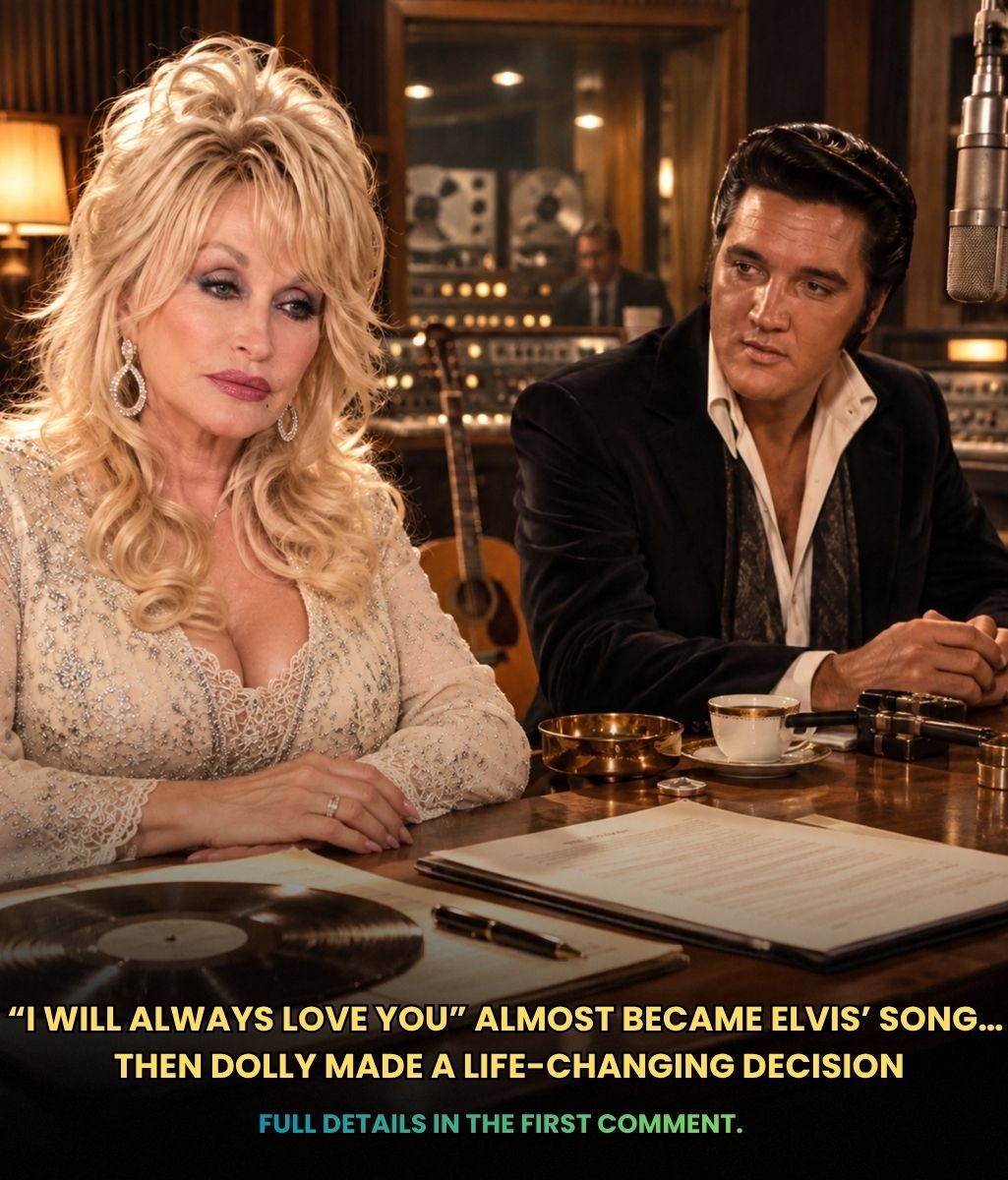
For a young songwriter in the 1970s, hearing that Elvis Presley wanted to record one of your songs could feel like the opportunity of a lifetime. That was the extraordinary position Dolly Parton found herself in after “I Will Always Love You” began attracting attention. Dolly had written the deeply personal farewell as she prepared to leave her professional partnership with Porter Wagoner, never imagining that the King of Rock and Roll might someday want to make it his own. According to Dolly’s later accounts, Elvis loved the song and planned to record it. She was overwhelmed by the possibility. Hearing Elvis sing words she had written would have been an unforgettable milestone. But just before the recording was expected to happen, Dolly learned there was a condition attached—one serious enough to force her into one of the hardest decisions of her career.
The condition involved publishing rights. Dolly has explained that Elvis’s manager, Colonel Tom Parker, expected songwriters to give up a substantial share of their publishing when Elvis recorded their material. For Dolly, this was not simply a technical detail buried inside a contract. Publishing represented ownership of her work and control over something she had created from her own experiences. She wanted Elvis to record the song so badly that she later recalled being deeply upset when the deal fell apart. Still, she refused to surrender the publishing rights required to make it happen. It was an extraordinary decision for a relatively young songwriter facing one of the biggest names in entertainment. She was effectively choosing ownership of her song over the prestige of having Elvis Presley record it.
The decision hurt precisely because Dolly admired Elvis. She was not rejecting him as a performer, nor was she suggesting he could not do justice to the song. Quite the opposite: part of the heartbreak came from imagining what Elvis might have done with it. Dolly later spoke emotionally about the lost opportunity. She also recounted that Priscilla Presley eventually told her Elvis had sung “I Will Always Love You” to her around the time of their separation. Whether heard on a record or in a private moment, the idea that the song had touched Elvis gave the story another layer of poignancy. Dolly had protected the business future of her composition, but the recording she dreamed of hearing would never exist.
Years later, history gave that difficult decision an astonishing second chapter. In 1992, Whitney Houston recorded “I Will Always Love You” for The Bodyguard, transforming Dolly’s country composition into a worldwide phenomenon. Whitney’s soaring interpretation introduced the song to millions of listeners who may never have heard Dolly’s original recording, while Dolly remained the songwriter and retained the benefits associated with protecting her publishing. Suddenly, a painful decision made decades earlier looked remarkably farsighted. The song Dolly had refused to surrender became one of the most valuable and recognizable compositions of her career.
Yet the story is more meaningful than a simple lesson about money. Dolly’s choice demonstrated something she understood early: artists must sometimes protect their work even when saying yes would be easier, more glamorous, and immediately rewarding. Imagine being told that Elvis Presley—the most famous singer in America—wanted your song, only to discover that accepting the opportunity meant giving away part of the ownership you had worked so hard to establish. Many young songwriters might have accepted without hesitation. Dolly did not. She understood that fame surrounding a recording could disappear, while ownership of a great song might matter for the rest of her life.
There is also a fascinating “what if” hidden inside the story. What would Elvis’s version have sounded like? Would he have delivered the song quietly and tenderly, or built it into one of the dramatic ballads associated with his later performances? Would his recording have become the version generations remembered? No one can know. That unanswered question has helped make the story one of country music’s most enduring pieces of behind-the-scenes history. Dolly herself could appreciate the enormous success the song eventually achieved while still regretting that she never heard Elvis officially record it. Making the right decision does not always mean losing all sadness about the alternative.
For older listeners, there is something particularly relatable about that contradiction. Most people eventually encounter a moment when they must choose between what they desperately want today and what they believe will matter tomorrow. Sometimes the correct decision feels terrible when it is made. Only years later does its importance become clear. Dolly could not have known exactly what the future held for “I Will Always Love You.” She could not have predicted Whitney Houston’s recording or the song’s extraordinary life across generations. All she knew was that she had written something meaningful and believed she should retain ownership of it.
And that is why the story still resonates decades later. Dolly Parton almost had an Elvis Presley recording of “I Will Always Love You,” but she was unwilling to purchase that dream by surrendering a substantial piece of her song. The studio performance never happened, leaving music fans forever wondering what might have been. Yet the decision helped protect a composition that would travel farther than almost anyone could have imagined. Sometimes the defining moment in an artist’s career is not the opportunity they accept, but the opportunity they have the courage to turn down. Dolly lost the chance to hear Elvis sing her classic—but by saying no, she protected a song that would ultimately become part of music history.