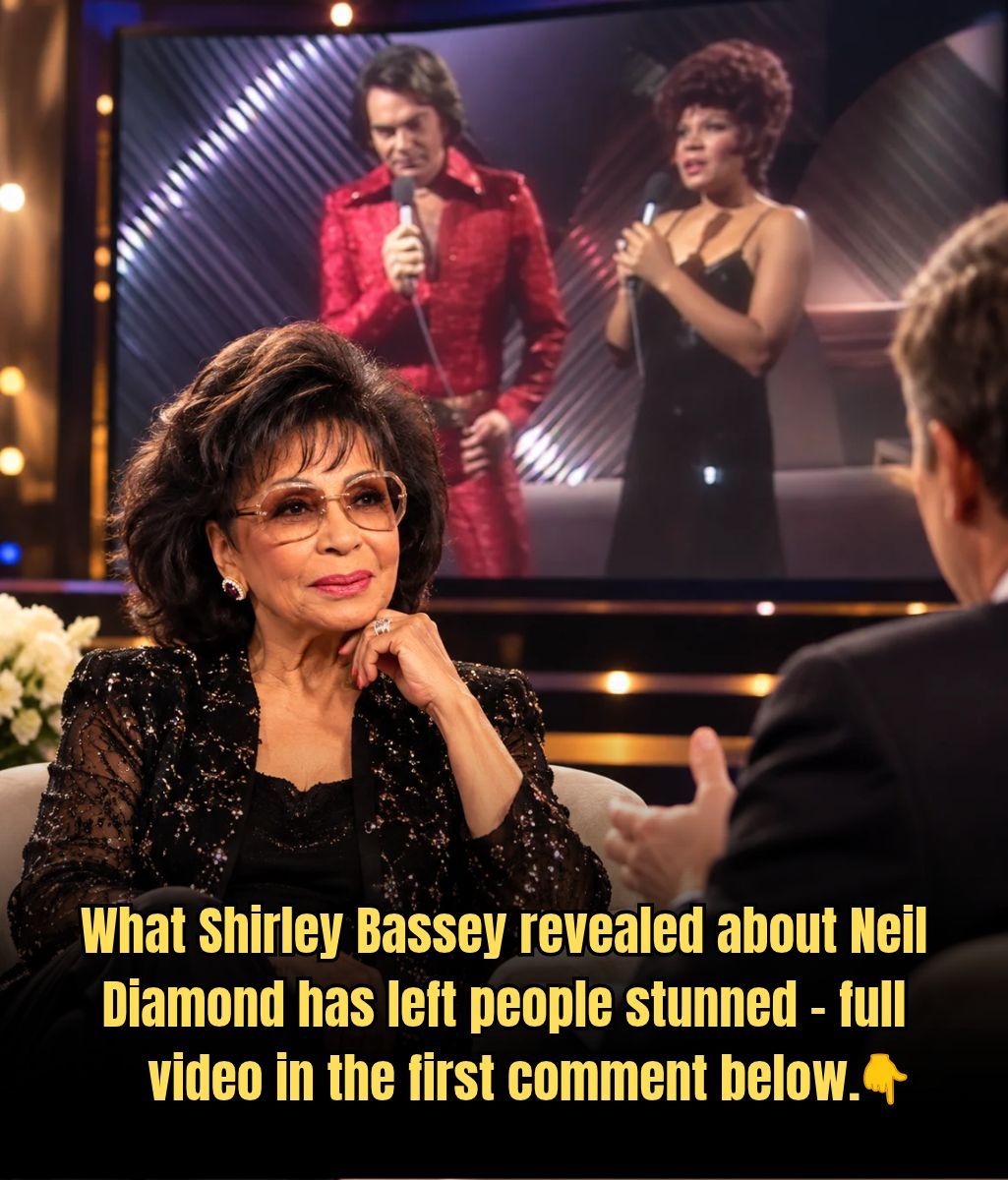
Some voices do more than entertain. They become part of our lives, accompanying us through moments of joy, heartbreak, hope, and reflection. Long after the music stops playing, those voices remain in our memories, carrying us back to a time when a particular song seemed to understand everything we were feeling. Shirley Bassey and Neil Diamond are two extraordinary artists whose music has touched generations, each leaving a distinctive mark on the history of popular entertainment.
Now imagine the curiosity surrounding a story suggesting that Bassey, at 89, has finally spoken candidly about Diamond, revealing something unexpected about the legendary singer. For longtime music lovers, the possibility alone is enough to awaken memories of cherished recordings, unforgettable performances, and an era when great voices could turn a simple melody into an experience that lasted a lifetime.
But what might such a revelation mean? And why would a story connecting these two celebrated performers capture the attention of music fans across generations?
Before drawing conclusions, it is important to distinguish an intriguing headline from a verified account. There is no confirmed evidence accompanying this claim that Shirley Bassey has made a new revelation about Neil Diamond. Without a reliable interview or firsthand statement, the details should not be presented as an established event. Nevertheless, the musical journeys of these two remarkable artists offer a fascinating opportunity to reflect on their achievements, their enduring influence, and the personal connections audiences have formed with their work.
SHIRLEY BASSEY: THE VOICE THAT COULD FILL AN ENTIRE ROOM
Long before her name became synonymous with dramatic performances and unforgettable theme songs, Shirley Bassey was a young Welsh singer with a remarkable voice and an unmistakable presence.
Born in Cardiff, Wales, on January 8, 1937, Bassey rose from modest beginnings to become one of Britain’s most celebrated entertainers. Her powerful delivery, commanding stage presence, and ability to communicate emotion through a single phrase helped establish her as an international star.
She did not simply sing a song. She inhabited it.
Whether delivering a dramatic ballad or a lively orchestral arrangement, Bassey possessed a rare ability to make audiences feel that every word mattered. Her performances combined strength with vulnerability, allowing listeners to hear both the confidence of an accomplished performer and the emotion beneath the surface.
Her association with the James Bond films brought her international recognition on an extraordinary scale. “Goldfinger,” released in 1964, became one of the defining recordings of her career, its bold brass arrangements and unforgettable vocal performance capturing the glamour and drama of the cinematic world.
She later recorded “Diamonds Are Forever” and “Moonraker,” further cementing her connection to one of the most recognizable film franchises in history.
Yet Bassey’s achievements extend far beyond those famous recordings. Her career represents decades of dedication, reinvention, and an unwavering commitment to performance. She became an artist whose name could command attention across countries and generations.
For audiences who grew up listening to her records, her voice remains inseparable from memories of elegant television performances, beautifully arranged orchestras, and a time when a singer’s stage presence could transform an entire evening.
NEIL DIAMOND: THE SONGWRITER WHO GAVE MILLIONS A VOICE
Neil Diamond followed a different path to musical greatness, but his influence has been equally remarkable.
Born in Brooklyn, New York, on January 24, 1941, Diamond developed into one of America’s most successful singer-songwriters. His work crossed the boundaries between pop, rock, adult contemporary music, and the traditions of American popular songwriting.
His greatest strength was his ability to take deeply personal emotions and express them through songs that felt universal.
“Sweet Caroline” became an enduring anthem, bringing people together in stadiums, concert halls, and family gatherings. Its familiar opening and uplifting chorus transformed it into a musical tradition that continues to unite audiences.
Then there was “Song Sung Blue,” a gentle reminder that music can help people navigate sadness and find comfort in shared experiences.
With “Cracklin’ Rosie,” “America,” “I Am… I Said,” and “Hello Again,” Diamond demonstrated the breadth of his songwriting and the emotional range of his performances.
Perhaps no song better illustrates his gift for emotional storytelling than “Love on the Rocks.” Its reflective tone and memorable melody capture the disappointment that can accompany relationships and the difficult process of accepting life’s uncertainties.
Diamond understood something fundamental about songwriting: people do not need an artist to explain every feeling. Sometimes, they simply need a melody that gives those feelings a place to live.
That is why his music has remained meaningful to listeners who first discovered it decades ago. A song heard in youth can acquire an entirely different meaning with age. The words remain unchanged, but the person listening has lived, lost, learned, and changed.
Neil Diamond’s music has accompanied millions through that process.
WHAT CONNECTS TWO VERY DIFFERENT MUSICAL LEGENDS?
At first glance, Shirley Bassey and Neil Diamond might seem to belong to different musical worlds.
Bassey became famous for her commanding interpretations, dramatic arrangements, and extraordinary stage presence. Diamond built his reputation through songwriting, memorable melodies, and performances that combined rock energy with deeply personal storytelling.
Yet their careers share an important foundation: both understood that a great performance must create an emotional connection with its audience.
Technical ability matters. So do discipline, timing, and musical knowledge. But the performances that endure often possess something more difficult to define.
They make people feel understood.
Bassey’s voice could communicate determination, longing, and triumph with extraordinary intensity. Diamond’s songs could evoke nostalgia, vulnerability, celebration, and the bittersweet realization that life rarely unfolds according to plan.
Neither artist needed to follow every passing trend to remain relevant. Instead, they built lasting relationships with audiences through recordings that continued to find new listeners long after their original release.
For older fans, these songs can feel like old photographs. A melody brings back a familiar street, a long drive, a family celebration, or a person whose memory remains close to the heart.
For younger listeners, the same recordings offer a window into a musical tradition built around distinctive voices, carefully crafted arrangements, and songs designed to endure.
That shared emotional foundation helps explain why stories connecting two celebrated artists can generate such interest.
THE QUESTION FANS WOULD LOVE TO HAVE ANSWERED
If Shirley Bassey were to discuss Neil Diamond in a revealing interview, longtime listeners would naturally want to hear her perspective on his songwriting, his performances, and the extraordinary influence of his music.
Did she admire a particular recording? Was there a song that left a lasting impression on her? Did their professional paths ever cross in a way that produced a memorable story?
These are interesting questions, but they remain questions unless supported by a credible account.
There is a meaningful difference between imagining what two legendary performers might have discussed and reporting that one has made a surprising confession about the other.
A compelling music story does not need an invented revelation to be worth telling. Sometimes, the documented history of an artist’s career provides more than enough drama, beauty, and human interest.
Bassey’s journey offers stories of determination, international recognition, and a lifetime spent mastering the art of performance. Diamond’s career reveals the extraordinary reach of songwriting that speaks to ordinary human experiences.
Their achievements stand on their own, without the need to manufacture a private conversation or suggest that either artist has disclosed a secret.
For fans who value these musical legends, that distinction protects the very thing that makes their stories meaningful: the truth behind the music.
WHY THESE SONGS STILL MATTER AFTER ALL THESE YEARS
Music possesses a remarkable ability to outlive the circumstances in which it was created.
A recording made decades ago can suddenly sound as if it were written for the present moment. A familiar chorus can restore the feeling of being young, while a once-lighthearted melody can take on new depth after years of experience.
For Shirley Bassey, the power lies in a voice that remains unmistakable. Her most celebrated recordings continue to demonstrate how a gifted performer can transform a song into something grand, dramatic, and deeply personal.
For Neil Diamond, the connection often begins with the stories themselves. His songs recognize the complicated mixture of hope and disappointment that defines much of human life.
Together, their legacies remind us that musical greatness takes many forms. Some artists become unforgettable through the sheer force of their voices. Others leave their mark by writing words and melodies that seem to belong to everyone who hears them.
The greatest performers often achieve both in their own distinctive ways.
And perhaps that is the real reason audiences continue to care about their lives and careers. Fans are not merely interested in famous names. They are interested in the memories those names represent.
A Shirley Bassey recording may recall an elegant evening from years ago. A Neil Diamond song may bring back a family gathering where everyone knew the words. The music becomes a bridge between the people we once were and the people we have become.
That connection is far more enduring than any unverified rumor.
A LEGACY THAT NEEDS NO SECRET REVELATION
At 89, Shirley Bassey represents a remarkable chapter in the history of international entertainment. Neil Diamond, whose songs have reached audiences around the world, represents another.
Their individual journeys demonstrate how music can cross generations without losing its emotional power. Their voices and recordings remain part of a cultural memory shared by people who may otherwise have very different experiences of the world.
The suggestion that Bassey has finally revealed something unexpected about Diamond may attract attention, but no such revelation should be treated as fact without reliable evidence.
What can be celebrated with confidence is the extraordinary music both artists have given their audiences.
Their recordings remind us of the importance of craftsmanship, perseverance, and the courage to express emotions honestly. They remind us that songs can become companions, returning to us when words alone are not enough.
And they remind us that the greatest musical legacies are not built on mystery. They are built on moments that listeners never forget.
Long after the applause fades and the concert lights go dark, a great song can still find its way back into the heart.
For generations of music lovers, that is the lasting gift of Shirley Bassey and Neil Diamond: two distinctive artistic journeys, two remarkable contributions to popular music, and a collection of songs that continue to make the past feel wonderfully close.