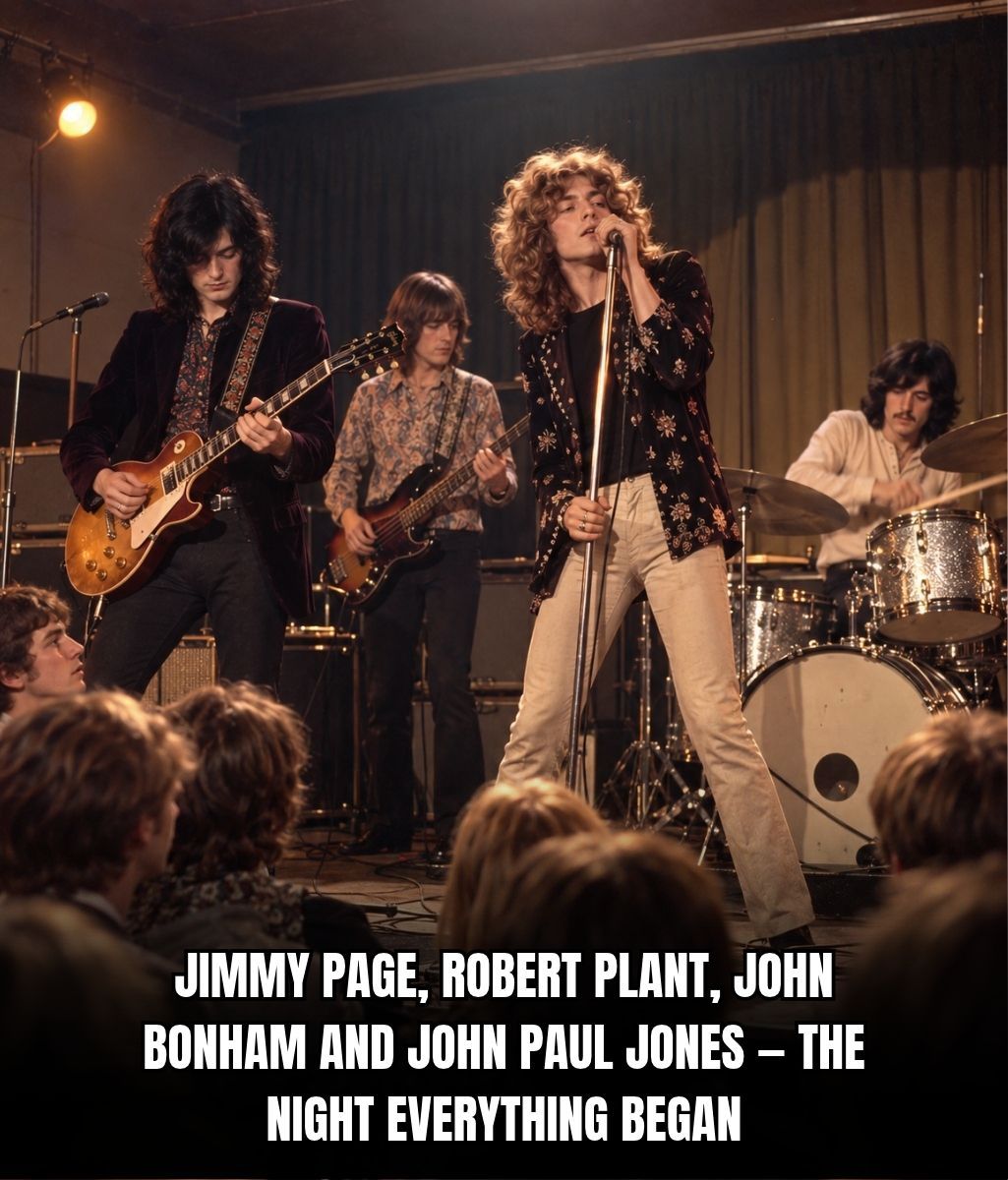
On the evening of September 7, 1968, four musicians stepped onto a modest stage at a school in Gladsaxe, Denmark. There were no enormous screens, no roaring stadium crowds, and no indication that the group would one day become one of the most influential rock bands in history. Jimmy Page, Robert Plant, John Paul Jones, and John Bonham were still finding their way together. They were introduced as The New Yardbirds, a name that connected them to the past even as their music began pointing toward an entirely different future. <Cite refs={[“turn903437search1″,”turn903437search3”]}/>
The venue was Gladsaxe Teen Club, a youth music gathering held at Egegård School near Copenhagen. It was a far cry from the legendary arenas that Led Zeppelin would later fill. Young people had come for an evening of live music and dancing, expecting a familiar name: The Yardbirds. But the group they encountered was a new formation, assembled after the original band had fallen apart. Only Jimmy Page remained from the previous lineup. The other three musicians were new faces—and together, they were about to begin a remarkable journey.
Jimmy Page had been determined to continue. After the Yardbirds disbanded, he set out to build a new group capable of carrying forward his musical ambitions. He found Robert Plant, whose powerful voice and instinctive blues feeling gave the music a new dimension. John Paul Jones, an accomplished musician and arranger, brought depth and precision to the bass and keyboards. John Bonham, known to his friends as Bonzo, possessed a thunderous drumming style that would become one of the band’s defining sounds. Each brought something different, and the combination was unlike anything Page had experienced before.
Yet their first performance came with very little preparation. The musicians had rehearsed together only a few times, and Page later recalled that they had spent roughly fifteen hours practicing before their first show. They were still learning how to communicate musically, how to build arrangements around one another, and how to turn four individual talents into a unified force. The uncertainty was real. But so was the excitement. They were stepping onto the stage before they could fully know what they had created. <Cite refs={[“turn903437search0″,”turn903437search1”]}/>
The setlist already hinted at the direction their sound would take. Songs such as “Train Kept A-Rollin’,” “I Can’t Quit You Baby,” “Dazed and Confused,” and “You Shook Me” carried the raw energy of blues and rock. Page’s guitar could be sharp and hypnotic; Plant’s voice could rise with an almost untamed intensity; Jones provided a strong musical foundation; and Bonham’s drums gave the performance a physical force. The group was not yet known by the name that would become famous, but the essential ingredients were already present. <Cite refs={[“turn903437search0″,”turn903437search8”]}/>
The audience’s reaction was not the kind of overwhelming celebration that might be imagined today. This was a local youth club, and the musicians were still unfamiliar to many of those in attendance. Yet a contemporary review in the club’s magazine praised the group’s performance, describing the music as impressive and singling out Page’s guitar work. The review suggested that the new lineup had succeeded in meeting the challenge of replacing the old Yardbirds. The first signs of something extraordinary were already there—but they were still being witnessed by an ordinary crowd on an ordinary evening. <Cite refs={[“turn903437search0″,”turn903437search3”]}/>
For the four musicians, the show was more than an obligation left behind by the Yardbirds. It was a test. They had to discover whether the chemistry they sensed in rehearsal could survive in front of an audience. Peter Grant, their manager, later remembered the excitement of watching them perform. Jimmy Page would also reflect on the uncertainty of that first concert, describing it as an experimental performance to see whether the new group could work. The answer, as history would reveal, was yes. The chemistry was there, even before the world had a name for it. <Cite refs={[“turn903437search0″,”turn903437search8”]}/>
Soon afterward, The New Yardbirds changed their name to Led Zeppelin. The new name would become synonymous with a powerful blend of hard rock, blues, folk influences, and adventurous musicianship. Their early concerts helped shape a sound that was heavier and more expansive than the music they had inherited from the Yardbirds. The band’s rise would not happen overnight, but the first performance in Denmark became a meaningful beginning—a moment when four musicians, still learning one another, began building something that would outlast them all.
Today, photographs from that evening preserve a glimpse of the band before the mythology fully formed. Robert Plant at the microphone, Jimmy Page with his guitar, John Paul Jones holding the musical center, and John Bonham behind the drums: four young men in a school hall, surrounded by an audience that could not yet know how important the night would become. The modest setting makes the story even more remarkable. Rock history did not begin beneath stadium lights. It began in a school gymnasium, with a new band taking its first uncertain steps.
And that is what makes the first Led Zeppelin performance so unforgettable. The world would eventually know their music through towering riffs, unforgettable recordings, and performances that seemed to push the limits of rock and roll. But every legend has a beginning, and theirs was not polished or grand. It was human—four musicians with extraordinary talent, a short time to prepare, and the courage to step onto a stage together. On that September evening in Denmark, the future was still unknown. Yet the first notes had already begun to change the story of rock music. The legend of Led Zeppelin was not born fully formed. It began with one performance, one small stage, and four musicians who dared to begin.