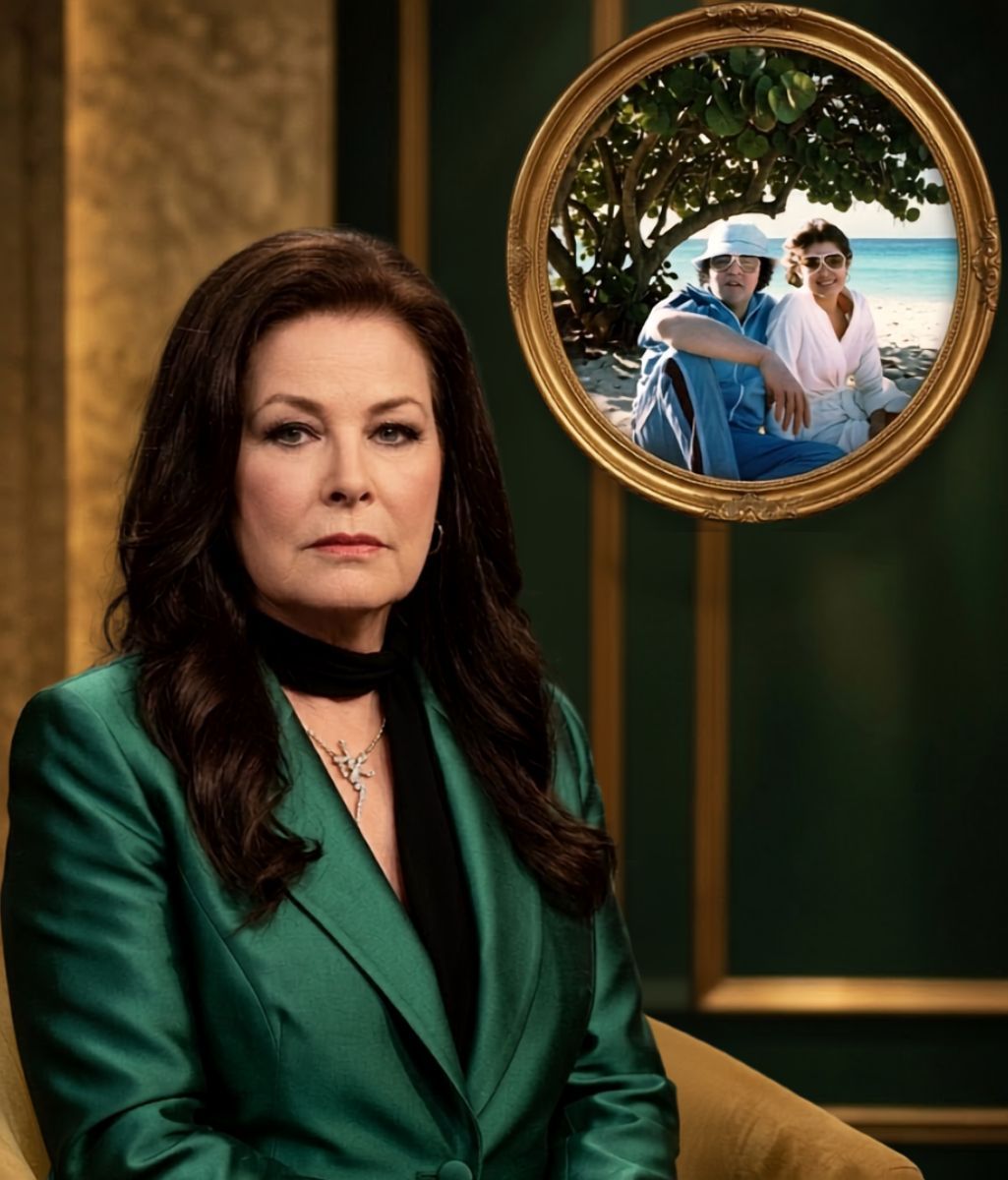
At 69 years old, Ginger Alden remains one of the few people who can speak about the final chapter of Elvis Presley’s life from firsthand experience. She was not simply a name connected to the King of Rock ’n’ Roll. She became his fiancée, his companion during the final months of his life, and the person who was with him during the devastating final moments of August 1977. Nearly five decades later, her memories continue to attract attention because they offer a deeply personal perspective on a period of Elvis’s life that remains surrounded by curiosity, speculation, and unanswered questions. Alden later documented her experiences in her memoir Elvis and Ginger, explaining that she had carried her memories for decades before deciding to tell her own side of the story.
The story of how Elvis and Ginger first became acquainted is surprisingly ordinary at first. In November 1976, Elvis invited Ginger’s sister Terry, who had recently won the Miss Tennessee title, to visit him at Graceland. Ginger came along with her sisters, and according to accounts of that meeting, Elvis quickly became interested in getting to know Ginger better. What followed was an unexpectedly rapid relationship. Within only a few months, Elvis had proposed marriage, making Ginger the last woman to whom he became engaged before his death. But the question that has remained for decades is why Ginger? Why did Elvis, after years of complicated relationships and an extraordinary amount of public attention, become so drawn to this young woman he had only recently met? There is no single verified explanation that can completely answer that question, and it would be misleading to pretend that one dramatic secret explains everything. What Ginger’s own recollections do suggest, however, is that Elvis saw something in her that made him feel comfortable enough to bring her into his private world. Their relationship developed quickly, and soon she was accompanying him on trips, spending time at Graceland, and becoming part of the small circle surrounding him during the final months of his life.
Ginger’s memoir presents Elvis as a far more complicated person than the public image suggested. She remembered a man who could be generous, affectionate, protective, thoughtful, and deeply devoted to the people he trusted, while also being a person shaped by the extraordinary pressures of fame. Her account was not simply an attempt to repeat stories fans had already heard. It was her effort to offer her own perspective and separate her memories from the rumors and speculation that had surrounded Elvis’s final year. That distinction is important. By the time Ginger entered Elvis’s life, he was already a worldwide icon. His name had become larger than almost any individual person could reasonably manage. Everywhere he went, people recognized him. His performances attracted enormous crowds. His private life was constantly discussed. Yet Ginger’s memories describe a man who could also be surprisingly personal and private away from the stage.
Perhaps that was one of the reasons their connection developed so quickly. Elvis did not need another person who only saw the King. He needed people who could see Elvis. That difference may help explain why Ginger became such an important part of his final chapter. She was entering a private environment where the rules were very different from those of the public world. She had to learn quickly that the man admired by millions could also be complicated, demanding, emotional, and deeply protective of his personal space. Their relationship moved at an extraordinary pace. Within roughly two months of dating, Elvis proposed, according to biographical accounts. He gave Ginger an engagement ring and began making plans for their future together. A wedding was reportedly planned for December 1977, but Elvis died on August 16, 1977, before that future could become reality.
For Ginger, the sudden end was devastating. She went from preparing for a future with one of the most famous men in the world to confronting a loss that would permanently change her life. She was also thrust into an unimaginable level of public attention. Reporters and mourners arrived at Graceland, while the world tried to understand what had happened to Elvis Presley. But Ginger was living through the loss from an entirely different perspective. She was not simply mourning a celebrity. She was mourning someone she loved and expected to marry. That distinction gives her memories an emotional weight that cannot be captured by headlines alone.
In the years that followed, Ginger largely kept her story private. She eventually chose to write Elvis and Ginger, published in 2014, after decades of carrying those memories. The memoir became a way for her to describe the relationship from her own perspective and preserve the version of Elvis she personally knew. What makes her story especially compelling is that it does not present Elvis as a perfect hero or a simple villain. Instead, it portrays a complicated human being. That is perhaps the most important point to remember when discussing his final relationship. Elvis was a legendary performer, but he was also a man with personal struggles, strong emotions, complicated relationships, and an intense need for trust.
Ginger’s presence during that period gave her a view of Elvis that most fans could never have experienced. She saw him away from the concert stage. She saw the person behind the famous name. She witnessed his private routines and his interactions with people around him. And she experienced the enormous contrast between the public Elvis and the private man. That may be the real reason her story continues to fascinate people nearly fifty years later. Fans often want a simple answer to the question of why Elvis chose Ginger. But real relationships rarely have a single explanation. Attraction, companionship, trust, timing, personality, and circumstance can all play a role. In Elvis’s case, his decision to become engaged to Ginger came during a particularly important period of his life, when he was looking toward the future while simultaneously carrying the enormous weight of his past.
Perhaps Ginger represented something he wanted at that moment: a new beginning. Not another chapter of his career. Not another performance. But the possibility of a private life beyond the stage. That possibility makes the story especially poignant because it never had the opportunity to fully unfold. Elvis died before the wedding could take place. He died before they could discover what their life together might have become. And Ginger was left carrying not only memories of the relationship but also the unanswered questions that naturally follow a life interrupted so suddenly.
Today, decades later, she has been willing to revisit those memories with a perspective shaped by time. Her reflections continue to offer an intimate glimpse into Elvis’s final months and the relationship they shared. That may ultimately be the most important part of her story. The question is not simply why Elvis began dating Ginger Alden. The deeper question is what he found in her during those final months that made him imagine a future with her. No headline can completely answer that. No photograph can explain it. And no amount of speculation can replace the memories of the people who were actually there.
What we do know is that their relationship began in late 1976, moved remarkably quickly, and ended tragically less than a year later. Ginger became Elvis’s fiancée, and her memoir later provided her personal account of those final months. At 69, Ginger Alden remains one of the surviving witnesses to that extraordinary final chapter. The world remembers Elvis Presley as the King of Rock ’n’ Roll. Ginger remembers the man behind the legend. And perhaps the most haunting truth is that Elvis’s decision to choose her was never really about fame, appearances, or a single mysterious reason. It was about two people meeting at a particular moment in time, forming a connection that moved faster than either could have imagined, and beginning a future that history would never allow them to finish. That unfinished future may be the most powerful part of their story — and the reason people are still asking questions nearly five decades later.