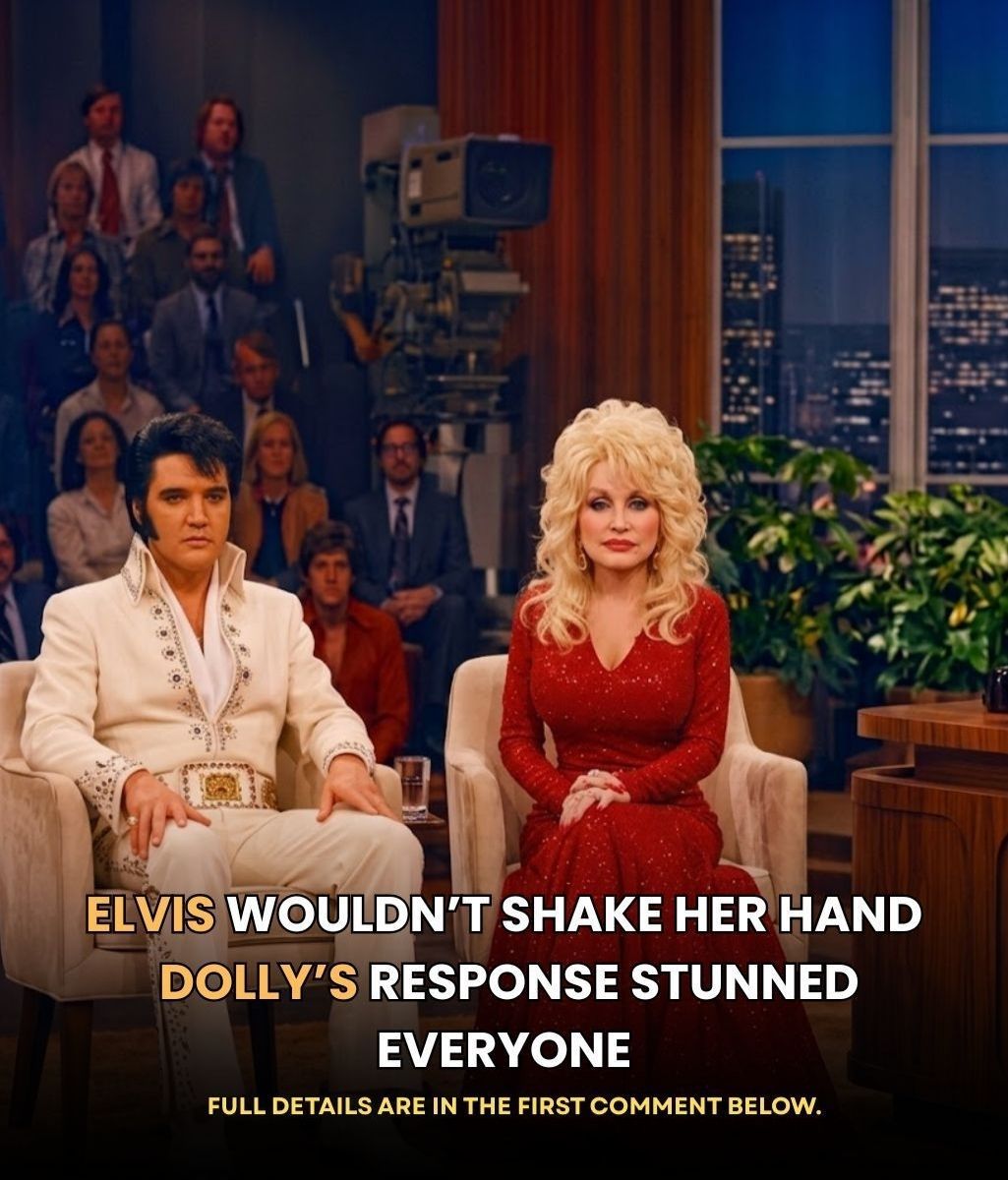
Some stories about music legends grow more dramatic with every retelling. A missed handshake becomes a public confrontation. A private disappointment becomes a mysterious feud. Before long, the world is left with a tale that sounds almost too extraordinary to be true.
But sometimes, the real story is more powerful than the rumor.
For years, fans have wondered what might have happened if Elvis Presley and Dolly Parton had finally stood together in a recording studio. Imagine the King of Rock and Roll singing one of country music’s most beloved ballads, his unmistakable voice bringing a new dimension to a song written by a young woman from the mountains of Tennessee.
It nearly happened.
Elvis wanted to record Dolly’s “I Will Always Love You.” Dolly was thrilled at the prospect. She had admired Elvis, respected his talent, and understood what it could mean for her song to be interpreted by one of the most famous performers in the world.
Then a business disagreement brought the dream to an end.
There was no verified television confrontation, no documented refusal to shake hands, and no confirmed dramatic exchange between the two stars. In fact, Dolly later explained that she and Elvis had never met face-to-face.
Instead, their almost-collaboration became one of the most fascinating stories in modern music history—a story about ambition, artistic independence, heartbreak, and the courage to protect something you have created.
And at its center was a decision Dolly Parton had to make when the opportunity of a lifetime suddenly came with a price.
THE SONG THAT OPENED THE DOOR TO ELVIS
In 1973, Dolly Parton was approaching a turning point in her career.
She had spent years working alongside country singer Porter Wagoner, building a reputation as a performer and songwriter. Their professional partnership had helped introduce her to a wide audience, but Dolly knew she needed to establish herself as an artist in her own right.
Leaving a successful partnership was not easy. It meant stepping away from the familiar and accepting the uncertainty of what might come next.
Dolly understood, however, that remaining in the same place would not allow her to fulfill her ambitions.
She wanted to write songs that reflected her own experiences, sing them in her own voice, and build a future on the strength of her creativity.
During this period, she wrote “I Will Always Love You,” a song expressing affection and gratitude while acknowledging that sometimes love requires saying goodbye.
The song was initially written for Porter Wagoner as Dolly prepared to leave their professional partnership. Rather than ending their relationship in anger, she chose to communicate her feelings through music.
The result was extraordinary.
The melody was gentle, but its emotional message was strong. The narrator recognizes that moving forward may be necessary, even when the person being left behind remains deeply important.
It was not a song about hatred or revenge. It was a farewell offered with tenderness.
That emotional honesty helped make the song a country hit. It would eventually become one of Dolly’s signature compositions and one of the most recognizable ballads in popular music.
But before Whitney Houston transformed it into an international phenomenon in the 1990s, another legendary singer had expressed interest in recording it.
His name was Elvis Presley.
WHEN DOLLY HEARD THAT ELVIS WANTED HER SONG
For a songwriter, having Elvis Presley request a song was an extraordinary honor.
By 1974, Elvis was already a towering figure in American music. His recordings had changed popular culture, his performances had influenced generations of singers, and his name carried enormous commercial weight.
For Dolly, the possibility of hearing Elvis sing her composition seemed almost unbelievable.
She later recalled how excited she had been when she learned he wanted to record “I Will Always Love You.” She had even been invited to attend the recording session.
It was the kind of opportunity songwriters dream about.
A recording by Elvis could introduce Dolly’s work to millions of listeners who might never otherwise have encountered her music. His interpretation might become a lasting part of his catalog, and the association between the two artists could have created a remarkable chapter in music history.
Dolly was eager to see it happen.
But the plan depended on an agreement involving the song’s publishing rights.
In the music industry, publishing rights determine important aspects of who controls and earns revenue from a composition. For songwriters, those rights can represent years of work, future income, and the ability to decide how their creations are managed.
Dolly had built her career around writing her own songs. She understood that her catalog was more than a collection of melodies. It was the foundation of her independence.
Then came the condition that changed everything.
THE REQUEST THAT BROUGHT HER DREAM TO AN END
According to Dolly’s later accounts, Elvis’s manager, Colonel Tom Parker, informed her that the deal required surrendering a substantial share of the publishing rights.
Parker’s position, as Dolly described it, was that Elvis did not record songs unless his side received a share of the publishing.
For Dolly, the request presented an agonizing choice.
She wanted Elvis to record her song. She wanted to hear his voice bring the composition to life. She knew what the opportunity could mean for her career.
But she also knew what she would be giving up.
The song belonged to her as a songwriter. It had emerged from a deeply personal moment in her life, and its future represented an important part of her livelihood.
Dolly ultimately refused to surrender the rights.
The recording did not take place.
She later recalled crying all night because she was so disappointed. Her sadness was understandable. She had come close to hearing one of the greatest singers of the era perform a song she had written, only to watch the possibility disappear because the business terms were unacceptable.
But Dolly did not describe the situation as a personal insult from Elvis.
She made a distinction between the singer she admired and the conditions his management had presented. She believed Elvis loved the song and understood that the disagreement had prevented something both artists might have wanted.
That distinction matters.
The story was not about a famous man humiliating a country singer. It was about a songwriter facing an impossible decision at a pivotal moment in her career.
And it revealed something important about Dolly Parton: she was willing to endure heartbreak rather than surrender control of her work.
WHY THE HANDSHAKE STORY DOES NOT MATCH THE FACTS
The modern version of the story sometimes describes a dramatic encounter in which Elvis allegedly refused to shake Dolly’s hand in front of a stunned audience.
It is an attention-grabbing scene. It suggests anger, humiliation, and a secret confrontation that remained hidden for decades.
But the documented history does not support that account.
Dolly explained in interviews that she never actually met Elvis. Although she had opportunities to do so, the planned recording of “I Will Always Love You” did not bring them together.
That means the supposed public handshake refusal cannot be treated as an established event.
The distinction is important because their real story deserves to be remembered accurately. There is already enough emotion in the facts without inventing a confrontation that never took place.
Dolly was excited about the possibility of meeting Elvis. She was disappointed when the recording fell through. She later spoke with affection about him and said she believed they shared a natural connection through music and their backgrounds.
In other words, the two legends did not become enemies because of the failed deal.
Their story remained an almost-collaboration—one of those remarkable moments in music history when two extraordinary talents came close to working together but never quite reached the same studio.
Sometimes the collaborations that never happen become as fascinating as the ones that do.
THE DECISION THAT LATER PROVED ITS VALUE
Nearly two decades after Elvis’s planned recording fell through, “I Will Always Love You” reached an entirely new generation.
In 1992, Whitney Houston recorded the song for the film The Bodyguard. Her version transformed Dolly’s country ballad into a sweeping pop and soul performance that became a worldwide phenomenon.
Houston’s interpretation introduced the composition to millions of listeners and turned it into one of the most successful recordings of her career.
The song’s emotional core remained intact. It was still a farewell marked by gratitude and affection. But Houston’s powerful vocals and the arrangement gave the composition a new scale.
For Dolly, the success was deeply meaningful.
Because she had retained control of her publishing rights, she continued to benefit from the success of the song she had written. She later joked that the money earned from Whitney’s recording was enough to buy Graceland.
It was a memorable line, but it also captured the practical consequences of her decision.
Dolly had refused a deal that would have required giving up part of her ownership. Years later, the song became a global hit, and her commitment to retaining her rights proved enormously valuable.
She had not known that Whitney Houston would record it. She could not have predicted how many records the later version would sell or how many people would come to associate the song with Houston’s voice.
She simply knew she could not agree to the terms that had been presented to her.
Her decision required accepting an immediate disappointment in exchange for preserving her independence.
That is not always an easy choice, especially when the opportunity being lost seems impossible to replace.
THE DREAM THAT ELVIS NEVER GOT TO FULFILL
Dolly never stopped wondering what Elvis might have done with her song.
She later spoke about dreaming of Elvis singing “I Will Always Love You.” She even wrote a song inspired by one of those dreams, titled “I Dreamed About Elvis Last Night.”
The idea was poignant: although the two performers never recorded together, Dolly could still imagine his voice entering the world of her composition.
In 2023, she released a version of “I Dreamed About Elvis” featuring Ronnie McDowell, a singer known for his Elvis-style performances, along with members of Elvis’s backing group, the Jordanaires.
The recording offered a creative way to revisit the collaboration that had never happened.
It did not rewrite history. It did not pretend that Elvis had recorded the original song. Instead, it acknowledged a long-standing musical wish and gave Dolly a way to explore that memory through her own songwriting.
For fans, the track offered a glimpse into how deeply the missed opportunity had stayed with her.
The disappointment had never entirely disappeared, but it had become part of a much larger story about her career, her independence, and the extraordinary journey of a song that continued to find new life.
TWO LEGENDS WHO NEVER NEEDED A FEUD
Elvis Presley and Dolly Parton came from different musical worlds, yet both understood the power of a song that speaks directly to the heart.
Elvis changed the sound and image of popular music. Dolly built a catalog filled with stories of family, faith, heartbreak, resilience, and ordinary people facing extraordinary emotions.
Both were larger than life to their audiences. Both had to navigate the complicated machinery of the entertainment business. And both understood that a performer’s public image could never tell the whole story.
The absence of a recording together may always leave fans wondering what might have been.
Would Elvis have approached the song as a tender ballad? Would his interpretation have become a country standard? Would the recording have changed the song’s path through music history?
Those questions can never be answered.
What we do know is that Dolly protected her work, Elvis never recorded the song, and Whitney Houston later helped make it an international classic.
That history does not need a fabricated argument or an imaginary handshake to be remarkable.
It is a story about artistic ownership, difficult decisions, and the unpredictable way a song can travel through time.
THE FINAL LESSON IN A SONG ABOUT GOODBYE
Perhaps the deepest irony is that “I Will Always Love You” became famous as a song about letting someone go with affection rather than bitterness.
Its own history followed a similar path.
Dolly had to let go of the dream of hearing Elvis record it. She was disappointed, and she mourned the opportunity she had lost. But she did not surrender the song itself.
She carried it forward.
Years later, Whitney Houston’s version brought the composition to an audience Dolly could hardly have imagined when she first wrote it. The song became a bridge between generations, a farewell performed at weddings, funerals, concerts, and countless private moments of heartbreak.
And Dolly remained the songwriter at its center.
The story of Elvis and Dolly is not a tale of a handshake refused. It is a reminder that success sometimes begins with the courage to say no—even when saying yes would seem like the easiest path to a dream.
Dolly’s decision cost her an extraordinary opportunity in 1974. But it also preserved her independence and allowed her to benefit from the song’s remarkable future.
She never got to hear Elvis record “I Will Always Love You.”
Yet the song endured, found another legendary voice, and became one of the defining ballads of modern music.
Sometimes, the moment that breaks your heart is not the end of the story. Sometimes, it is the moment you discover what you are truly unwilling to give away.