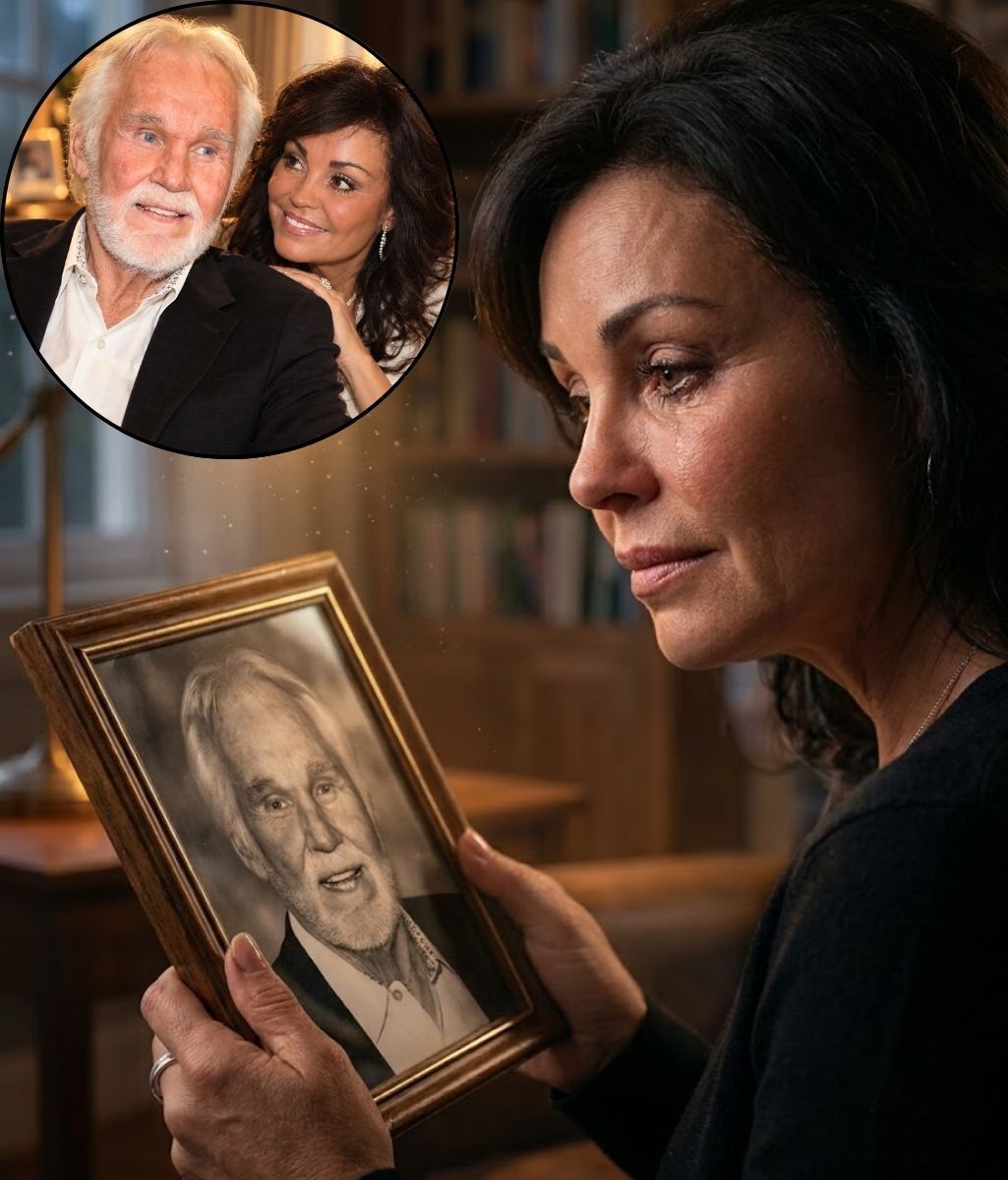
For millions of people, Kenny Rogers will always be remembered beneath the stage lights — silver hair, unmistakable beard, microphone in hand, and that warm, weathered voice turning songs into stories. He could make an enormous concert hall feel like a small room. Yet away from the applause existed another Kenny, one known far more intimately by his wife, Wanda Miller Rogers. Their life together was not built around “The Gambler,” awards, or celebrity photographs. Behind closed doors were ordinary mornings, family routines, laughter, difficult conversations, and the quieter responsibilities that never appeared in the spotlight.
Kenny and Wanda married in 1997, beginning a marriage that would last until Kenny’s death in 2020. Their relationship became one of the most private and important chapters of his later life. By then, Kenny had already lived through decades of success. He knew what it meant to hear his songs everywhere, to spend months traveling, and to have strangers feel as though they knew him because his voice had accompanied important moments in their lives. But fame and familiarity are not the same thing. The public knew Kenny Rogers the entertainer. His family knew the man who came home when the performance was over.
That distinction reveals something important about the final decades of Kenny’s story. A career as large as his can easily become the only story people remember. There were signature songs such as “The Gambler,” “Lady,” “Lucille,” “She Believes in Me,” “Coward of the County,” and “Through the Years.” There were collaborations, television appearances, tours, photographs, and generations of listeners. But none of those things could fully explain what mattered when the lights went out and Kenny returned to his family.
With Wanda, Kenny experienced a chapter centered increasingly on home and fatherhood. Their twin sons, Justin and Jordan, were born in 2004, when Kenny was already well into a life most performers could only imagine. Becoming a father again changed the balance between the road and home. The man who had spent so much of his adult life traveling now had another measure of time: birthdays, childhood milestones, evenings together, and years that suddenly seemed to move much faster than tour schedules ever had.
That quieter Kenny may surprise people who remember only the commanding performer. Onstage, he possessed remarkable confidence. At home, the meaningful moments could be wonderfully ordinary. That is often the side of famous people the public never gets to see. Success may fill walls with awards, but family life is built from smaller things — sitting together, telling stories, sharing meals, worrying about children, laughing over something nobody outside the house would understand.
Kenny’s later years increasingly reflected that awareness. After spending decades giving audiences his time, he eventually reached the point where being home mattered differently. His farewell touring years carried an unmistakable sense that time had become more valuable than another night of applause. For longtime fans, that decision was bittersweet. They wanted another song and another concert. But behind the entertainer was a husband and father who understood that some moments cannot be rescheduled.
Wanda’s perspective also offers a reminder that living beside a legend is different from admiring one from the audience. The public sees the finished performance. A family sees everything around it: the travel, exhaustion, preparation, uncertainty, and the strange adjustment of watching someone you love belong, in a small way, to millions of strangers. They also see the person without the stage clothes and the famous songs — the human being whose life continues after the audience has gone home.
Perhaps that is why stories about Kenny’s private life remain so compelling. His music itself was filled with characters who seemed real. He sang about choices, consequences, loyalty, regret, perseverance, and the passage of time. Listeners believed those stories because Kenny rarely sounded as though he were simply performing them. He sounded like someone sitting across the table telling you something he had learned the hard way.
That quality followed him home.
For Wanda, the most valuable memories would never need a chart position. They belonged to a private family history: years spent together, raising their sons, watching Kenny move gradually from the relentless pace of touring toward a quieter life. The world counted hit records. A family counts different things.
They count Christmas mornings.
Birthdays.
Inside jokes.
Conversations late at night.
Photographs nobody else sees.
The sound of someone walking into the house.
The familiar chair that eventually becomes painfully empty.
That is the part of loss celebrity cannot soften. When a famous performer dies, millions mourn the voice. A family mourns the person who occupied an ordinary place in everyday life. Fans can play an old recording and hear Kenny again. For those closest to him, that same recording can carry an entirely different weight.
And yet there is comfort in what remains.
Kenny left behind an extraordinary catalog, but he also left behind a family that knew him beyond the songs. His sons can hear the voice millions recognize and know something millions cannot: what that voice sounded like when it was speaking only to them. Wanda can look at the public photographs and remember everything happening outside the frame.
That may be the most touching difference between legacy and memory.
Legacy belongs to the world.
Memory belongs to the people who were there.
For fans, Kenny Rogers remains the storyteller beneath the spotlight, delivering another unforgettable line while thousands listen in silence. For his family, the most treasured version of Kenny may have existed after the curtain closed — when the microphone was gone, the crowd had disappeared, and there was nobody left to impress.
After all those years on the road, perhaps Kenny’s later life carried a lesson remarkably similar to the wisdom found in so many of his songs: eventually, you learn what is worth holding onto.
Awards gather dust.
Concert halls empty.
Charts change.
The road eventually ends.
But the ordinary moments shared with the people waiting at home become more valuable with every passing year.
That is the side of Kenny Rogers the world could never fully know.
Not Kenny the icon. Not Kenny the hitmaker. Not Kenny the man beneath the spotlight.
Just Kenny.
A husband. A father. A storyteller whose greatest private moments never needed an audience.
And perhaps that is exactly why they mattered so much.