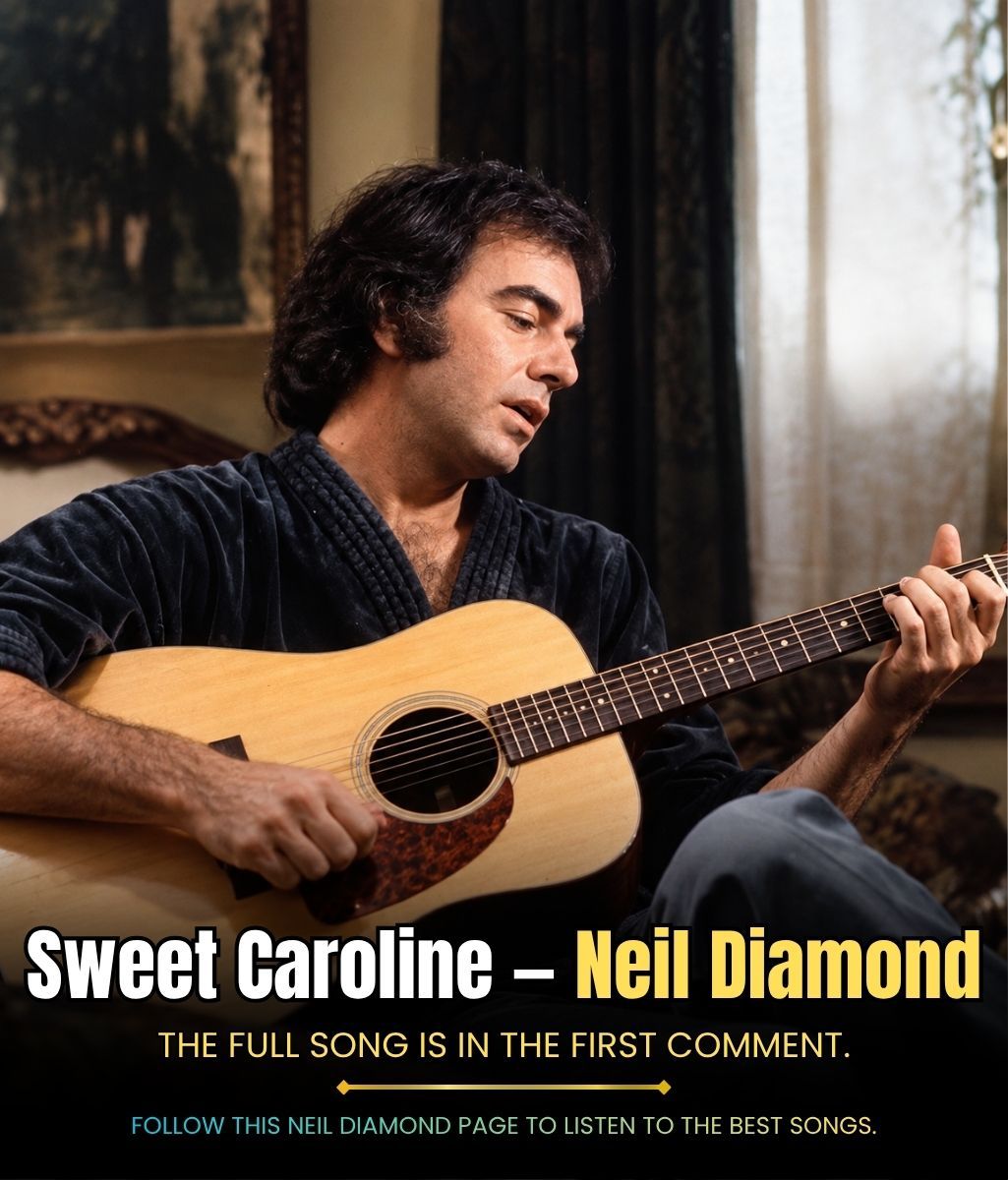
Sometimes a song doesn’t need an introduction. It only needs a few notes.
The moment the warm opening of Neil Diamond’s “Sweet Caroline” comes through the speakers, something familiar happens. People who may not know one another suddenly know exactly what comes next. At a ballpark, a wedding reception, a neighborhood bar, or a family gathering, somebody starts singing. Then another voice joins in.
And before long, the entire room seems to belong to the song.
That is a remarkable fate for a recording released in 1969. Popular music has changed almost beyond recognition since then, yet “Sweet Caroline” has never really left American life. It has simply traveled from one generation to another.
Neil Diamond wrote the song and recorded it at American Sound Studio in Memphis, with Tommy Cogbill and Tom Catalano credited as producers. Released as a single on MCA’s Uni label, “Sweet Caroline” climbed to No. 4 on the Billboard Hot 100 and became one of the defining recordings of Diamond’s career.
But chart numbers tell only a small part of this story.
Musically, “Sweet Caroline” is constructed with remarkable patience. It doesn’t immediately explode into the chorus everyone remembers. Instead, Diamond begins conversationally, almost as though he is recalling a private moment. The arrangement gradually grows around him. Strings rise, the rhythm becomes stronger, and anticipation builds until the chorus finally opens up.
That gradual climb is crucial.
Diamond’s voice was never polished in the conventional crooner sense. It had texture—a little grain, a little darkness, and an unmistakable sense of personality. On “Sweet Caroline,” those qualities make the romantic sentiment feel direct rather than overly sweet.
The lyrics describe the unexpected arrival of happiness and connection. There is gratitude in the song, but also surprise: life has somehow become better because another person is there.
It is uncomplicated, and that is part of its genius.
Listeners didn’t need to decipher an elaborate story. They could attach their own person to the name Caroline. A sweetheart, a wife, an old girlfriend, someone met during a summer long ago—the record left enough emotional space for everyone to bring something of their own.
Diamond later said that Caroline Kennedy, whom he had seen as a child in a magazine photograph, inspired the name used in the song. Decades afterward, however, he also explained that the song itself had been written about his then-wife, Marcia, and that he needed a three-syllable name that fit the melody.
Whatever its original inspiration, “Caroline” soon stopped belonging to any one person.
She belonged to everyone singing along.
That became especially clear as the song developed a second life in public spaces. Over the years, “Sweet Caroline” became inseparable from communal celebrations. Most famously, it became a tradition at Boston Red Sox games at Fenway Park, where thousands of spectators regularly sing it together.
And somewhere along the way, audiences added their own contributions.
The familiar shouted responses surrounding the chorus were not part of Diamond’s original lyric. They grew organically through years of people singing the song together. Today, leaving those audience responses out can almost feel stranger than including them.
That tells us something important about why “Sweet Caroline” endured.
It became participatory.
Most recordings ask us to listen. “Sweet Caroline” eventually began asking us to join in.
That quality has carried it far beyond baseball. It has been heard at weddings, parties, reunions, college events and countless bars where people who weren’t born when the record was released somehow know precisely when to raise their voices.
Yet beneath the communal celebration is still that original 1969 recording.
Put away the crowd noise for a moment and listen closely. There is something almost wistful underneath its optimism. Diamond does not sound like someone taking happiness for granted. He sounds like someone who has discovered it and is slightly amazed that it arrived.
Perhaps that is why the song works just as well on an old turntable as it does in a stadium.
For listeners who remember Neil Diamond in his prime, “Sweet Caroline” can open another door entirely. It can recall dashboard radios, record-store bins, Saturday-night gatherings and those years when a new song might follow you everywhere—from the car radio in the morning to a jukebox that evening.
Years pass. People move away. Families change. The places where we first heard our favorite records disappear.
But certain songs remain waiting for us.
And when “Sweet Caroline” begins, age seems temporarily irrelevant. A grandfather and grandson can sing the same chorus. A room full of strangers can become a choir. Someone who remembers 1969 can stand beside someone born forty years later, and for three minutes they share exactly the same piece of music.
Neil Diamond could hardly have planned that.
He simply wrote a song.
America kept singing it.
More than half a century later, those opening notes still carry an invitation: come back for a few minutes, sing louder than you normally would, and remember the people who once sang it beside you.
When “Sweet Caroline” starts playing, who do you remember singing along with?