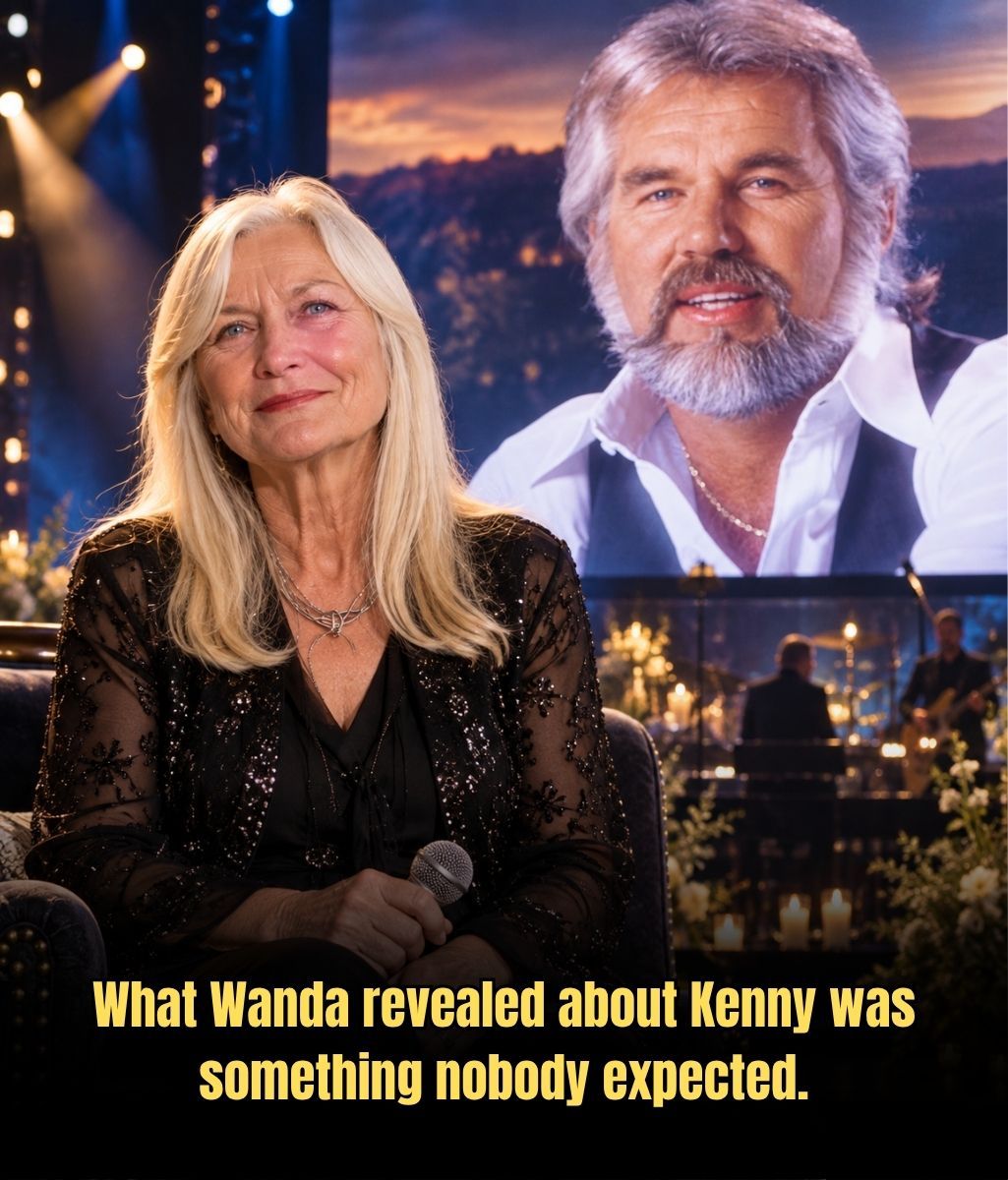
Six years after Kenny Rogers died on March 20, 2020, the stories shared by his widow, Wanda Miller Rogers, continue to reveal a side of the country legend that audiences rarely saw. Some headlines describe Wanda as only now “finally speaking out,” but she has actually discussed Kenny, their marriage and their final years in several interviews since his death. What makes her memories surprising is not some hidden scandal. It is the enormous difference between the Kenny Rogers millions saw beneath the stage lights and the man who eventually wanted nothing more complicated than time at home with his wife and children.
Kenny had spent most of his adult life chasing the next opportunity. His career stretched from the First Edition through one of the most successful solo runs in country-pop history. “Lucille,” “The Gambler,” “Lady,” “Coward of the County,” “Through the Years” and “Islands in the Stream” made his voice instantly recognizable. But Rogers was also unusually candid about the personal cost of ambition. Looking back, he acknowledged that there was sometimes a thin line between being driven and being selfish. The career that gave millions of people treasured memories also meant that people closest to him sometimes had to share him with the world.
Then Wanda Miller entered his life. The two married in 1997 despite an age difference that initially caused concern within Wanda’s family. Kenny had already been married four times, and there were obvious reasons for people around them to wonder whether another marriage could truly last. Yet this one became the longest marriage of his life. Kenny eventually described Wanda in strikingly simple terms: she was his soul mate. Their marriage lasted nearly 23 years, until his death at age 81.
Perhaps the greatest transformation came when Wanda told Kenny that she wanted children. Rogers initially resisted the idea. He was already in his sixties and understood what becoming a father again would mean. He worried about his age and about whether he would have enough years to watch another child grow up. Eventually he changed his mind, and in 2004, Wanda gave birth to twin boys, Justin and Jordan. Suddenly, the man who had spent decades organizing his life around recording sessions and concert schedules had two young reasons to reconsider what mattered most.
The twins changed Kenny profoundly. As they grew older, he began speaking more openly about the conflict between performing and fatherhood. In one emotional interview, simply imagining whether he would be around long enough to watch the boys become men was enough to affect him deeply. By the time he began planning his farewell from touring, his priorities had become unmistakable. Kenny said he was missing important parts of his sons’ lives and summed up his new outlook with a sentence that would have sounded almost impossible during his most relentless touring years: “I’m a father first and a singer second.”
Wanda’s memories after Kenny’s death make that transformation even more poignant. The twins later recalled ordinary “Super Saturdays” spent with their father—breakfast, errands, the car wash and simple family outings. There were no backstage passes in those memories. No Grammy Awards. No enormous arenas. To millions of strangers, Kenny Rogers was The Gambler. To Justin and Jordan, some of their most valuable memories involved their father doing the kind of ordinary things millions of other fathers did every weekend.
Even Kenny’s final day reflected that quieter life. Wanda later remembered that there was no dramatic Hollywood-style farewell. They spent time together at home, watching movies and sharing vanilla ice cream with chocolate sauce, something Kenny enjoyed. After his father died, Justin offered his mother a thought that stayed with her: because Kenny had died at home, his “sweet spirit” would always be there. For Wanda, grief was therefore attached not only to losing a famous husband but also to every ordinary corner of the home where their family life had unfolded.
There was another difficult reality Kenny had apparently understood before Wanda was ready to face it: someday she would have to continue living without him. Wanda has spoken about Kenny wanting her eventually to find happiness again rather than spend the remainder of her life alone. That request reveals something unexpectedly tender about their relationship. The man who knew his age might mean leaving first was thinking about the life his wife would have after he was gone. Love, in that sense, meant giving her permission to keep living rather than asking her to remain permanently trapped inside grief.
That may be the most surprising truth contained in Wanda’s memories six years later. Kenny Rogers spent decades becoming larger than life, but his final chapter was increasingly about becoming ordinary again. He wanted mornings at home. He wanted time with Justin and Jordan. He wanted Wanda beside him. The applause that had once seemed endless could no longer compete with the realization that his sons were growing up while he was away. Kenny had already conquered the stage; what he could never conquer was time.
So there is no need for a secret confession to make Wanda Miller Rogers’ story emotional. The real revelation is quieter and considerably more human. Kenny Rogers spent much of his life building a career people would remember forever, only to discover near the end that legacy and love were not necessarily the same thing. The world will remember “The Gambler.” Wanda remembers her husband. Justin and Jordan remember their father. And perhaps that was exactly how Kenny wanted the final chapter of his story to be told: not as a superstar walking away from the spotlight, but as a man who finally understood that the people waiting at home were worth more than one more standing ovation.
Follow Kenny Rogers for more timeless songs, rare photographs, unforgettable performances, and stories from his legendary career. ❤️🎶