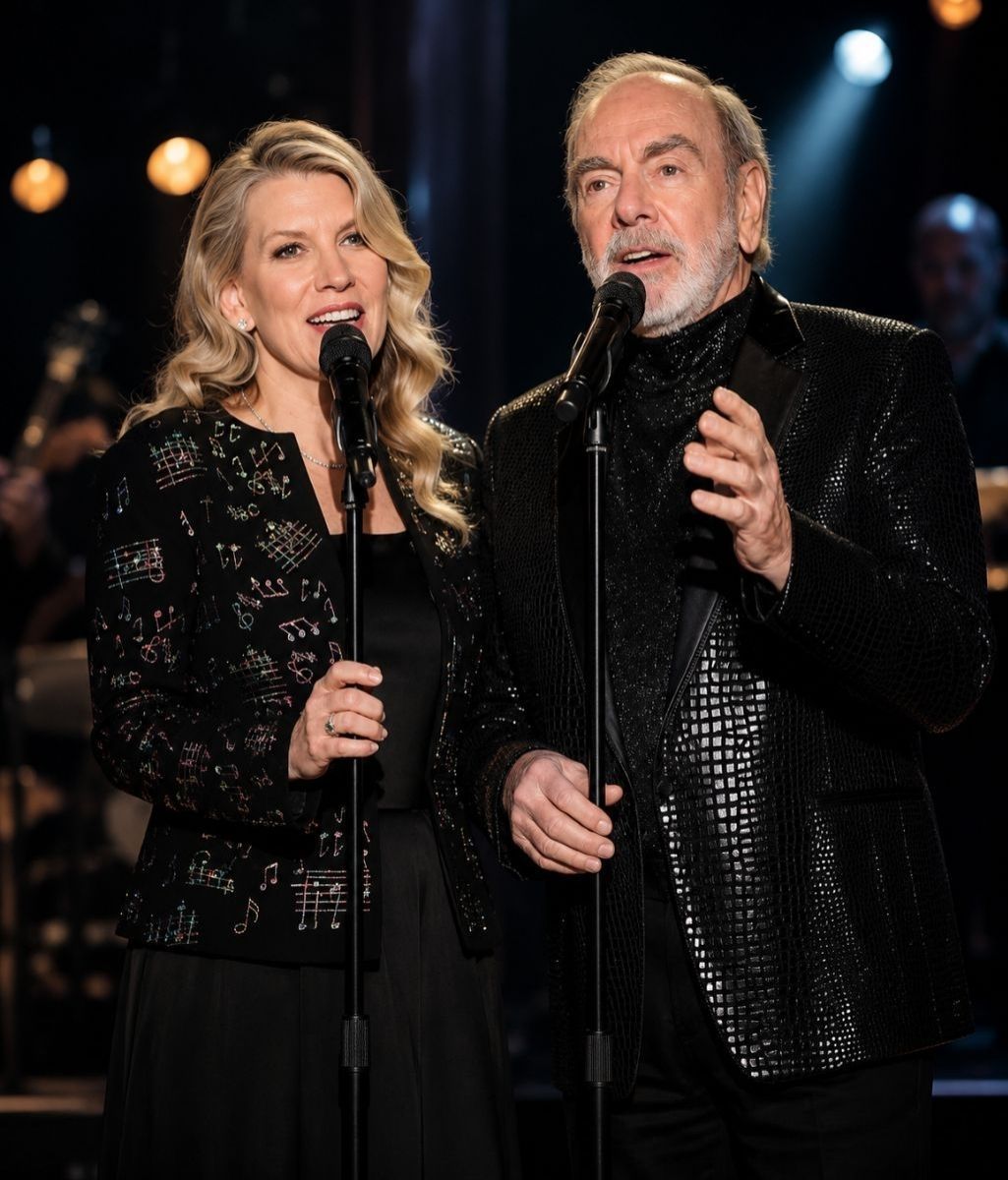
There are evenings when an audience knows exactly what it has come to hear. With Neil Diamond, the expectations are almost inevitable. People wait for the opening notes of “Sweet Caroline.” They hope for the familiar warmth of “Forever in Blue Jeans,” the introspection of “I Am… I Said,” or the sweeping emotion of “America.” These are songs that have traveled with listeners for decades.
But imagine an evening when Neil Diamond walks onto the stage beside his wife, Katie McNeil Diamond, and instead of reaching immediately into that extraordinary catalog, introduces something entirely unfamiliar: a brand-new song.
For an artist whose music has become inseparable from memory, the idea alone carries enormous emotional weight.
A new Neil Diamond song would not arrive in an empty room. It would arrive surrounded by more than half a century of history. Every person listening would bring something different to it—the first Diamond record they bought, the concert they attended years ago, the song that played during an important chapter of life, or perhaps the voice of someone they once knew singing along from another room.
That is the remarkable burden and privilege of longevity.
A young songwriter presents a new song and asks an audience to imagine the future. A legendary songwriter presents one, and the audience cannot help hearing the past alongside it.
With Katie beside him, the scene would naturally feel more intimate than a typical concert performance. She has shared much of Neil’s later-life journey away from the relentless touring schedule that once carried him from city to city. Seeing them together onstage would therefore shift the atmosphere away from spectacle and toward something quieter: two people sharing a piece of music with a room full of listeners.
And sometimes quiet moments become the ones audiences remember longest.
Neil Diamond has always understood the power of simplicity. His greatest songs rarely needed complicated explanations. A strong melody, carefully chosen words, and that unmistakable voice could do the work. Even when his arrangements grew large enough to fill arenas, there was often something conversational underneath them.
He sounded as though he were telling the story directly to you.
That quality helped songs such as “I Am… I Said” endure. It helped turn “Sweet Caroline,” released in 1969, from a successful recording into a multigenerational tradition. It allowed “America” to fill enormous rooms while still carrying the emotional directness of a personal story.
More importantly, those songs accumulated memories.
That is something no songwriter can manufacture.
Time has to do it.
A record plays in someone’s first car. Years later, it plays at a family gathering. Decades pass, and suddenly the same melody is being introduced to grandchildren. The recording has not changed, but the listener has. Every year adds another layer.
For longtime Neil Diamond fans, hearing something new at this stage of his life would therefore feel very different from hearing a new release in the 1970s or 1980s.
Back then, another album could always be expected.
Another tour seemed likely.
Another song was waiting somewhere ahead.
After so many decades, every new musical moment carries a different sense of time.
That may explain why an ending could become more memorable than the performance itself.
Perhaps the final note fades and there is a brief silence before the applause. Perhaps Neil looks toward Katie rather than immediately toward the audience. Perhaps nothing dramatic happens at all—and that simplicity is precisely what makes the moment linger.
Because after a lifetime spent performing before enormous crowds, sometimes the smallest gesture can say more than another grand finale ever could.
Older listeners understand this instinctively.
As the years pass, we often discover that our most important memories are not necessarily the loudest ones. We remember someone reaching across a table. We remember a familiar voice calling our name. We remember an ordinary afternoon that did not seem important until years later.
Music works the same way.
Neil Diamond’s career can be measured through enormous achievements, famous recordings, packed concert halls, and songs known around the world. But statistics cannot explain why someone hears the opening notes of “Sweet Caroline” and suddenly remembers being twenty years old.
That belongs to memory, not mathematics.
And this is why the image of Neil and Katie standing together with a new song feels so compelling. It places something unfamiliar beside everything audiences already know.
For a few minutes, nobody can rely on memory.
There is no famous chorus waiting to be shouted.
There is no decades-old recording against which to compare every note.
Everyone must simply listen.
Then the song reaches its ending.
And perhaps that is where the meaning becomes clear.
After all the years, all the records, all the stages, and all those millions of voices singing his songs back to him, the most affecting sight is not necessarily Neil Diamond the icon.
It is simply Neil, standing beside the person who has shared this chapter of his life, allowing one more melody to find its way into the world.
For longtime fans, that image connects two versions of time.
There is the young songwriter who once sat down with an idea and created songs without knowing whether anyone would remember them.
And there is the older artist who can now look into an audience and see generations who did.
That is the extraordinary thing about a musical lifetime.
Eventually, the songs stop belonging only to the person who wrote them. They become part of birthdays, road trips, marriages, friendships, Saturday nights, baseball games, quiet mornings, and memories of people who are no longer sitting beside us.
The songwriter gives them away.
The audience carries them forward.
And decades later, when that songwriter returns with something new, everyone listens a little more carefully because they understand just how quickly a new song can become an old memory.
So when the final note disappears and Neil and Katie remain together beneath the stage lights, perhaps the audience does not need another spectacular ending.
The years themselves have already supplied it.
A new song may have brought everyone to silence.
But the sight of Neil Diamond and Katie together at the end is what people would carry home—one quiet image after more than half a century of music, reminding them that sometimes the most unforgettable part of a song begins only after the singing stops.