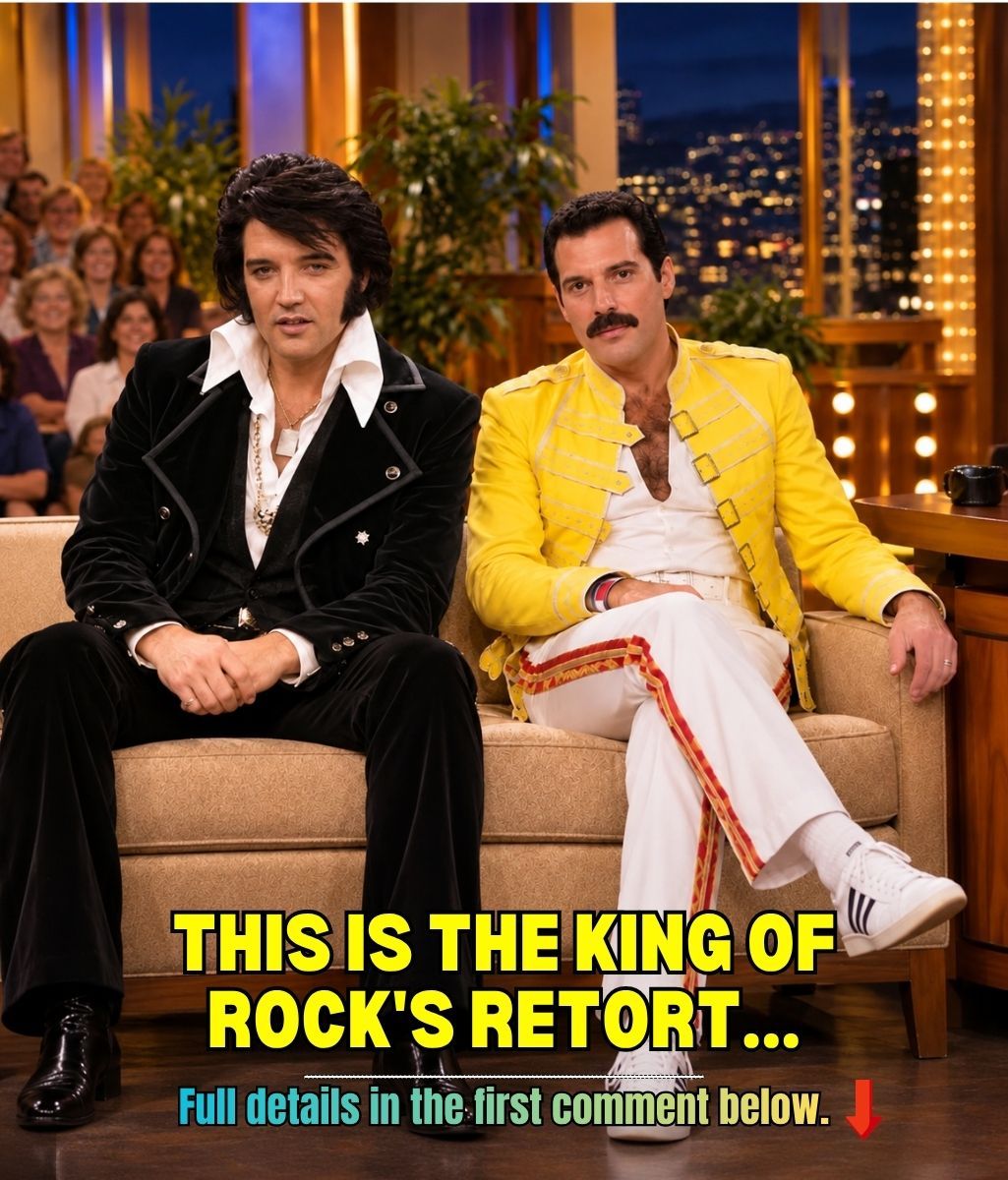
Imagine two of the most extraordinary names in music history standing at the centre of an unexpected television moment. One was Elvis Presley, the King of Rock and Roll, whose voice and performances had transformed popular music. The other was Freddie Mercury, the unforgettable frontman of Queen, a performer whose extraordinary stage presence would eventually make him one of the most celebrated entertainers of his generation.
Both men possessed something that could never be manufactured: an unmistakable personality, an extraordinary connection with audiences, and the ability to turn a musical performance into an unforgettable experience.
Yet their names also invite an intriguing question. What would happen if two such powerful musical personalities found themselves on opposite sides of an unexpected confrontation?
The story of an alleged television snub between Freddie Mercury and Elvis Presley has all the ingredients of a fascinating musical mystery. But before accepting the dramatic version of events, it is important to separate documented history from an entertaining story. There is no reliably established account of Freddie publicly snubbing Elvis on live television or Elvis delivering a response that left Freddie speechless.
Still, imagining these two legends sharing such a moment reminds us of just how different their musical journeys were — and how much they had in common.
Elvis Presley changed the sound of popular music. When he emerged in the 1950s, his energetic performances, distinctive voice, and unmistakable style captured the attention of an entire generation. Songs such as Heartbreak Hotel, Hound Dog, and Jailhouse Rock helped establish him as a cultural phenomenon.
He was more than a successful recording artist. Elvis became a symbol of a musical revolution, inspiring countless performers who followed him.
Freddie Mercury belonged to a different generation, but he understood the power of a truly unforgettable performer. Born Farrokh Bulsara, he eventually became the unmistakable voice of Queen, a band that would redefine the possibilities of rock music.
With songs such as Bohemian Rhapsody, We Are the Champions, and Somebody to Love, Freddie demonstrated an extraordinary ability to combine theatrical imagination with powerful musical expression.
His performances were never ordinary. He could command a stadium with a single gesture, encourage thousands of people to sing together, and transform a concert into an experience that audiences remembered for the rest of their lives.
In many ways, the two performers shared a remarkable gift.
They understood that an audience does not simply want to hear music. It wants to feel something.
Elvis could make a room come alive with his voice and movement. Freddie could stand before an enormous crowd and make every person feel as though the performance was happening just for them.
Their personalities were different, their musical styles belonged to different eras, and their approaches to entertainment reflected their individual experiences. Yet both understood the importance of authenticity and the responsibility that comes with standing before an audience.
There is also an interesting historical connection between their musical worlds. Elvis’s influence helped shape the development of modern rock and roll, creating an environment in which later generations of performers could explore new sounds and possibilities.
Freddie Mercury and Queen emerged from that evolving musical landscape, taking rock music in a bold new direction.
Although there is no verified public confrontation between the two men, their legacies can still be compared through the extraordinary influence they had on popular culture.
Elvis represented the beginning of a revolution that changed the relationship between music, youth culture, and entertainment. Freddie represented another remarkable chapter in that continuing evolution, bringing theatrical ambition and musical experimentation to a global audience.
Both men also understood the loneliness that could exist behind enormous fame. Millions of people might recognise your face, sing your songs, and celebrate your achievements, yet very few could truly understand the private pressures of living such an extraordinary life.
That is perhaps one of the most fascinating things about legendary performers.
The bigger the legend becomes, the harder it can be for the world to remember the human being behind it.
Elvis Presley passed away in 1977, leaving behind a musical legacy that continues to influence artists across generations. Freddie Mercury followed him in 1991, leaving behind performances that remain among the most celebrated moments in rock history.
Neither man needed to defeat the other to establish his place in music history.
Elvis had his revolution. Freddie had his own. And the world was fortunate enough to experience both.
Perhaps the most interesting question is not whether Freddie Mercury ever challenged the King of Rock and Roll on television, but what these two extraordinary performers might have thought of each other’s talents had they shared a genuine conversation.
Would Elvis have admired Freddie’s theatrical brilliance? Would Freddie have appreciated the musical revolution Elvis helped create?
We can only imagine.
Two generations. Two unmistakable voices. Two extraordinary legacies. And one truth that time has never changed: the greatest musical legends do not need to compete for history’s attention — their music speaks for itself.