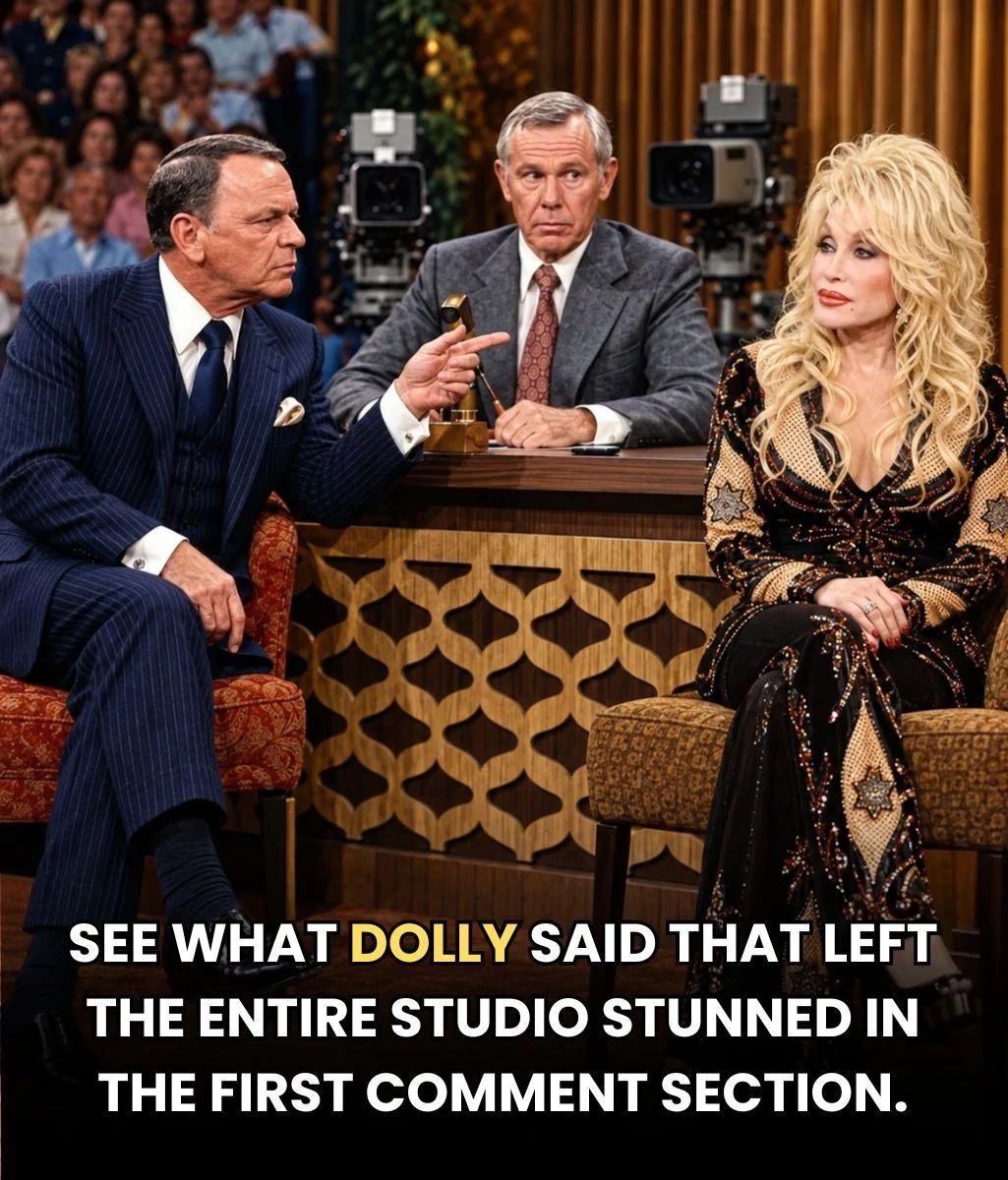
There are moments in television history that audiences remember for years, not because of elaborate performances or carefully rehearsed speeches, but because someone responds to an unexpected remark with remarkable composure. Imagine the scene: two towering figures from different generations of American entertainment, Frank Sinatra, the legendary voice of traditional pop, and Dolly Parton, the extraordinary country singer-songwriter whose personality is as unforgettable as her music. The headline suggests that Sinatra insulted Dolly during a live television appearance and that she answered with just ten words, leaving the studio silent. It is a dramatic story, but there is an important distinction to make: no reliable historical record or authenticated television footage has established that this particular confrontation ever happened. Nevertheless, the personalities involved and the changing attitudes of the entertainment industry offer an interesting story worth exploring.
Frank Sinatra was one of the most influential entertainers of the twentieth century. His career stretched across music, film, television, and live performance, earning him a reputation as an artist with extraordinary confidence and an unmistakable presence. Songs such as “My Way,” “Strangers in the Night,” “New York, New York,” and “I’ve Got You Under My Skin” became part of the American musical landscape. Sinatra represented an era when a performer’s reputation could be built through vocal ability, stage presence, and an unmistakable personal style. He was admired by millions, respected by fellow musicians, and frequently regarded as one of the greatest interpreters of popular songs. Yet his larger-than-life reputation also meant that his opinions and public behavior attracted considerable attention.
Dolly Parton, meanwhile, built her reputation through an entirely different musical tradition. Growing up in the mountains of East Tennessee, she developed a love of music in a family where resources were limited but imagination and determination were abundant. She arrived in Nashville with ambitious dreams and gradually established herself as a songwriter and performer. Her early partnership with Porter Wagoner introduced her to a wider television audience, but Dolly always possessed ambitions beyond being part of another artist’s program. She wanted to write her own songs, make her own decisions, and establish an identity that audiences would recognize immediately. That determination eventually helped transform her into one of the most successful and respected women in American entertainment.
What makes Dolly’s story particularly remarkable is that she never allowed other people’s expectations to determine the limits of her abilities. Her colorful appearance, distinctive voice, and playful sense of humor sometimes encouraged people to underestimate her. However, behind the public personality was a highly disciplined songwriter and businesswoman. She wrote songs that became classics, including “Jolene,” “Coat of Many Colors,” “I Will Always Love You,” and “9 to 5.” Her compositions reached audiences far beyond country music, demonstrating that genuine songwriting talent does not belong to a single musical category. She understood that people could appreciate her humor and glamorous image while also respecting the seriousness of her creative work.
There is, however, a real television moment that demonstrates how gracefully Dolly could respond when someone questioned her public image. In a widely discussed 1977 interview with Barbara Walters, the journalist asked pointed questions about Dolly’s appearance and whether she ever felt that people regarded her as a joke. Rather than becoming defensive or allowing the conversation to unsettle her, Dolly answered with her characteristic humor and confidence. She acknowledged that people made fun of her but made it clear that she understood her own choices. The exchange revealed something important about her personality: she was perfectly capable of laughing at herself without surrendering control over how others defined her. It remains a memorable example of her ability to turn an uncomfortable interview into an opportunity to demonstrate intelligence and self-confidence.
This is perhaps why a story about Dolly supposedly answering Frank Sinatra with a devastating ten-word response can sound so convincing. It fits a familiar image of two powerful personalities meeting in an unpredictable television moment. But a compelling story is not necessarily a documented historical event. There is no authenticated transcript, contemporary newspaper report, or reliable recording establishing that Sinatra publicly insulted Dolly in the manner described. Without such evidence, the alleged exchange should not be presented as a confirmed incident. What can be appreciated, however, is the contrast between their musical worlds and the remarkable careers they built through different paths. Both understood the importance of individuality, professional discipline, and maintaining a lasting connection with audiences.
Sinatra’s influence on popular music was enormous, while Dolly’s achievements helped expand the possibilities for women in country music and beyond. Their careers also demonstrate how the entertainment industry changed over several decades. Sinatra emerged during a period when traditional pop singers dominated radio and concert stages. Dolly rose during a time when country music was developing a broader national audience and television was becoming an increasingly important platform for performers. Although their musical identities were different, both understood that an artist needed more than a collection of successful recordings to remain relevant. A distinctive personality, an enduring body of work, and an authentic relationship with listeners were essential ingredients of lasting success.
Perhaps the most interesting lesson from Dolly’s real television appearances is that confidence does not always require a dramatic confrontation. Sometimes the most memorable response is delivered with a smile, a thoughtful observation, or a simple refusal to accept someone else’s judgment. Dolly has repeatedly demonstrated that she can acknowledge criticism without allowing it to define her. Her humor has become an essential part of her public identity, but it has never diminished the seriousness of her accomplishments. Behind the laughter is a woman who understood the music business, protected her creative independence, and continued building a remarkable career through changing generations. That combination of warmth, intelligence, and determination has helped make her an enduring figure in American culture.
Ultimately, the greatest answer Dolly Parton has ever given her critics may not have been ten words spoken during a fictional television confrontation, but an entire lifetime of achievements. Her songs continue to be recorded and performed, her influence reaches across musical generations, and her story remains an inspiration to people who believe that talent should never be judged by appearance or background. Frank Sinatra left behind an extraordinary musical legacy of his own, and Dolly Parton has created one that stands proudly alongside the greatest names in American entertainment. Their supposed television confrontation may lack historical evidence, but the real accomplishments of these two legendary performers need no embellishment. Sometimes, the truth is already remarkable enough.