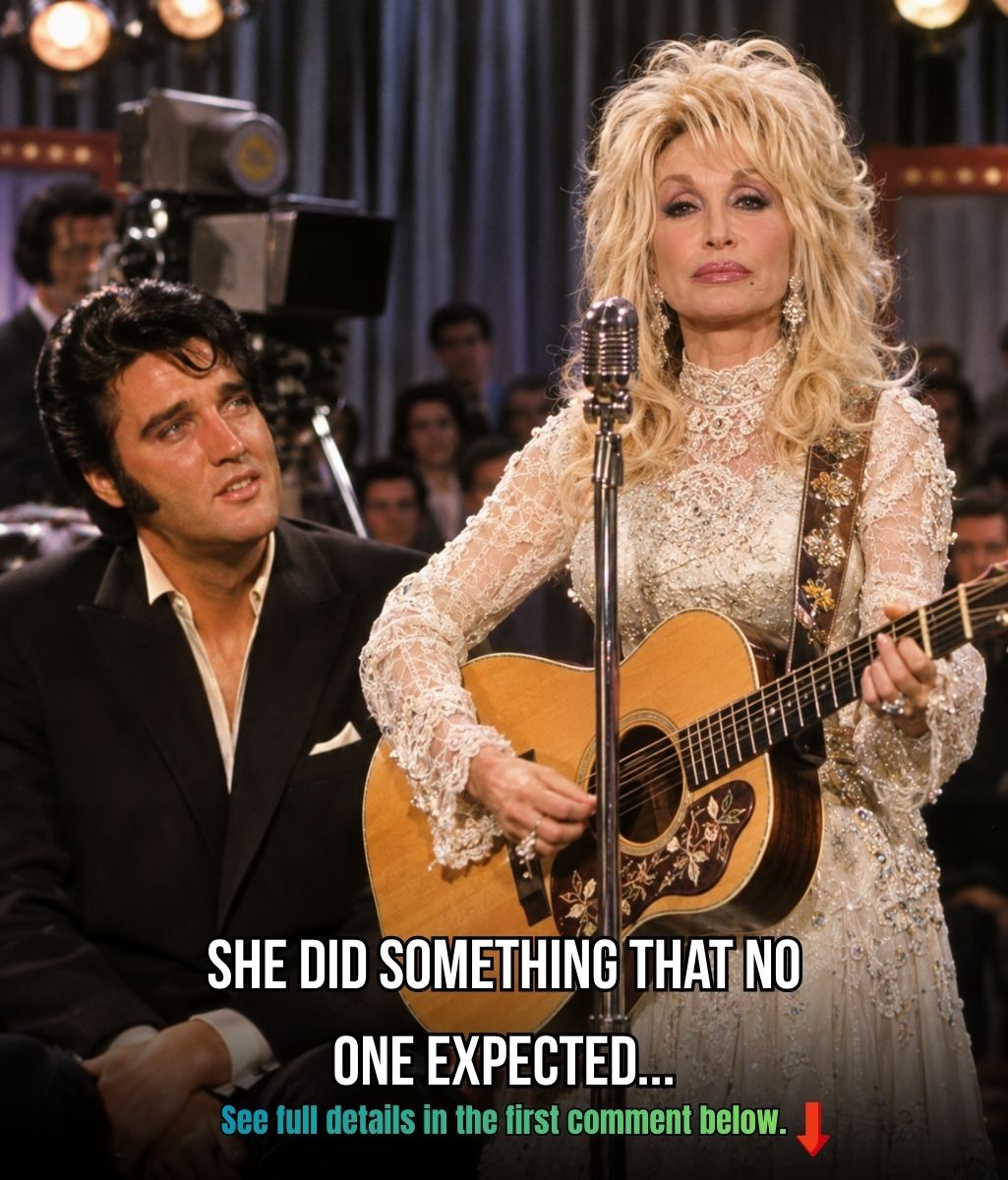
For years, stories about Elvis Presley and Dolly Parton have captured the imagination of music lovers. Both came from humble Southern beginnings. Both grew up surrounded by gospel music. And both carried a deep love for the songs that spoke about faith, heartbreak, forgiveness, and hope. One viral story claims Elvis challenged Dolly to sing gospel on live television, leaving him in tears after her unexpected response. Although that encounter has never been verified, the real story connecting these two legends is remarkably emotional—and it actually happened.
Dolly Parton never hid her admiration for Elvis. She grew up listening to his music and felt a special connection to the man behind the famous image. She once described feeling as though they were kindred spirits, particularly because of their shared Southern roots and their love of gospel music. Elvis’s devotion to spiritual songs was something Dolly understood deeply. For both artists, gospel was more than a musical style. It was connected to childhood, family, faith, and the emotional foundation upon which their careers were built. <Cite refs={[“turn183379search8”]}/>
Elvis’s love for gospel was well documented throughout his career. Even when he became one of the world’s biggest entertainers, he frequently returned to sacred music. He recorded gospel albums, sang with gospel groups, and often spent hours singing spiritual songs with friends and musicians away from the spotlight. His recordings of How Great Thou Art, He Touched Me, and Amazing Grace revealed a side of him that audiences sometimes saw only briefly during his rock-and-roll performances. Gospel music remained deeply personal to Elvis, and it was among the music he seemed most comfortable singing.
Dolly’s own musical roots were just as deeply connected to faith. Growing up in the Smoky Mountains of Tennessee, she was surrounded by family, church music, and the traditions of Appalachian singing. Her childhood was filled with music long before she became a star. Those early experiences shaped the way she wrote songs, often blending the language of everyday life with themes of faith, hope, suffering, and redemption. Throughout her career, she returned to gospel music whenever she felt the need to express something that went beyond ordinary storytelling.
But the most emotional connection between Dolly and Elvis centered on a song that was never officially recorded by the King. In 1974, Elvis expressed interest in recording Dolly’s composition “I Will Always Love You.” Dolly was thrilled. She later explained that she had been invited to the studio and was excited at the possibility of meeting Elvis and hearing him sing her song. For a songwriter, the idea of one of the greatest voices in music history interpreting a deeply personal composition was almost unimaginable. <Cite refs={[“turn183379search1″,”turn183379search6”]}/>
Then came the phone call that changed everything. Elvis’s manager, Colonel Tom Parker, informed Dolly that if Elvis recorded the song, his management expected a substantial share of the publishing rights. Dolly was faced with an impossible choice. She wanted desperately to hear Elvis sing her song, but she also understood the importance of protecting the rights to her own work. She had written the song herself, and its publishing ownership represented something far more valuable than a single recording opportunity.
Dolly ultimately refused the deal. The decision broke her heart. In a later interview, she revealed that she cried all night long after turning down the opportunity. It was not because she was angry with Elvis. She emphasized that she loved him and believed he was just as disappointed. The problem was the business arrangement, not the singer himself. Dolly later said she still dreamed about Elvis singing the song, and the thought of what that recording might have sounded like remained with her. <Cite refs={[“turn183379search1″,”turn183379search5″,”turn183379search6”]}/>
Years later, Dolly learned something that made the story even more touching. Priscilla Presley reportedly told her that Elvis had sung I Will Always Love You to her after they left the courthouse following their divorce. Dolly said the revelation deeply touched her. Although Elvis never officially recorded the song, he had apparently carried it into one of the most personal moments of his own life. The song that Dolly had written as a farewell to Porter Wagoner had found its way into another farewell, connecting two lives through a melody and words that neither could forget. <Cite refs={[“turn183379search1″,”turn183379search6”]}/>
That is perhaps why the imagined story of Elvis and Dolly singing gospel together feels so believable to fans. Their voices represented different eras of American music, but their emotional foundations were remarkably similar. Both understood the power of a song to comfort someone who was hurting. Both knew what it meant to rise from humble beginnings and carry the memories of home into a world that could sometimes feel overwhelming. And both understood that music could say things the heart struggled to express.
The duet that fans wish had happened never became part of history. But the song Elvis almost recorded, the tears Dolly shed over the decision, and the admiration she carried for him are real. Sometimes the most heartbreaking musical stories are not about a performance that happened. They are about the beautiful moment that nearly happened—and the melody that remained in our imagination long afterward.