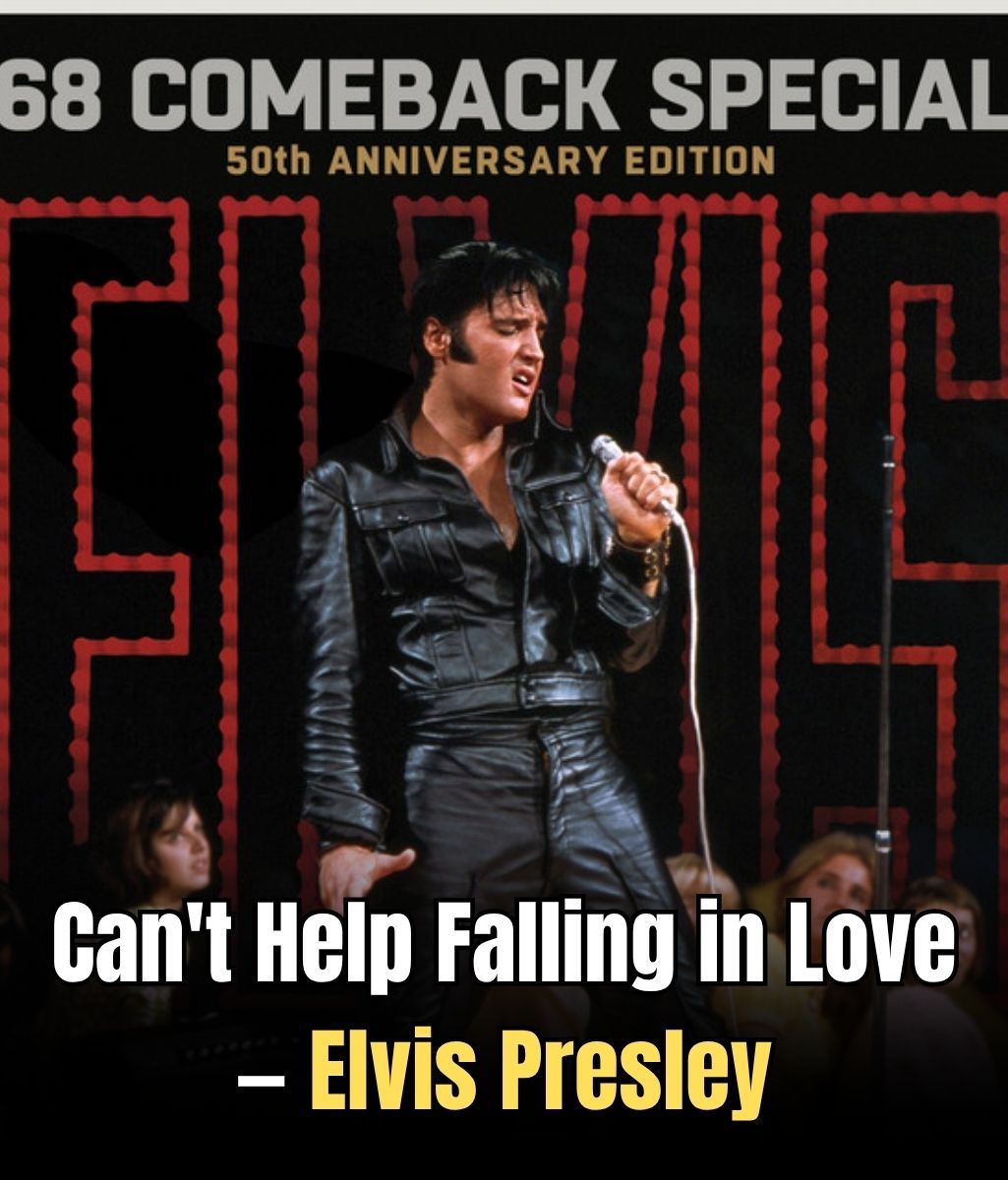
There are certain records you recognize before the singer has even finished the first line. Elvis Presley’s “Can’t Help Falling in Love” is one of them.
For listeners who grew up with Elvis, those gentle opening notes can still change the atmosphere of a room. They might bring back a slow dance in a high-school gym, a wedding reception in a VFW hall, an old record turning beneath a needle, or a late-night drive when the AM radio seemed to understand exactly what you were feeling.
This was not the rebellious Elvis who had shaken up American television in the 1950s. There was no pounding rock-and-roll beat demanding attention. Instead, Elvis sounded close, calm and almost vulnerable.
And more than six decades later, that quietness remains the song’s greatest strength.
“Can’t Help Falling in Love” was written by Hugo Peretti, Luigi Creatore and George David Weiss and recorded by Elvis on March 23, 1961, at Radio Recorders in Hollywood for the motion picture Blue Hawaii. The session brought together an extraordinary group of musicians, including guitarists Scotty Moore and Hank Garland, pianist Floyd Cramer and drummer D.J. Fontana, with vocal support from the Jordanaires and the Surfers.
Yet the finished record never feels crowded.
Everything seems designed to leave room for Elvis.
That restraint matters because the emotional idea behind the song is so simple. It is about the moment when caution and love stop agreeing with each other. The mind says to be careful; the heart has already made its decision.
There is no complicated story to follow and no villain standing between two lovers. The song simply accepts that falling deeply in love can feel inevitable.
Elvis understood how to sing that kind of simplicity.
Listen to the recording again and notice how little he tries to prove. He doesn’t turn every phrase into a vocal showcase. He allows his lower register to carry much of the intimacy, then gradually lets the performance open emotionally. The result feels less like a singer performing for thousands of strangers and more like one person making a promise to another.
That was an important side of Elvis Presley.
By 1961, audiences already knew the explosive performer who had helped transform popular music. But songs like this demonstrated why his appeal could extend far beyond rock and roll. Elvis could sound dangerous, playful, lonely, spiritual or tender—and on “Can’t Help Falling in Love,” tenderness won.
The record became a major international success. Released in connection with Blue Hawaii in 1961, it later reached No. 1 on the UK singles chart, where the “Can’t Help Falling in Love”/“Rock-A-Hula Baby” release held the top position for several weeks in early 1962.
But its chart life was only the beginning.
As Elvis moved into the concert years of his career, “Can’t Help Falling in Love” took on another role. It became closely associated with the end of his live shows. A song originally heard in a romantic Hollywood setting gradually became something resembling a farewell between Elvis and his audience.
That transformation is part of what makes the recording so unusual.
For one generation, it was a contemporary love song from a handsome young movie star. For another, it became the sound of Elvis leaving the stage. For later generations, it became a wedding standard, a slow-dance favorite and one of the recordings most immediately associated with his gentler side.
The song survived because its emotion never depended on 1961.
Imagine how many times it has been played while two people danced together in a nearly empty room. How many couples chose it because the words expressed something they could not quite say themselves. How many people later heard it after losing someone and discovered that a love song could become a memory song.
That is one of the strange gifts of old records.
We change, but the voice coming from the speakers does not.
The Elvis who sings “Can’t Help Falling in Love” remains forever young. His voice is still warm and controlled. The musicians are still waiting behind him. The record still moves toward its final promise with the same unhurried certainty it had when listeners first brought it home more than sixty years ago.
Only we have grown older.
Perhaps that is why hearing it today can feel so different from hearing it when we were young. Once, it might have represented the love we hoped to find. Years later, it may represent the person we found, the person we lost, or the life we built together.
Elvis recorded hundreds of songs, including performances far louder and more dramatic than this one. But few demonstrate his ability to make a microphone disappear quite so beautifully.
Put the record on tonight, turn the lights down, and listen from the beginning.
For three minutes, 1961 doesn’t seem very far away.
Who were you thinking about the first time Elvis made this song mean something to you?