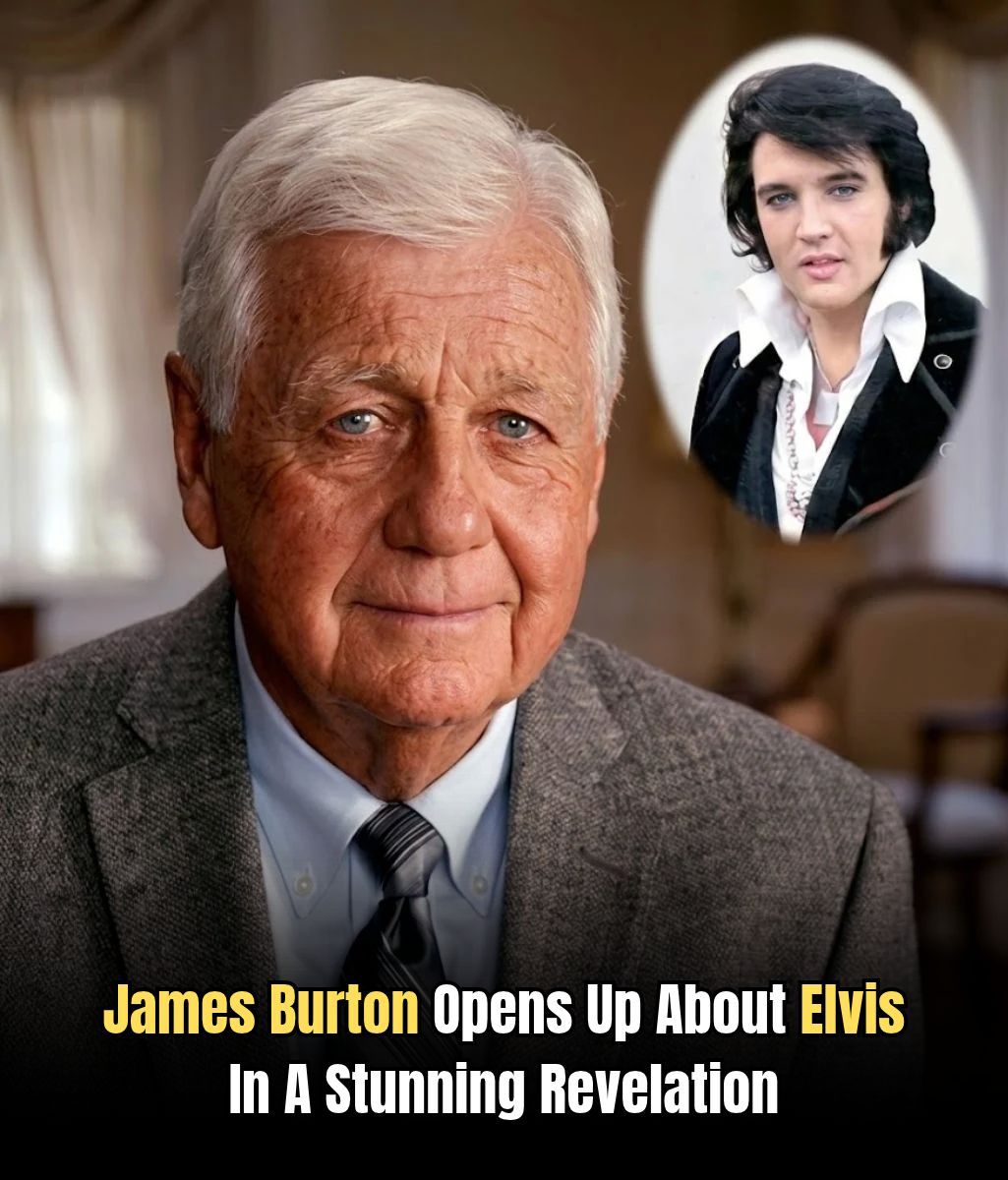
Some memories never lose their color, no matter how many decades pass. For James Burton, the legendary guitarist whose unmistakable playing helped shape the sound of Elvis Presley’s later career, the memories of standing beside the King of Rock ’n’ Roll belong to a chapter of music history that can never truly be repeated. The bright stage lights, the roar of the audience, and the familiar silhouette of Elvis holding a microphone may now belong to another era, but the music continues to bring those moments back to life. Behind the legend was a working musician, a demanding performer, and a man whose presence could transform an ordinary concert into something unforgettable.
James Burton was already an accomplished guitarist long before he became closely associated with Elvis. Born in Dubberly, Louisiana, in 1939, Burton developed a distinctive style that combined precision, imagination, and remarkable musical instinct. His career began at a young age, and his talent quickly attracted attention in the world of professional music. He became known for his clean, expressive guitar work and his ability to make every note serve the song. Whether playing country, rockabilly, or rock ’n’ roll, Burton possessed a sound that other musicians could recognize almost immediately.
His path eventually led him to Elvis Presley, one of the most influential entertainers of the twentieth century. By the late 1960s, Elvis was preparing to return to live performance after years spent concentrating heavily on films and recording projects. His celebrated 1968 television special marked a powerful turning point, reminding audiences of the charisma, confidence, and musical energy that had made him a cultural phenomenon. As Elvis prepared to take the stage again, he needed musicians capable of matching his intensity while giving his performances a fresh, contemporary sound. James Burton became an important part of that musical vision.
Burton joined Elvis’s circle of musicians in 1969 and became the lead guitarist in the group that supported the singer during his Las Vegas engagements and subsequent tours. Their partnership placed Burton at the heart of a remarkable period in Elvis’s performing career. Night after night, the guitarist helped provide the musical foundation for a voice that had already changed popular music. The arrangements could shift from powerful rock numbers to tender ballads, from gospel-inspired passages to the dramatic sweep of country music. Burton understood how to follow Elvis’s instincts without overwhelming the performance. His guitar did more than accompany the King; it helped give the music its pulse, texture, and emotional force.
For audiences watching from their seats, the experience could appear almost effortless. Elvis moved across the stage with familiar confidence, acknowledging his musicians and drawing thousands of people into the performance. Yet a great concert depends on far more than the person standing in the spotlight. It requires timing, trust, concentration, and the ability to respond to unexpected changes in the moment. Burton possessed those qualities in abundance. His playing could be subtle when the song demanded restraint and forceful when the performance needed another surge of energy. That musical understanding helped make the Elvis concerts of the era so compelling.
One of the most remarkable aspects of Burton’s career is that his work with Elvis became only one chapter in an extraordinary musical journey. Before and after their partnership, he played with numerous major performers across country, rock, and pop. His professional history included work with Ricky Nelson, and he became widely respected among musicians for his versatility and technical skill. Burton was never simply a guitarist who happened to stand beside a superstar. He was an influential musician in his own right, someone whose playing helped shape the sound of American popular music across several generations.
Still, the association with Elvis carries a special emotional weight. Elvis died on August 16, 1977, at the age of 42, leaving behind a legacy that continues to inspire musicians and listeners around the world. For those who worked closely with him, his death meant the loss of a colleague whose career had become inseparable from their own memories. The stage performances, rehearsals, and long stretches of touring could never be recreated in quite the same way. What remained were the recordings, photographs, and recollections of people who had witnessed that extraordinary period firsthand.
When fans imagine what James Burton might remember most vividly, it is tempting to picture a dramatic backstage confession or a secret that changes everything we thought we knew about Elvis. But the lasting significance of their relationship does not depend on a sensational revelation. Unless a specific recent interview is available, it would be misleading to claim that Burton has now disclosed a previously unknown secret. The documented history of their musical partnership is already remarkable enough. It tells the story of two professionals whose talents met at a moment when Elvis was reclaiming the stage and reaching audiences in a new way.
Perhaps the most moving part of that history is the way music preserves a presence long after a person is gone. When listeners hear Elvis perform, Burton’s guitar can still be heard within the arrangements, answering the singer’s phrasing and strengthening the emotional atmosphere of the song. A familiar note can bring back the sound of an old television set, a concert remembered from youth, or a time when the future seemed wide open. For longtime fans, these recordings are not merely pieces of entertainment. They are fragments of personal history, carrying the memories of family members, friendships, and years that can never return.
James Burton’s contribution reminds us that legends are rarely built alone. Behind every unforgettable performance stands a community of musicians, songwriters, technicians, and collaborators whose skill helps turn a great talent into a lasting cultural force. Elvis may have occupied the center of the stage, but the musicians around him helped create the sound that millions came to love. Burton’s guitar became part of that legacy, preserving a connection between the performer and the audiences who continue to listen.
At 86, James Burton’s place in music history rests on decades of extraordinary work and the enduring sound of the instrument he made his own. His association with Elvis Presley remains one of the most celebrated chapters of that career—not because it requires a hidden scandal or a shocking confession, but because the music itself continues to speak. The years may have carried the performers away from the stage, but they have not silenced the songs. And whenever Elvis’s voice rises from an old recording, the guitar of James Burton helps bring that remarkable era back into the room, one unforgettable note at a time.