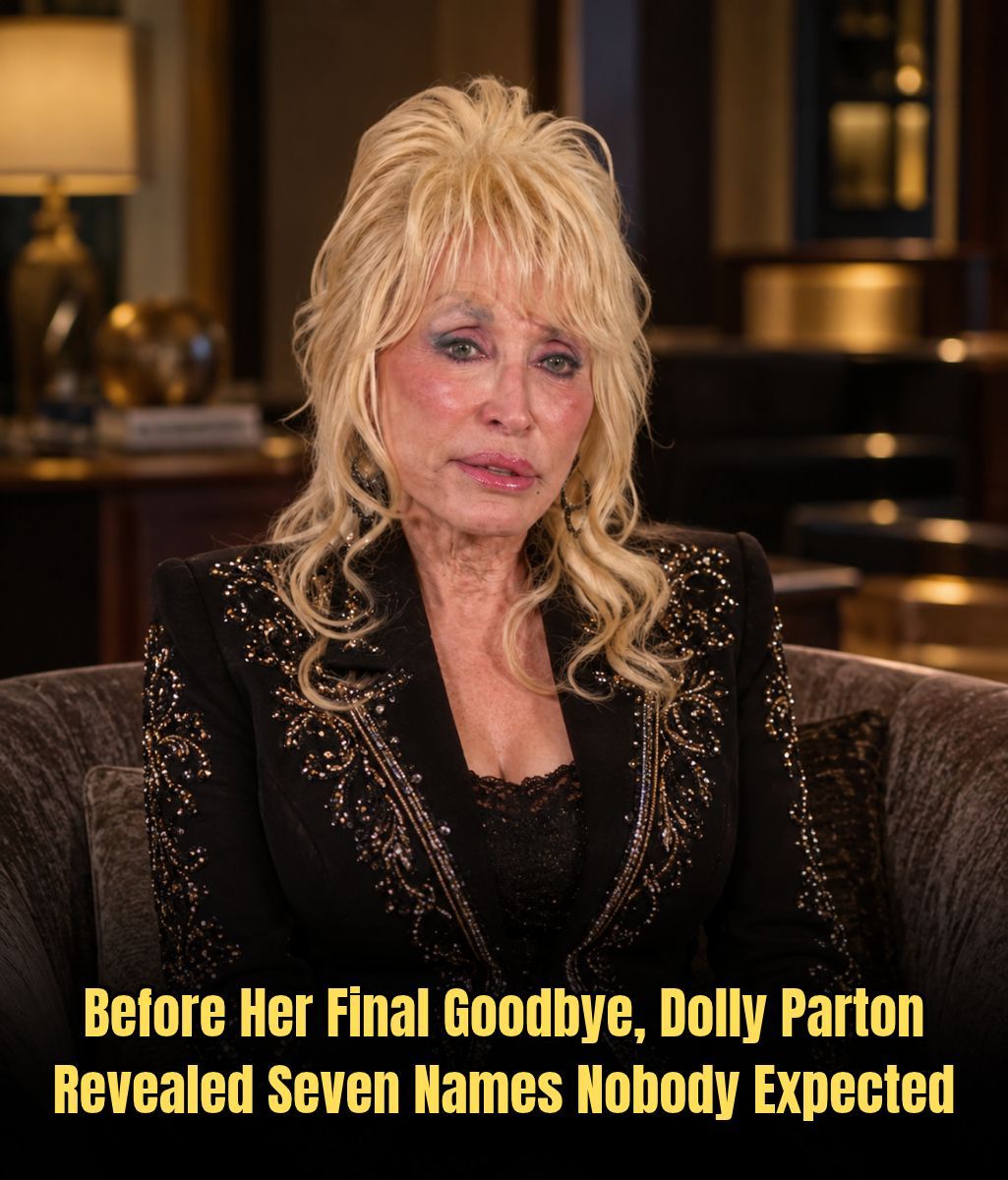
For decades, Dolly Parton has been one of the most recognizable and beloved figures in country music. Her bright smile, sparkling stage costumes, quick wit, and extraordinary songwriting have made her a familiar presence in millions of homes. She has written about heartbreak and hope, poverty and ambition, family and forgiveness. She has made audiences laugh with a perfectly timed joke and brought them to tears with a song that seems to understand a lifetime of unspoken feelings. Yet even after so many years in the public eye, Dolly continues to inspire curiosity about the woman behind the legend.
That curiosity makes a headline claiming that Dolly revealed seven names she detested especially intriguing. What names could provoke such a strong reaction from a woman widely admired for her humor and gracious public personality? Were the names connected to painful memories, difficult relationships, or experiences from her long journey through the entertainment industry?
There is, however, an important distinction between a captivating headline and a documented revelation. No reliable evidence establishes that Dolly Parton publicly identified seven people whose names she hated or detested. Without a verifiable interview, recording, or statement, such a list should not be presented as an authentic confession. The more meaningful story lies in what Dolly’s life teaches us about personality, disappointment, forgiveness, and the complicated relationships that can accompany extraordinary success.
1. THE WOMAN WHO TURNED ADVERSITY INTO ART
Dolly Parton’s story began in the mountains of East Tennessee, far from the glamorous world she would eventually enter. Raised in a large family with limited financial resources, she learned early that life could be difficult without losing its capacity for beauty. Music was part of her childhood, and storytelling became one of the ways she made sense of the world around her.
Those early experiences shaped the songwriter she became. Dolly developed an extraordinary ability to transform personal observations into songs that felt universal. She could write about a difficult childhood without reducing it to misery, celebrate ambition without pretending success came easily, and explore heartbreak without suggesting that sadness had the final word.
Her rise in Nashville required persistence. The music industry was competitive, and a young woman with ambitious dreams had to establish her own identity. Dolly did so through talent, determination, and a personality that could not easily be mistaken for anyone else’s.
She also learned the importance of humor. Rather than allowing criticism to define her, she often answered it with wit. Her ability to laugh at herself while remaining confident in her abilities became an essential part of her public image.
That history does not mean Dolly never experienced disappointment or conflict. It means that the documented story of her life is already rich with lessons about resilience, without requiring an invented list of enemies.
2. WHY THE WORLD IS SO CURIOUS ABOUT HER PRIVATE FEELINGS
Fame creates an unusual relationship between a performer and the public. Fans may feel they know an artist after listening to the same songs for decades, even though they have never met the person behind them. Every interview, public appearance, and personal anecdote becomes another piece of a much larger picture.
With Dolly, that curiosity has always been especially strong. Her personality feels welcoming, and her storytelling often gives audiences the impression that she is speaking directly to them. People want to know what makes her laugh, what has hurt her, which experiences shaped her values, and how she has navigated the complicated world of celebrity.
A headline about seven names she supposedly detested offers the promise of an entirely different Dolly: someone revealing private resentments after a lifetime of public charm.
But people are rarely as simple as their public image suggests. A kind person can disagree with others. A generous person can establish firm boundaries. Someone known for humor can still take certain matters seriously. None of those possibilities proves that a dramatic confession occurred.
The difference between understanding a celebrity and inventing a private story about that celebrity matters. Genuine insight begins with what a person has actually said and done, not with what would make the most sensational headline.
3. THE COST OF LIVING IN THE PUBLIC EYE
Dolly’s career has placed her under public scrutiny for generations. Her appearance, personality, business decisions, music, and personal relationships have all attracted attention. Few artists maintain such a recognizable identity for so long without encountering criticism or misunderstanding.
The pressures of fame can be exhausting. An ordinary disagreement may become a public controversy, while a private decision can be interpreted by strangers who know only a small part of the circumstances. Over time, a celebrity may learn to protect certain aspects of life simply because constant explanation leaves little room for peace.
Dolly and her husband, Carl Dean, demonstrated a strong preference for keeping much of their private relationship away from the spotlight. Their marriage lasted nearly six decades, yet Carl largely avoided public appearances and interviews. Their choice offered a reminder that not every important relationship needs to become public entertainment.
Privacy can be a form of protection. It allows people to resolve disagreements without an audience, maintain relationships without outside commentary, and preserve parts of their lives that belong to them alone.
For a performer whose professional life was so public, such boundaries were particularly valuable. They helped distinguish the person who entertained millions from the private individual who still needed ordinary moments of quiet.
4. SEVEN NAMES—AND THE DANGER OF AN UNVERIFIED LIST
The number seven gives a headline a sense of precision. It suggests that a revelation has been carefully counted and that readers are about to discover a definite set of answers. But a numbered list is not evidence in itself.
Without a reliable source, naming seven individuals and claiming Dolly detested them would risk attributing feelings to her that she may never have expressed. It could also unfairly damage the reputations of people whose names were included without justification.
A responsible account should not manufacture such a list merely to satisfy the promise of a sensational headline. If Dolly made a documented public statement about a disagreement or a difficult professional experience, the original context would matter. A humorous remark should not automatically be treated as a serious declaration of hatred, and criticism of someone’s actions should not be transformed into a lifelong personal feud.
This distinction is particularly important when writing about older artists whose careers span several generations. Memories can be incomplete, remarks can be repeated without context, and online stories can gradually turn speculation into something that appears factual.
A surprising story is not necessarily a true story. The strongest tribute is one that respects the artist enough to distinguish her real words from a narrative created to attract attention.
5. THE PEOPLE WHO CHALLENGED HER ALONG THE WAY
Although no verified list of seven hated names has been established, Dolly’s career illustrates the challenges that can arise when a determined artist enters a competitive industry.
Early in her career, she had to establish herself as more than a promising singer. She was a songwriter with a distinct voice, an ambitious performer, and a woman determined to control the direction of her own professional life. That determination required difficult decisions and the willingness to keep moving when circumstances did not immediately favor her.
Her time working with Porter Wagoner became an important chapter in her development. Their professional partnership helped introduce her to a broad audience, but Dolly eventually pursued a solo career of her own. The transition was significant, requiring her to step away from a familiar arrangement and trust her ability to succeed independently.
Their relationship was not simply a story of conflict. It was also a story of professional influence, gratitude, and change. Wagoner played an important role in Dolly’s early career, and Dolly went on to build an extraordinary career of her own.
The lesson is more interesting than a list of supposed enemies. People can be important to our lives even when circumstances change. A professional relationship may involve tension and difficult choices while still contributing something valuable to both individuals.
Dolly’s journey demonstrates that independence sometimes requires courage, but courage does not have to mean denying the importance of those who came before.
6. WHAT HER MUSIC REVEALS ABOUT HUMAN NATURE
Dolly Parton’s songs have explored a wide range of human experiences, from the pain of separation to the determination required to pursue a dream. Her writing often finds dignity in ordinary lives and meaning in moments that might otherwise pass unnoticed.
Consider the enduring emotional power of “Coat of Many Colors.” The song draws on a childhood memory and turns an experience of poverty into a story about family love and personal dignity. Its message does not depend on wealth or status. It rests on the belief that a person’s worth cannot be measured by outward appearances.
Other songs reveal different dimensions of her songwriting. “Jolene” captures the vulnerability of someone confronting the possibility of losing a loved one. “I Will Always Love You” expresses affection through the difficult act of letting someone go. Both songs endure because they recognize that human relationships can contain contradictory feelings.
Love does not eliminate insecurity. Gratitude does not prevent sadness. Moving forward does not require pretending that the past never mattered.
These emotional complexities make Dolly’s music feel authentic. She does not need to announce that she dislikes seven people to demonstrate that she understands conflict. Her songs have spent decades exploring the feelings that arise when people disappoint one another, make difficult decisions, or discover that love sometimes requires distance.
7. THE LEGACY THAT MATTERS MORE THAN A LIST OF ENEMIES
Dolly Parton’s influence reaches far beyond the recording studio. Alongside her musical accomplishments, her philanthropic work has become an important part of her public legacy. Through the Imagination Library, the book-gifting program she founded, millions of children have received books intended to encourage early literacy and a lifelong love of reading.
That work reflects a different kind of celebrity influence. Rather than using fame solely to attract attention, Dolly has helped direct resources toward a practical goal that can benefit families and communities.
Her career has also demonstrated the value of reinvention. She has moved between country music, pop, film, television, business, and charitable initiatives while retaining a distinctive identity. Her success has never depended on becoming indistinguishable from the latest trend.
For longtime fans, those achievements form a much stronger foundation for admiration than any unverified revelation about personal dislikes. They show an artist who has maintained her individuality, worked consistently, and used her position to create opportunities beyond herself.
A legacy should not be reduced to the people a celebrity supposedly disliked. It should be understood through the work, values, decisions, and contributions that can be examined honestly.
THE TRUTH BEHIND THE HEADLINE
The claim that Dolly Parton revealed seven names she detested before her passing is not supported by a reliable source established here. It would therefore be misleading to present any seven names as an authentic list or to suggest that a final confession took place.
What remains is a more enduring story: that of a woman who rose from humble beginnings to become one of country music’s most influential figures, who transformed personal experiences into songs that reached millions, and who learned to navigate fame without surrendering every part of her private life.
Dolly’s story reminds us that admiration does not require a person to be flawless. Artists are human beings, shaped by relationships, difficult decisions, disappointments, and changing circumstances. Their lives become meaningful not because they never encounter conflict, but because of what they create and how they choose to move forward.
Perhaps the most valuable question is not which names Dolly supposedly detested. It is what her remarkable journey teaches us about the way we treat one another, the importance of protecting our peace, and the difference between holding a grudge and learning from experience.
The world may always be curious about the private thoughts of its favorite stars. But the most enduring truths are often found in the work they leave behind.
Dolly Parton’s greatest legacy is not a list of people she may or may not have disliked. It is a lifetime of music, generosity, humor, and stories that continue to bring people together. And for the generations who have found comfort in her voice, that legacy is more than enough.