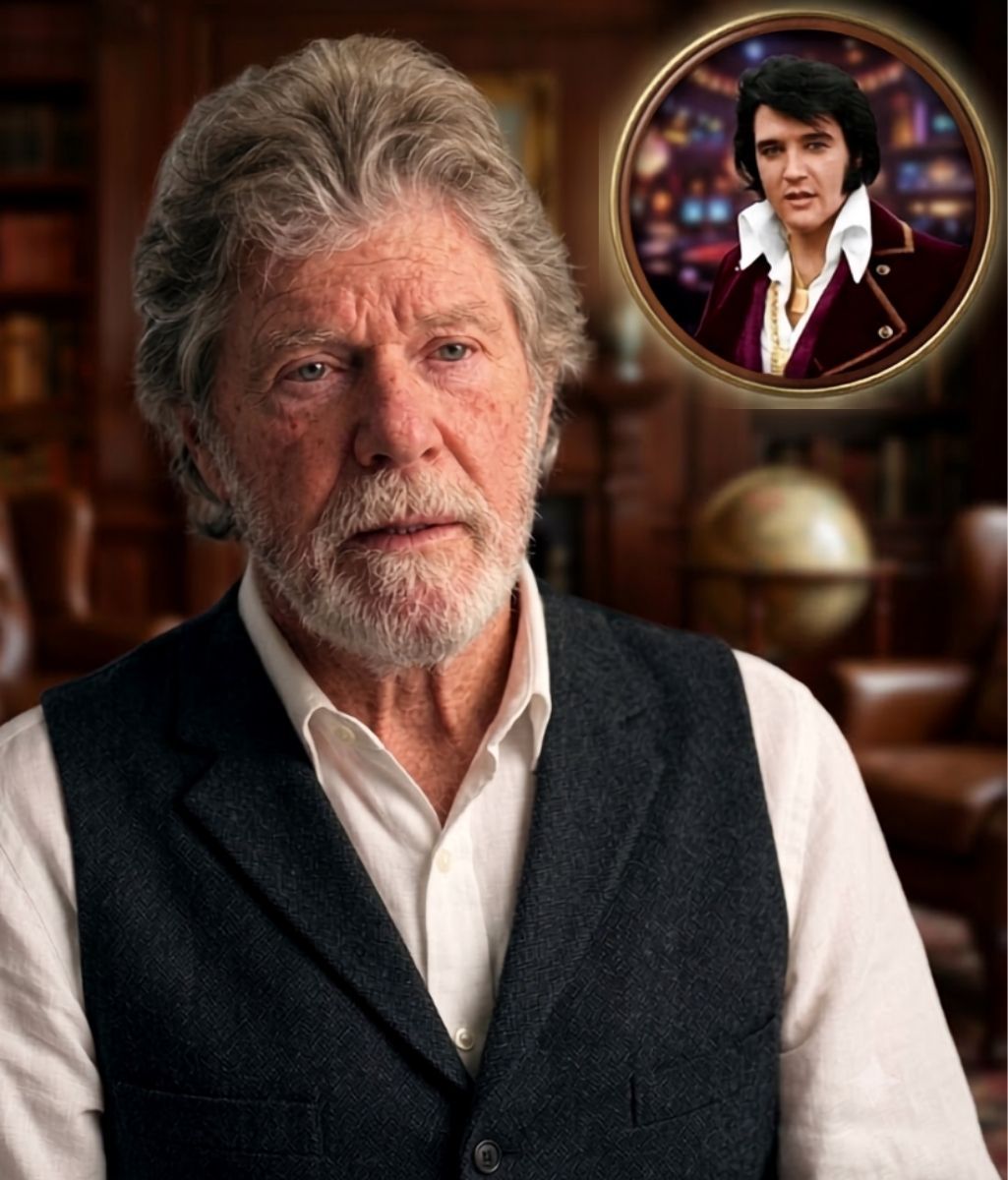
For millions of music lovers, Elvis Presley will always be the King of Rock ‘n’ Roll. His voice, his unforgettable performances, and his extraordinary influence on American music have secured his place in history. But behind the dazzling stage lights and the image recognized around the world was a man whose private life could be far more complicated than many fans ever realized.
Few people were in a better position to understand that side of Elvis than Jerry Schilling, one of his closest friends and a trusted member of his inner circle. Their friendship began in Memphis in 1954, when Jerry was just 12 years old and Elvis was a 19-year-old aspiring musician who had recently begun making a name for himself.
At the time, neither could have imagined how dramatically their lives would change. Elvis would soon become an international sensation, while Jerry would eventually work alongside him, travel with him, and witness some of the most important moments of his life.
Their relationship lasted for more than two decades. And when Elvis died on August 16, 1977, Jerry lost someone who had become far more than a famous friend.
He had lost a lifelong companion.
The Friendship Behind the Legend
To the outside world, Elvis was a superstar surrounded by admirers, expensive cars, glamorous appearances, and the constant demands of fame. But Jerry knew the young man from Memphis long before the world began calling him the King.
Their friendship grew through ordinary experiences as well as extraordinary ones. They shared conversations, adventures, professional responsibilities, and moments that never appeared in newspaper headlines.
As Elvis’s career expanded, Jerry became part of the close-knit group commonly known as the Memphis Mafia. The group included friends and associates who traveled with Elvis, helped manage the practical demands of his career, and witnessed his life away from the public stage.
Yet Jerry’s importance to Elvis cannot be understood simply through his position within that circle. What made their relationship distinctive was its history. Jerry had known Elvis before the fame reached its extraordinary heights, giving him a perspective that few people could claim.
In later years, Jerry explained that he had initially avoided speaking publicly about Elvis after his friend’s death. He needed time to continue his own life and come to terms with a loss he had never expected to experience so young.
That silence was not evidence of a hidden conspiracy or a secret revelation waiting to emerge. It reflected something much more human: the difficulty of speaking about someone whose absence had changed your life forever.
The Dream That Might Have Changed Elvis’s Career
One of the most revealing stories Jerry later shared concerned Elvis’s interest in the film A Star Is Born, the 1976 musical drama that starred Barbra Streisand and Kris Kristofferson.
In March 1975, Streisand met Elvis backstage at the Las Vegas Hilton and discussed the possibility of casting him in the film. According to Jerry’s recollection, Elvis was fascinated by the idea. The two performers reportedly spent more than two hours discussing the project in a quiet space backstage.
For Elvis, the opportunity represented more than another movie role. It offered the possibility of returning to serious dramatic acting after years in which his film career had largely been shaped by commercially successful musical productions.
Elvis had demonstrated considerable screen presence in earlier films, including Jailhouse Rock and King Creole. However, he had grown increasingly dissatisfied with the direction of many of his later movie projects.
A challenging dramatic role could have allowed him to explore a different side of his abilities and reconnect with his ambitions as an actor.
But Elvis never appeared in A Star Is Born. The role ultimately went to Kris Kristofferson.
The reasons behind that outcome have been discussed by people familiar with the production, including disagreements and complications involving billing and financial arrangements. Jerry later expressed the belief that the disappointment weighed heavily on Elvis.
In a 2025 retrospective published by the Los Angeles Times, Jerry reflected on that meeting with Streisand and described it as the last time he remembered seeing a particular spark in his friend’s eyes.
It is a poignant recollection, although it remains Jerry’s personal interpretation of a complicated period in Elvis’s life rather than definitive proof that one missed opportunity determined everything that followed.
The Man Behind the Famous Smile
One of the most important contributions Jerry made to Elvis’s story was his willingness to describe the singer as a human being rather than an untouchable celebrity.
In his memoir, Me and a Guy Named Elvis, published in 2006, Jerry offered readers a personal account of their friendship. He described Elvis’s generosity, humor, vulnerabilities, and occasional frustrations, allowing admirers to see a more complicated portrait of the man behind the legend.
Jerry also recalled moments when Elvis appeared physically unwell. In one account, he described seeing Elvis walking downstairs at Graceland with his father, Vernon Presley, while using an oxygen mask. The sight shocked Jerry because he had rarely seen his friend appear so vulnerable.
According to Jerry, Elvis tried to make light of the situation rather than discuss his condition openly.
The story illustrates a difficult aspect of Elvis’s private life: the contrast between the image of a powerful entertainer and the reality of a person dealing with personal challenges.
It also reminds us that fame can create distance between a public figure and the people who genuinely care about him. When millions expect someone to remain strong, energetic, and endlessly entertaining, acknowledging weakness can become surprisingly difficult.
Jerry’s memories helped bring that hidden vulnerability into focus.
Why Jerry Waited to Tell His Story
Jerry did not publish his memoir until nearly three decades after Elvis’s death. By then, countless books, documentaries, and interviews had explored the singer’s extraordinary rise and tragic final years.
Jerry explained that he wanted to offer something different. Rather than simply repeating familiar stories about the superstar, he wanted readers to understand the personal friendship that existed beneath the public image.
His account included happy memories, difficult experiences, and moments that did not always present Elvis in a perfect light.
That honesty is part of what makes firsthand recollections valuable. A meaningful friendship does not require pretending that the other person never made mistakes. It means remembering the whole individual, including the qualities that inspired affection and the struggles that made life difficult.
Jerry’s story also revealed how deeply Elvis had influenced his own life. Their relationship helped shape his professional path, and Jerry continued working in the entertainment industry after his friend’s death.
He later worked with other prominent musicians and became involved in documentaries and projects connected to Elvis’s legacy.
Even decades after 1977, Elvis remained an important part of Jerry’s personal history.
A Legacy That Goes Beyond the Headlines
The passing of Elvis Presley left a void in music that has never truly been filled. His recordings continue to reach new audiences, while his performances remain a reference point for generations of singers and musicians.
But stories like Jerry Schilling’s remind us that the legacy of a legendary performer is not measured solely by record sales, awards, or the size of the crowds who attended his concerts.
It is also measured by the relationships he formed, the lives he influenced, and the memories carried by those who knew him personally.
Jerry did not need to uncover a shocking secret to tell a remarkable story about Elvis. His recollections were powerful precisely because they revealed the human experiences behind the famous name.
A childhood friendship. A dream of a different future. The disappointments of a demanding career. And the lasting grief of losing someone who had been part of his life since he was a boy.
These are the details that give Elvis’s story its human dimension.
Nearly five decades after Elvis’s death, fans continue to ask what the world might have seen if his career had taken a different direction. Would he have returned to dramatic acting? Could a different film role have renewed his creative ambitions? What other performances might he have delivered if he had lived longer?
No one can answer those questions with certainty.
What remains undeniable is the impact of the music he left behind and the importance of preserving authentic memories from people who knew him.
Through Jerry Schilling’s recollections, Elvis Presley becomes more than the King on the stage. He becomes the young friend from Memphis, the ambitious performer with unfinished dreams, and the complicated human being remembered by someone who knew him long before the world did.
And perhaps that is the most moving truth of all: behind one of the most recognizable figures in music history was a friendship that continued to matter long after the applause had faded.