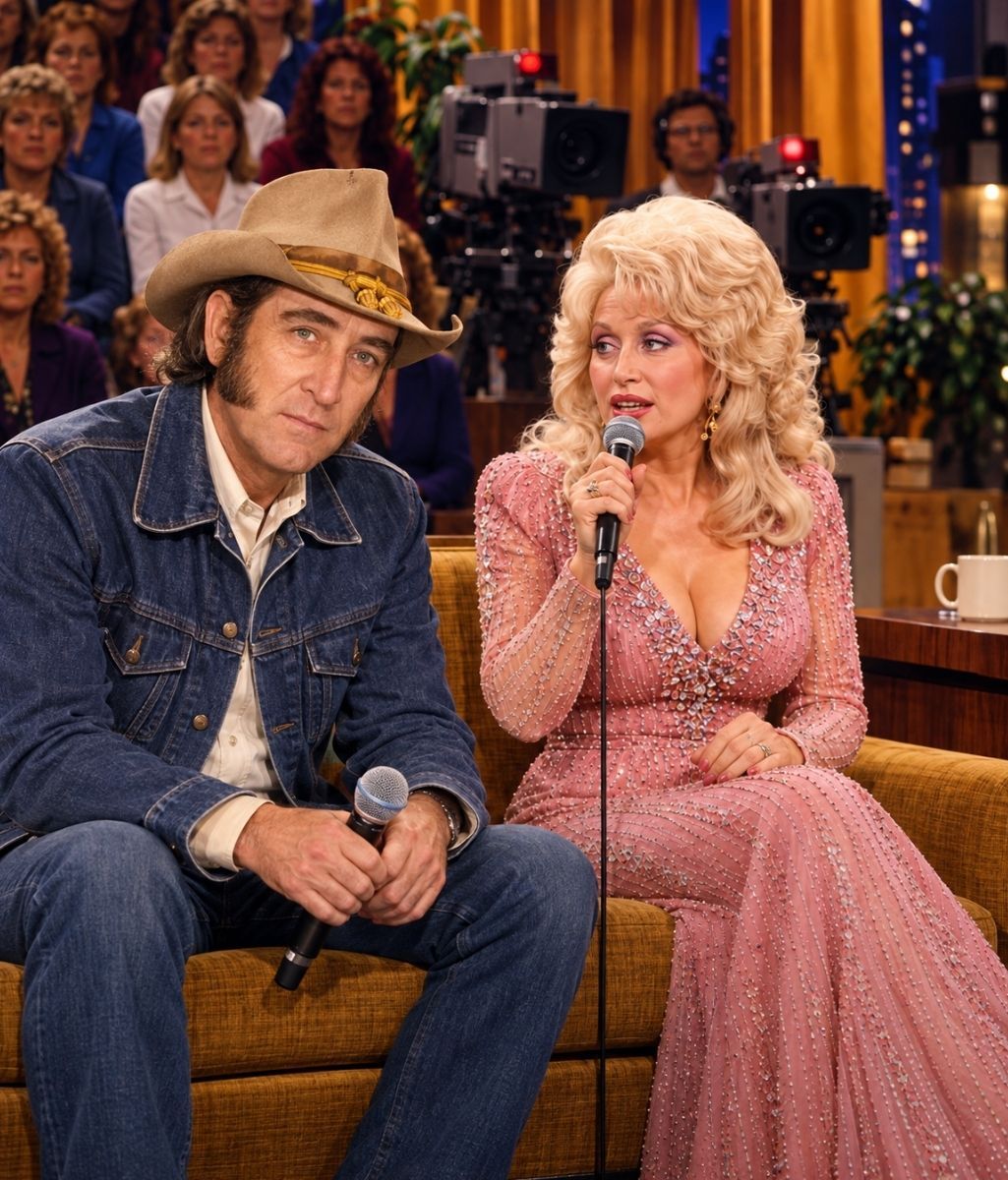
There are moments in country music that seem almost too perfect to be true. A quick-witted singer offers a playful challenge. A quiet legend responds with the calm confidence of someone who has never needed to raise his voice to command a room. And suddenly, everyone is reminded that the greatest performers do not always need elaborate introductions or spectacular gestures.
Sometimes, all they need is a song.
Imagine Dolly Parton turning toward Don Williams with that familiar sparkle in her eyes, inviting the gentle-voiced country star to sing one of her songs before an audience. Dolly, known for her humor and quick timing, might have expected a playful exchange. Don, meanwhile, was famous for an entirely different kind of stage presence: relaxed, unhurried, and almost stubbornly uninterested in unnecessary theatrics.
What might he have done?
The specific challenge described in this story has not been independently verified, so it would be misleading to present a dramatic response from Don as a documented historical event. Yet the imagined encounter captures something genuinely fascinating about these two artists. Both understood that a great country song does not need to shout to be heard, and a great singer does not need to show off to be remembered.
Their contrasting personalities offer a wonderful opportunity to revisit the musical values that made country music so beloved by generations of American listeners.
DOLLY PARTON: THE WOMAN WHO COULD TURN A MOMENT INTO MAGIC
Few entertainers have mastered the art of making an audience feel welcome quite like Dolly Parton.
With her unmistakable voice, sparkling stage presence, and natural gift for storytelling, Dolly has spent decades turning performances into personal experiences. She can make a stadium laugh with a single remark, then bring the same audience to silence with a song about family, heartbreak, or the quiet sacrifices people make for those they love.
Her humor has always been part of her artistry.
Dolly understands timing. She knows when to let a joke breathe, when to surprise an audience, and when to step aside so that a song can deliver its full emotional impact.
But beneath the wit is a serious songwriter whose work has become part of the foundation of modern country music.
Songs such as Coat of Many Colors reveal the memories and values that shaped her childhood. Jolene demonstrates her ability to turn a simple situation into an unforgettable emotional drama. And I Will Always Love You, written in 1973, has become one of the most enduring songs about love, gratitude, and the painful necessity of letting go.
Dolly’s greatest strength is her ability to make complicated feelings sound remarkably simple.
She can tell a story in a few lines and leave listeners thinking about it for years.
That same combination of warmth and mischief makes the idea of her challenging another singer especially appealing. Dolly has always understood that music can be serious without becoming solemn. A little humor can open the door to a beautiful moment.
And if she were to invite a fellow artist to sing one of her songs, the real question would not simply be whether he could perform it.
It would be what he might discover inside it.
DON WILLIAMS: THE QUIET MAN WHO NEVER NEEDED TO SHOUT
Don Williams occupied a special place in country music because he did so much by doing so little.
Born in Floydada, Texas, in 1939, Williams developed a style that stood apart from the louder, more theatrical traditions of popular entertainment. His warm baritone, relaxed phrasing, and carefully restrained arrangements made his recordings feel less like performances and more like conversations with an old friend.
Fans eventually came to know him as the Gentle Giant, a nickname that reflected both his physical presence and the reassuring quality of his music.
He did not need to leap across the stage or demand attention with dramatic gestures. He could stand almost motionless, deliver a line in that unmistakable voice, and make an audience feel as though he were singing directly to one person.
His recordings included enduring favorites such as Tulsa Time, I Believe in You, Lord, I Hope This Day Is Good, and Good Ole Boys Like Me.
Each song demonstrated a different aspect of his appeal. Some carried an easy, almost conversational rhythm. Others explored faith, personal responsibility, love, and the ordinary experiences that give life its meaning.
Williams trusted the song.
He did not bury its message beneath unnecessary ornamentation. He allowed the melody to unfold, gave the lyrics room to breathe, and let his voice communicate the emotion without forcing it.
In a business that often rewards the loudest performance, Don Williams proved that quiet confidence can be just as powerful.
That is why the idea of Dolly Parton challenging him to sing one of her songs creates such an intriguing contrast. Dolly could fill a room with personality before the first note. Don could captivate that same room by making the audience lean in and listen.
Neither approach was superior.
They were simply different expressions of the same musical truth.
WHAT WOULD HAPPEN IF DON SANG A DOLLY PARTON CLASSIC?
Imagine the setting: an audience gathered for an evening celebrating country music, surrounded by familiar faces, warm stage lights, and the unmistakable anticipation that comes whenever two respected performers share a moment.
Dolly smiles and offers Don a challenge.
Perhaps she suggests Jolene, her famous tale of jealousy, insecurity, and the fear of losing someone you love. It is a song that demands emotional precision. The narrator must sound vulnerable without losing her dignity, pleading without becoming helpless.
Or perhaps she chooses I Will Always Love You, a song that requires a singer to communicate affection and sadness without allowing the emotion to become excessive.
For a performer like Don Williams, either song would present an interesting artistic question.
How would his gentle baritone transform a melody that audiences associate so strongly with Dolly?
Would he make Jolene sound less like a desperate plea and more like a quiet confession? Could he turn I Will Always Love You into a restrained farewell, with every line delivered as though the singer were speaking to someone sitting across the kitchen table?
These are possibilities, not claims about a performance that has been verified.
But they reveal why the idea captures the imagination.
A great song can survive a change of voice because its emotional foundation is strong enough to support a different interpretation. The words remain, the melody remains, and the central feeling remains. What changes is the perspective through which the audience experiences it.
Dolly’s original recordings carry her distinctive personality and emotional instincts. Don’s approach would naturally suggest a different atmosphere.
The result might be quieter, more reflective, and less theatrical—but still deeply moving.
That is the beauty of country music. It leaves room for individuality while preserving the shared experiences that connect listeners.
THE RESPONSE THAT WOULD HAVE FIT DON WILLIAMS PERFECTLY
The most tempting part of the headline is the suggestion that Don delivered a response so unexpected that the entire crowd was left speechless.
Without reliable evidence, no exact reply should be attributed to him.
Still, his public musical persona offers a useful reminder of the kind of confidence that defined his career.
Don Williams rarely appeared to be in a hurry. His performances were built around patience, control, and an understanding that the strongest moment in a song often arrives when the singer refuses to overstate it.
Imagine, then, a performer accepting a challenge without making a grand announcement. No dramatic speech. No elaborate demonstration. Just a small smile, a glance toward the musicians, and a quiet request to begin the music.
The audience would settle.
The first notes would rise from the band.
And the singer would allow the song to speak.
That imagined response feels fitting because it reflects what listeners loved about Don. He did not need to compete with a room. He knew how to create stillness inside it.
There is something deeply reassuring about that kind of artistry.
In everyday life, we are surrounded by people trying to be noticed. Don Williams built a career by reminding listeners that being genuine can matter more than being spectacular.
His performances offered a welcome refuge from the noise.
And for audiences who grew up with his recordings, that quietness became part of the pleasure of listening.
TWO LEGENDS, ONE SHARED BELIEF IN THE SONG
Dolly Parton and Don Williams approached music from different directions, yet their careers reveal a common respect for songwriting.
Dolly’s style is often associated with vivid storytelling, memorable characters, humor, and emotional candor. Don’s is associated with restraint, warmth, and an unhurried delivery that lets the listener discover the meaning at a personal pace.
But both understood that a song begins with a feeling worth expressing.
They also understood the importance of the audience.
Country music has always relied on a special relationship between the performer and the listener. The songs are often rooted in familiar experiences: falling in love, raising a family, losing someone dear, struggling to make ends meet, or trying to find the courage to begin again.
Listeners return to these songs because they recognize themselves in them.
A performance by Dolly can make an audience feel as though an old friend has invited everyone into the living room for a story. A performance by Don can create the sensation of sitting quietly with someone who understands more than he needs to say.
Both experiences are powerful.
And both remind us that country music’s greatest achievements have never depended entirely on fashion or production.
They depend on honesty.
WHY THEIR MUSIC STILL MATTERS
For fans who discovered country music decades ago, Dolly Parton and Don Williams represent more than successful careers.
They represent a period when a familiar song could become part of a family’s history.
A Don Williams recording might recall long drives along country roads, evenings spent listening to the radio, or a time when a particular voice seemed to understand the worries nobody discussed openly.
A Dolly Parton song might bring back a family gathering, a memory of a mother or grandmother, or a moment when a lyric helped someone make sense of a difficult goodbye.
Music has a remarkable ability to preserve emotional details that photographs cannot capture.
A photograph may show where we stood. A song can remind us how we felt.
That is why classic country music continues to find new listeners even as musical trends change. The arrangements may belong to another era, but the feelings remain familiar.
Love still requires courage. Loss still leaves an empty chair. Families still carry stories from one generation to the next. And people still need songs that acknowledge the beauty and difficulty of ordinary life.
Dolly and Don understood those truths.
Their voices were different, their personalities were different, and their musical paths were distinct. Yet both left behind recordings that continue to offer comfort, recognition, and a sense of connection.
THE REAL SURPRISE IS THE MUSIC ITSELF
Perhaps the most important lesson in the imagined Dolly Parton–Don Williams encounter is not whether one artist challenged the other.
It is the possibility that a familiar song can reveal something new when placed in the hands of a different performer.
A song written from one person’s experience can become meaningful to another. A melody recorded decades ago can still bring tears to someone hearing it for the first time. And a singer who seems quiet beside a larger-than-life personality can discover an entirely different kind of power within the music.
That is the magic that keeps country music alive.
We do not need to invent a spectacular confrontation to appreciate these two artists. Dolly’s songwriting and Don’s unmistakable voice already provide enough reason to celebrate them.
One gave the world songs filled with character, wit, and emotional honesty. The other reminded listeners that a gentle voice, delivered with sincerity, could reach places that volume alone never could.
And somewhere between those two approaches lies the enduring spirit of country music.
A great song does not belong to a single performance. It belongs to everyone who has ever found a piece of their own life inside it.
That is why the music of Dolly Parton and Don Williams continues to matter—and why, decades from now, listeners will still be pressing play, closing their eyes, and allowing those familiar voices to take them home.